
Black Hole Gravity Wells
When a massive star runs out of fuel, it collapses under its own weight into a point of infinite density. This process creates a region where gravity becomes so intense that even light cannot escape its pull. Much like a deep pit in the middle of a trampoline that pulls all nearby marbles into its center, a black hole warps the fabric of space itself. This is the extreme version of the gravitational force we examined in Station 10 during our look at tidal interactions.
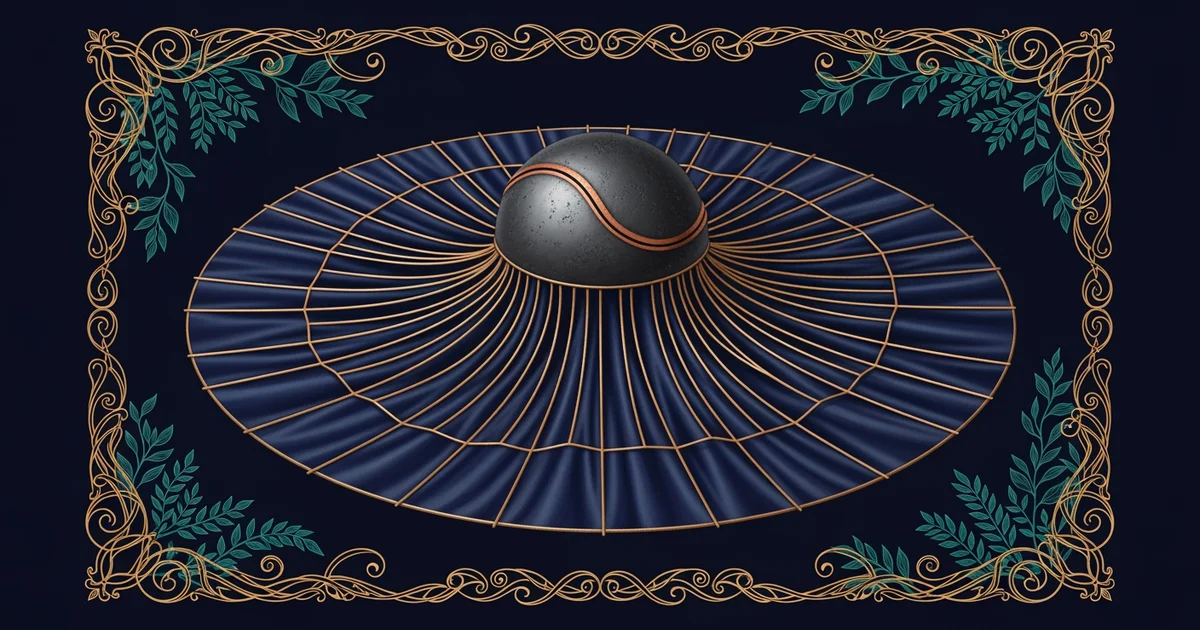
The Anatomy of a Gravity Well
A black hole exists as a region of space where the escape velocity exceeds the speed of light. Because nothing in the universe travels faster than light, any object that crosses the boundary known as the event horizon becomes trapped forever. Think of this boundary as a point of no return for a boat drifting toward a massive waterfall. Once the current becomes stronger than the engine power of the boat, the vessel must fall over the edge regardless of its speed.
Key term: Event horizon — the spherical boundary around a black hole beyond which the gravitational pull is too strong for light to escape.
This gravitational trap functions similarly to high-interest debt in a financial account. If you borrow money at a rate that grows faster than your ability to earn, the debt eventually consumes all your future income. In the same way, the mass of a black hole creates a curve in space so steep that all paths lead inward. The density of the object determines how close you must get before the pull becomes impossible to overcome.
Density and the Curvature of Space
Gravity depends on the mass of an object and the distance from its center. When you compress a large amount of mass into a tiny space, the gravitational force at the surface increases significantly. This creates a steep gravity well that distorts the geometry of the surrounding area. To understand why this happens, consider the following physical properties of these intense environments:
- Singularity formation: The core of the hole contains all the mass crushed into a single point of zero volume, which creates infinite curvature in the fabric of space.
- Spacetime distortion: The extreme mass causes time to slow down near the event horizon relative to an observer far away, a phenomenon known as gravitational time dilation.
- Light trapping: Photons follow the curved paths of space, but near a black hole, these paths curve back toward the center, making escape impossible for light.
These factors ensure that the region remains invisible to standard telescopes. We only detect these objects by observing how they influence nearby stars or gas clouds. When gas spirals toward the hole, it heats up and emits radiation before it crosses the point of no return. This process allows us to map the location of these invisible giants by looking at the glowing material trapped in their orbit.
| Feature | Effect on Matter | Resulting Observation |
|---|---|---|
| Event Horizon | Prevents escape | Dark central region |
| Accretion Disk | Heats gas | Bright X-ray glow |
| Gravity Well | Bends light | Distorted background |
This table shows how we identify black holes despite their lack of light. By watching the behavior of light and matter near the edge, we can measure the mass of the hidden object. The interaction between the gravity well and the surrounding environment provides the evidence we need to study these extreme physics. We are effectively observing the shadow cast by the hole against the bright backdrop of the galaxy. This confirms that gravity acts as the primary architect of the structure of our universe.
Black hole gravity wells represent regions where space is so severely curved by dense mass that no path leads away from the center.
But this model of static gravity wells changes when we consider how these massive objects ripple through space during collisions.