
Spacetime Geometry Analysis
Imagine placing a heavy bowling ball onto a soft mattress to watch the fabric curve downward. This simple act reveals how massive objects influence the space surrounding them in our vast universe. While we often think of space as an empty stage, it actually acts like a flexible fabric that reacts to matter. When objects move through this region, they follow the curves created by mass instead of traveling in straight lines. Understanding this geometry explains why planets orbit stars and how light itself bends during its long journey across the cosmos.
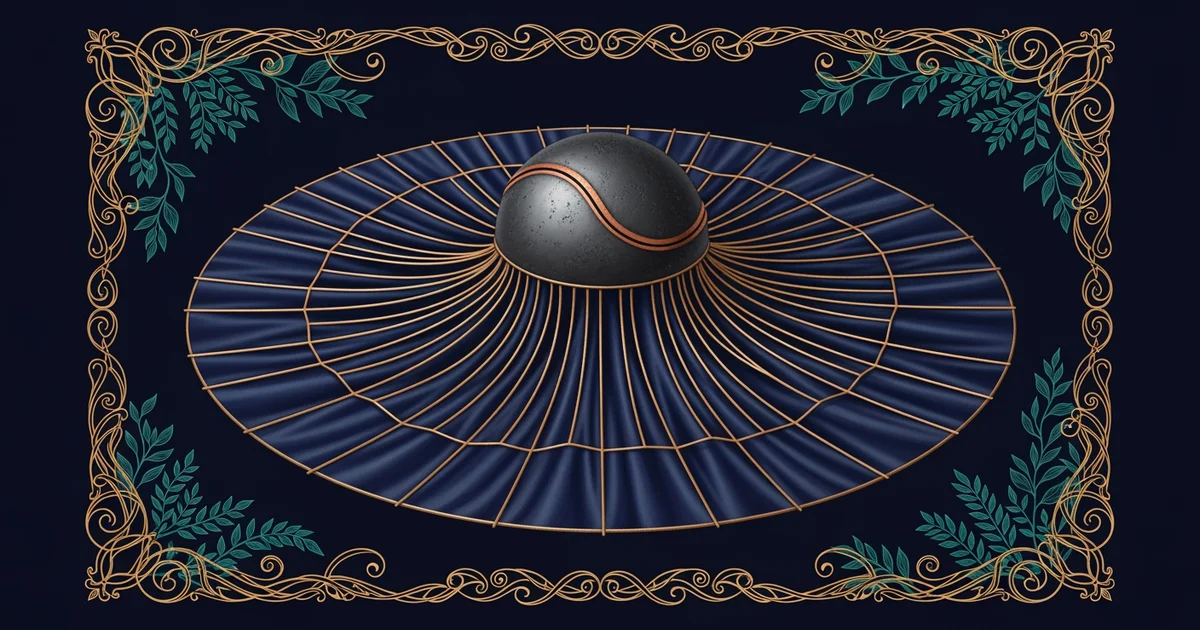
The Fabric of Spacetime
Gravity functions by warping the geometry of spacetime, which combines our three spatial dimensions with the flow of time. Think of this as a vast, invisible net that stretches across every corner of the galaxy. When a massive object like a star sits within this net, it creates a deep depression in the surrounding area. Smaller objects nearby do not fall because of a mysterious pulling force from the star. They follow the natural slope of the distorted fabric, which leads them to circle the larger mass. This geometric shift dictates the path of everything from tiny asteroids to massive, glowing gas giants.
Key term: Spacetime — the four-dimensional continuum where three dimensions of space and one dimension of time merge into a single, flexible fabric.
Because mass dictates how this fabric curves, the density of an object determines the intensity of the local distortion. A highly compact object creates a much steeper slope than a diffuse cloud of gas with the same total mass. When we map these regions, we observe that the geometry becomes more complex as we approach the center of the gravitational source. This curvature acts like a highway system that guides all moving bodies along specific, predictable paths. If you were to travel through this region, you would feel as though you were moving straight, even though the path itself is curved by the local geometry.
Visualizing Gravitational Lensing
We can observe this warping effect directly through the phenomenon of gravitational lensing, which occurs when light passes near a massive object. As light travels from a distant galaxy, it must navigate the curved spacetime created by foreground clusters of matter. The light rays bend around the massive object, often creating distorted or magnified images of the distant source. This effect proves that gravity does not just pull on physical matter but actually shapes the very paths that light must follow. Astronomers use these natural lenses as cosmic telescopes to study objects that would otherwise remain hidden from our view.
| Observation Type | Physical Cause | Resulting Effect |
|---|---|---|
| Orbital Motion | Spacetime slope | Objects move in closed loops |
| Light Bending | Spatial warping | Distant images appear shifted |
| Time Dilation | Temporal stretch | Clocks run slower near mass |
This table illustrates how different phenomena arise from the same underlying geometric distortion of the universe. When we study these interactions, we see that gravity is not a traditional force but a consequence of geometry. The intensity of the lensing depends on the mass of the intervening object and the alignment of the light source. By measuring the degree of bending, scientists can calculate the mass of invisible dark matter that fills the space between galaxies. These measurements confirm that our model of spacetime geometry accurately predicts the behavior of light and matter on a grand scale.
As we refine our maps of these warped regions, we gain deeper insight into the structure of the universe. Every star and galaxy leaves a unique mark on the fabric of space that persists for billions of years. By observing how light navigates these complex curves, we can reconstruct the history of cosmic expansion. This geometric approach transforms our understanding of gravity from a simple pull into a dynamic interaction between mass and the shape of the cosmos itself. We continue to use these tools to probe the limits of our knowledge regarding the fundamental nature of reality.
Gravity acts as a geometric property of the universe where mass defines the curvature of spacetime and dictates the paths of all moving objects.
But what does it look like in practice when these massive gravitational forces interact with the flow of time itself?