
Newtonian Law of Attraction
Imagine you are holding two magnets that pull toward each other across your desk. If you move them slightly apart, the force between them drops off much faster than you expect. Gravity behaves in this exact same way as it reaches across the vast emptiness of our solar system. Understanding this relationship helps us predict how planets orbit the sun without flying off into the dark void.
The Mechanics of Inverse Distance
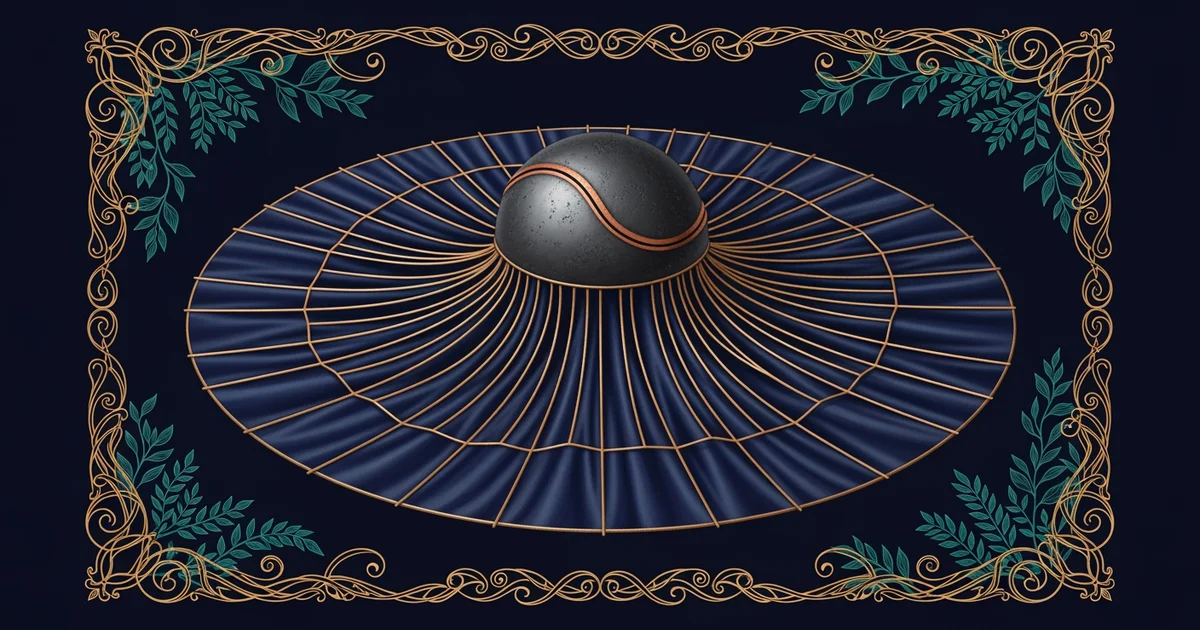
Gravity acts as an invisible tether that connects every object with mass in our entire universe. This force follows a strict rule known as the inverse square law which governs how influence spreads over distance. If you double the distance between two objects, the gravitational pull becomes one-fourth as strong as before. This happens because the force spreads out over an imaginary sphere that grows larger as you move away. Think of this like a light bulb illuminating a room where the brightness fades quickly as you step back. The light does not just dim linearly because it must cover a larger surface area with every step.
Key term: Inverse square law — the physical principle stating that a specified physical quantity is inversely proportional to the square of the distance from the source.
If you move three times further away, the gravity drops to one-ninth of the original starting strength. This rapid decline explains why the sun holds onto distant planets despite their massive orbital paths through space. Even a tiny change in distance creates a massive shift in how hard gravity pulls on objects. Scientists use this predictable pattern to calculate the exact speed required for satellites to remain in stable orbits. Without this mathematical consistency, the solar system would be a chaotic mess of colliding rocks and planets.
Applying Gravity to Orbital Motion
We can visualize this relationship by looking at how the distance from the sun impacts acceleration. The following table illustrates how the force changes as we move away from a central massive object.
| Distance Multiplier | Force Strength | Change Factor |
|---|---|---|
| 1x (Original) | 100% | Baseline |
| 2x (Double) | 25% | 1/4th |
| 3x (Triple) | 11% | 1/9th |
| 4x (Quadruple) | 6% | 1/16th |
This table shows that gravity loses its grip very quickly as objects drift into deep space. The force acts as a bank account where every extra unit of distance costs you dearly. If a planet drifts twice as far from the sun, it feels only a quarter of the pull. This forces the planet to move much slower to maintain a stable and circular orbit path. If it moved faster, it would escape the sun's grip and drift into the cold stars.
Our solar system relies on this balance to keep every planet in its own lane. We can express the gravitational force between two objects with masses and separated by distance using the following equation:
In this equation, represents the constant of universal gravitation that scales the force to real values. The variable is the most important part because it dictates the rapid drop in strength. Because the distance is squared, even small changes in the gap between objects have huge impacts. This simple relationship explains why inner planets orbit quickly while outer planets take long, slow years.
The inverse square law dictates that gravitational influence weakens rapidly as the distance between two massive objects increases.
The next Station introduces spacetime, which determines how gravity works by bending the very fabric of the universe.