
Einstein and Spacetime
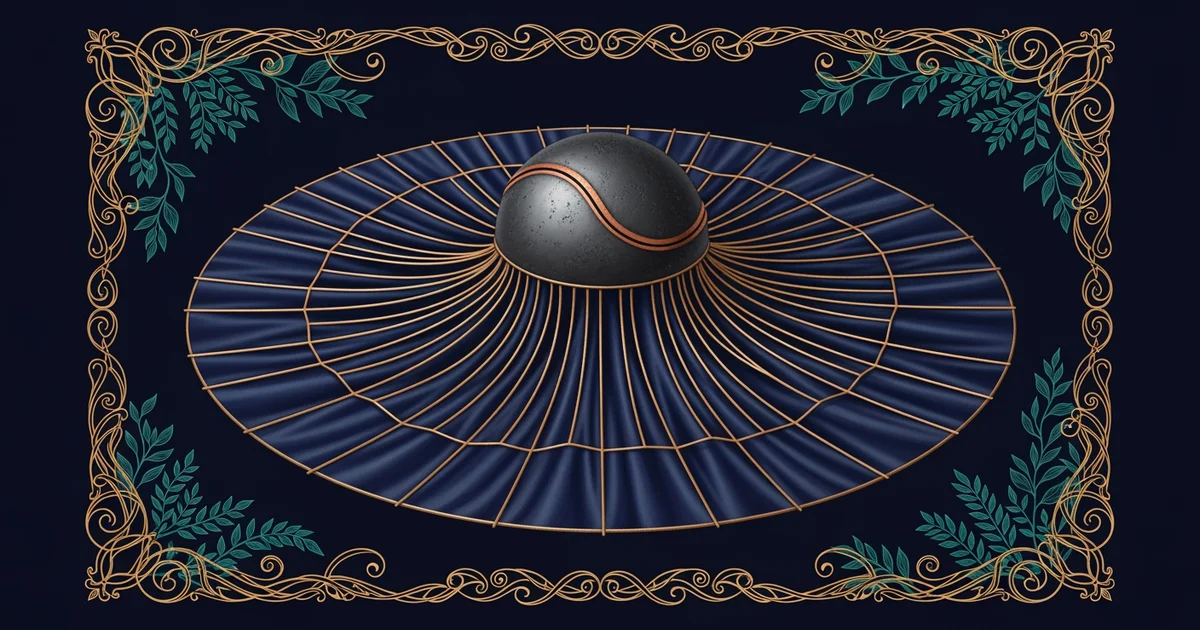
Imagine a heavy bowling ball resting on a soft, stretched trampoline surface. The fabric curves downward around the ball, creating a deep dip in the middle. If you roll a smaller marble nearby, it will spiral toward that heavy ball. This simple motion happens because the path itself has changed shape, not because of a mysterious pull. Albert Einstein changed our view of the universe by showing that space and time act just like that fabric.
The Geometry of Reality
Gravity is not a traditional force that pulls objects together across empty space. Instead, it is the result of mass curving the geometry of the universe itself. We call this combined structure spacetime, which acts as a four-dimensional stage for every event. Massive objects like stars or planets force this stage to bend and warp around them. Smaller objects simply follow the natural curves formed by this distortion in the fabric of space. This explains why planets orbit the sun without needing strings to keep them in place.
Key term: Spacetime — the four-dimensional fusion of three dimensions of space and one dimension of time into a single flexible fabric.
Every object with mass tells the fabric of reality how to curve around it. A planet moving through space follows the straightest possible path along this curved surface. Because the surface itself is bent, the path of the planet appears to us as a circle. Think of an airplane flying over the curved surface of the Earth. The pilot flies in a straight line, but the path looks like a curve on a map. Gravity works in the same way by bending the very geometry of our universe.
Visualizing Cosmic Curvature
To understand how this works, we can look at how different objects warp the fabric of reality. The amount of curvature depends entirely on the density and mass of the object involved. A massive star creates a much deeper well than a small planet does. This means that light passing near a massive star will bend as it follows the curve. We can see this effect when we observe distant galaxies behind a large cluster of stars. The light from those galaxies bends around the cluster, acting like a giant cosmic lens.
| Object Type | Mass Impact | Effect on Spacetime | Path Deviation |
|---|---|---|---|
| Small Asteroid | Very Low | Minimal local dip | Almost straight |
| Large Planet | Moderate | Noticeable curve | Slight bending |
| Massive Star | Very High | Deep gravity well | Strong warping |
This framework helps us understand how gravity influences time as well as physical movement. According to this theory, time actually slows down near objects with very high mass. The deeper the curve in the fabric, the slower time moves relative to distant observers. This effect is not just a theory, as modern satellites must account for this time difference to stay accurate. Without these adjustments, our global navigation systems would fail within a single day of operation.
Understanding the curvature of the universe requires us to rethink our basic ideas about motion. We often assume that objects move in straight lines unless something pushes them away. In a curved universe, the concept of a straight line becomes a path of least resistance. Everything in the cosmos is just sliding along the slopes created by massive stars and galaxies. This perspective allows us to map the movement of stars with incredible precision and clarity.
Gravity is the physical consequence of mass warping the geometry of spacetime rather than an invisible pulling force.
The next Station introduces velocity, which explains how speed prevents objects from falling into the wells created by massive bodies.