
Communication Signal Interference
During the 1989 Quebec blackout, millions of people suddenly lost access to their vital communication networks and electrical power grids. This massive failure proved that solar activity creates invisible hurdles for our modern electronic systems to overcome every single day.
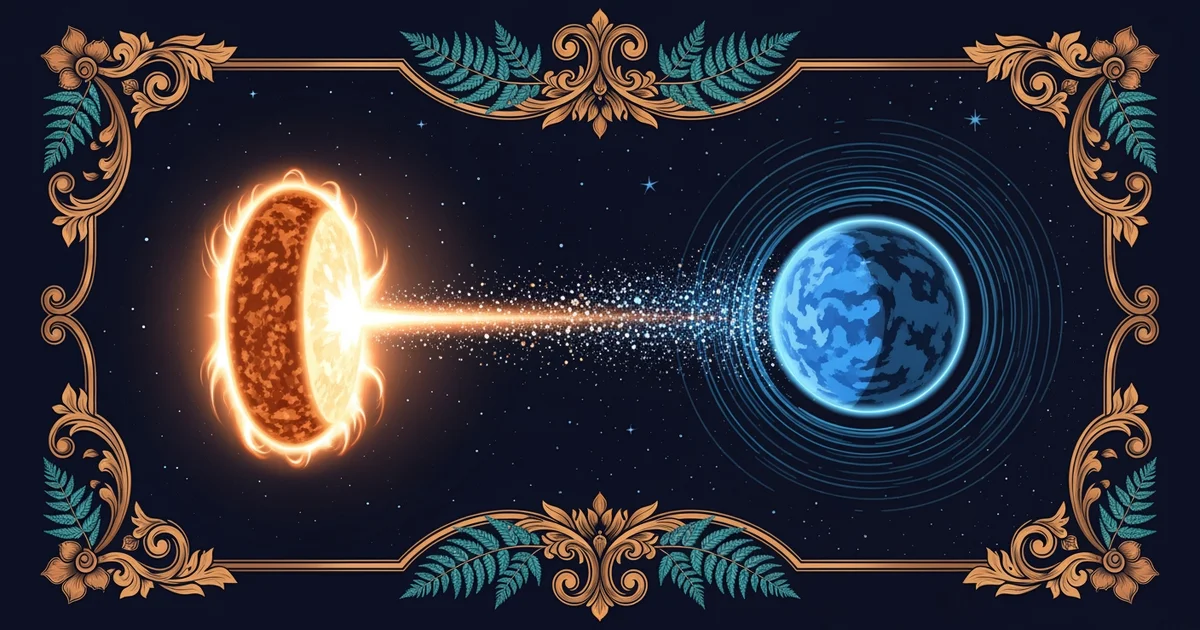
Impact of Solar Emissions on Radio Waves
When the Sun releases a burst of energy, it sends charged particles racing toward our planet at incredible speeds. These particles interact with the upper layers of our atmosphere, creating a phenomenon known as ionospheric disturbance that alters the density of the air. Radio signals rely on bouncing off these atmospheric layers to travel long distances across the curved surface of the Earth. When the ionosphere becomes unstable, these signals scatter or fade away entirely, which leaves communication systems unable to transmit data effectively. Think of this like trying to bounce a basketball on a floor that is constantly shifting and tilting beneath your feet. The ball never hits the intended spot because the surface itself is moving unpredictably, making the entire process of passing data impossible to control.
Key term: Ionospheric disturbance — the fluctuation in the density of the upper atmosphere caused by solar radiation that disrupts radio wave propagation.
Satellite Navigation and Signal Integrity
Beyond radio waves, the Global Positioning System, or GPS, faces severe challenges whenever solar storms impact the space environment around our planet. These satellites transmit precise timing signals to devices on the ground to determine exact locations for aviation and shipping. Solar activity adds extra electrons to the path of these signals, which causes the waves to slow down or bend slightly. This tiny delay leads to massive errors in location data, potentially placing a ship or plane miles away from its actual position. The following table highlights how different types of solar events impact our technological infrastructure during peak solar activity periods.
| Solar Event Type | Primary Impact Area | Expected Signal Outcome |
|---|---|---|
| Solar Flares | High-frequency radio | Sudden signal blackout |
| Coronal Mass Ejection | Satellite electronics | Hardware damage or reset |
| Geomagnetic Storms | GPS timing precision | Increased location error |
Satellite operators must constantly monitor these shifts to protect their expensive hardware from permanent damage caused by electrical surges. If the atmosphere remains charged for too long, the satellites might lose their orientation or suffer from corrupted computer memory banks. Engineers often implement automated safety protocols to keep these systems online while the solar activity passes through our local orbital space.
- Signal Scattering: Solar particles cause the atmosphere to become turbulent, which prevents radio waves from reaching their intended targets on the ground.
- Timing Jitter: Extra electrons in the upper atmosphere force GPS signals to travel through a thicker, more chaotic medium than they expect.
- Hardware Degradation: Intense radiation from solar events can physically damage the sensitive internal circuitry of satellites, leading to mission failure or data loss.
These three points summarize the primary ways that solar activity compromises our ability to maintain constant global connectivity across various platforms. We rely on these systems for everything from financial transactions to emergency services, making the threat of solar interference a major concern for modern infrastructure planners. Scientists study these patterns to predict when the next big event might occur, allowing operators to prepare their systems for potential downtime. By understanding these risks, we can build more resilient networks that survive even the most intense solar weather events without losing critical data streams. Our world depends on the invisible links connecting satellites to the ground, and protecting them requires constant vigilance against the unpredictable nature of our nearest star.
Modern technology remains highly susceptible to solar interference because our reliance on radio and satellite signals forces us to use the volatile upper atmosphere as a transmission medium.
But this model of atmospheric reliance becomes even more dangerous when we consider how forecasting space weather might mitigate these risks in the future.