
Solar Flares and Explosions
Imagine your home power grid suddenly flickering as if a giant invisible hand pulled the main switch. This happens when our Sun releases bursts of energy that travel through space to reach Earth. These events are not random accidents but part of the complex way our star manages its internal magnetic tension. Understanding these solar outbursts helps us protect the satellites and power systems that keep our modern lives moving forward. While the Sun appears steady from our perspective, its surface is a chaotic landscape of shifting magnetic fields and intense heat.
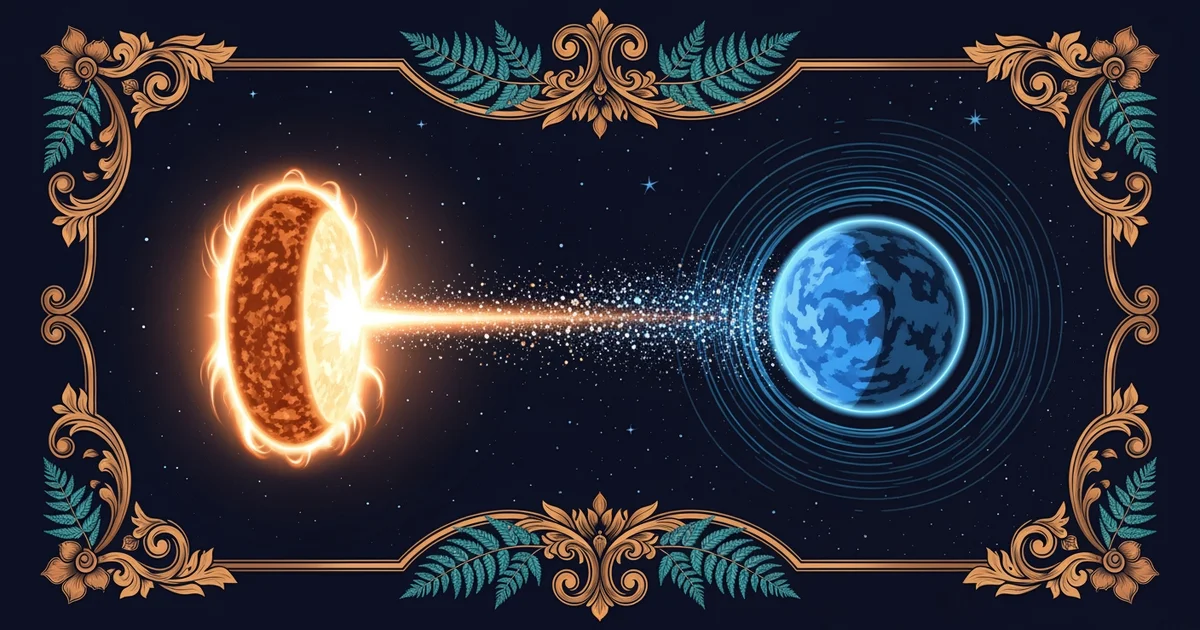
Understanding Solar Eruptions
When magnetic field lines on the Sun become twisted and tangled, they eventually snap and release massive amounts of energy. This sudden release creates a solar flare, which is a bright flash of radiation that travels at the speed of light. These flares release energy across the entire electromagnetic spectrum, ranging from radio waves to X-rays. Think of a solar flare like a sudden burst of static electricity when you touch a metal doorknob after walking across a carpet. The energy discharge is rapid and intense, but it primarily affects our atmosphere and radio communication systems here on Earth.
Key term: Solar flare — a sudden, intense eruption of radiation from the Sun's atmosphere caused by the release of magnetic energy.
While solar flares are flashes of light, a coronal mass ejection involves the actual physical movement of solar material into space. These events, often called CMEs, launch billions of tons of charged particles away from the solar surface at high speeds. Unlike flares that arrive in minutes, these clouds of plasma take days to travel across the solar system. When these clouds collide with Earth, they interact with our magnetic field to create geomagnetic storms. This process is like a massive ocean wave hitting a sea wall, causing ripples that spread across the entire coastline.
Categorizing Solar Activity
Solar events vary significantly in their scale and the specific impact they have on our orbital environment. We can distinguish between these events based on their physical nature and how they reach our planet. The following list highlights the core differences between these two primary types of solar activity:
- Solar flares act as intense bursts of light and radiation that reach Earth in about eight minutes, disrupting high-frequency radio waves and satellite navigation signals immediately upon arrival.
- Coronal mass ejections function as giant clouds of magnetized plasma that move much slower than light, taking one to three days to reach Earth and causing widespread electrical grid fluctuations.
- Both events originate from the same magnetic disturbances on the Sun, yet they represent different ways the star sheds excess energy into the surrounding space environment.
| Event Type | Primary Output | Travel Time | Main Earth Impact |
|---|---|---|---|
| Solar Flare | Electromagnetic radiation | 8 minutes | Radio blackout |
| CME | Plasma and magnetic field | 1-3 days | Power grid stress |
| Solar Wind | Continuous particle flow | 2-4 days | Aurora displays |
These events are distinct but often occur together during periods of high solar activity. A large flare can sometimes act as a warning sign for a following coronal mass ejection. By monitoring these patterns, scientists can predict when our technology might face interference from space weather. This knowledge allows operators to adjust power loads or reorient satellites to prevent permanent damage from incoming plasma clouds. We rely on this data to maintain the stability of our technological infrastructure in an increasingly connected global society. The Sun remains a powerful engine, and its occasional outbursts remind us of our place in the solar system.
Solar flares and coronal mass ejections represent distinct ways the Sun releases stored magnetic energy that can disrupt our technological systems.
The next Station introduces the solar cycle, which determines how often these explosive events occur.