
Defining the Magnetosphere
Imagine your home has a specialized force field that stops stray baseballs from breaking every single window. Our planet enjoys a similar level of protection that shields us from the constant stream of high energy particles emitted by the Sun. Without this invisible barrier, the delicate electrical grids and satellite systems we rely on every day would face constant, destructive interference from solar storms. Understanding this shield is essential to grasping how life thrives while orbiting such a volatile and active star.
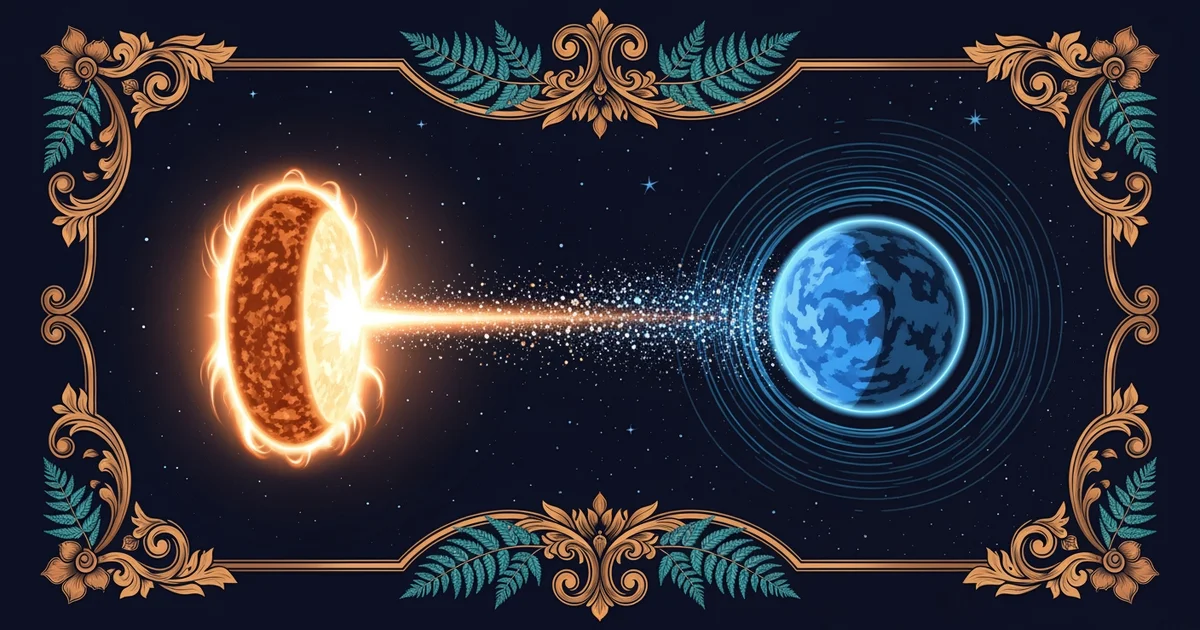
The Invisible Shield Protecting Our World
The magnetosphere acts as a giant magnetic bubble that surrounds our entire planet in space. Think of it like a protective umbrella that diverts the heavy rain of solar radiation away from our atmosphere. This magnetic field originates deep within the Earth where molten iron flows in a constant, spinning motion. As this liquid metal moves, it generates powerful electrical currents that create a magnetic field extending far into the vacuum of space. By deflecting these incoming solar particles, the magnetosphere prevents the atmosphere from being stripped away over long periods of time.
Key term: Magnetosphere — the region of space surrounding a planet where its magnetic field dominates the motion of charged particles.
This interaction between the planet and the Sun is not a static event but a dynamic process. When the Sun releases a burst of energy, the magnetosphere compresses on the side facing the star. This compression creates a bow shock that slows down the incoming solar wind before it hits our main magnetic boundary. The following table outlines how the magnetosphere interacts with different components of the solar environment:
| Component | Interaction Type | Resulting Effect |
|---|---|---|
| Solar Wind | Deflection | Prevents atmospheric erosion |
| Solar Flares | Absorption | Traps particles in radiation belts |
| Cosmic Rays | Scattering | Reduces radiation reaching the surface |
Mapping the Boundaries of Planetary Safety
Beyond the primary boundary of the magnetosphere, the interaction creates complex structures that manage how radiation flows around us. The solar wind pushes against the magnetic field lines, stretching them out into a long tail on the side facing away from the Sun. This tail acts like a storage area for energy that can occasionally release back toward the poles. When these trapped particles hit the upper atmosphere near the poles, they produce the brilliant lights we know as auroras. This process demonstrates that the magnetosphere does not just block energy but also redistributes it safely.
To understand the scale of this protection, we must look at how the field changes depending on solar activity levels. During periods of high solar output, the magnetosphere experiences intense pressure that can cause the field lines to snap and reconnect. These reconnection events are the primary reason we see fluctuations in satellite performance and radio communications on the ground. We can categorize the intensity of these solar interactions through three distinct stages of magnetic pressure:
- Quiet State: The magnetosphere maintains a stable shape and effectively shields the planet from standard solar wind speeds.
- Active State: Increased particle density causes the outer edges of the magnetosphere to compress and vibrate significantly.
- Storm State: Severe solar activity leads to rapid magnetic reconnection that can temporarily overwhelm local protective barriers.
By studying these stages, scientists can predict when our technological infrastructure might be at risk from solar interference. This knowledge allows engineers to build better shielding for satellites and power grids. Because we live in an era dependent on global connectivity, maintaining the integrity of our digital world requires constant monitoring of this magnetic boundary. We are effectively living inside a giant, natural laboratory that is constantly tested by the immense power of our closest star.
The magnetosphere functions as a dynamic magnetic shield that deflects harmful solar radiation and preserves the conditions necessary for our technological civilization to function.
The next station will explore how solar flares and explosive events challenge this shield and disrupt our modern electrical systems.