
Introducing the Active Solar System
Imagine your home power grid suddenly failing during a calm afternoon without any storm clouds. This mystery happens because our Sun is not just a quiet ball of glowing light. It acts like a giant, restless engine that constantly pushes energy into the dark vacuum of space. While we feel safe on the ground, our technology floats inside a massive, invisible ocean of solar particles. Understanding this environment is the first step toward protecting the systems that run our modern civilization.
The Nature of Solar Activity
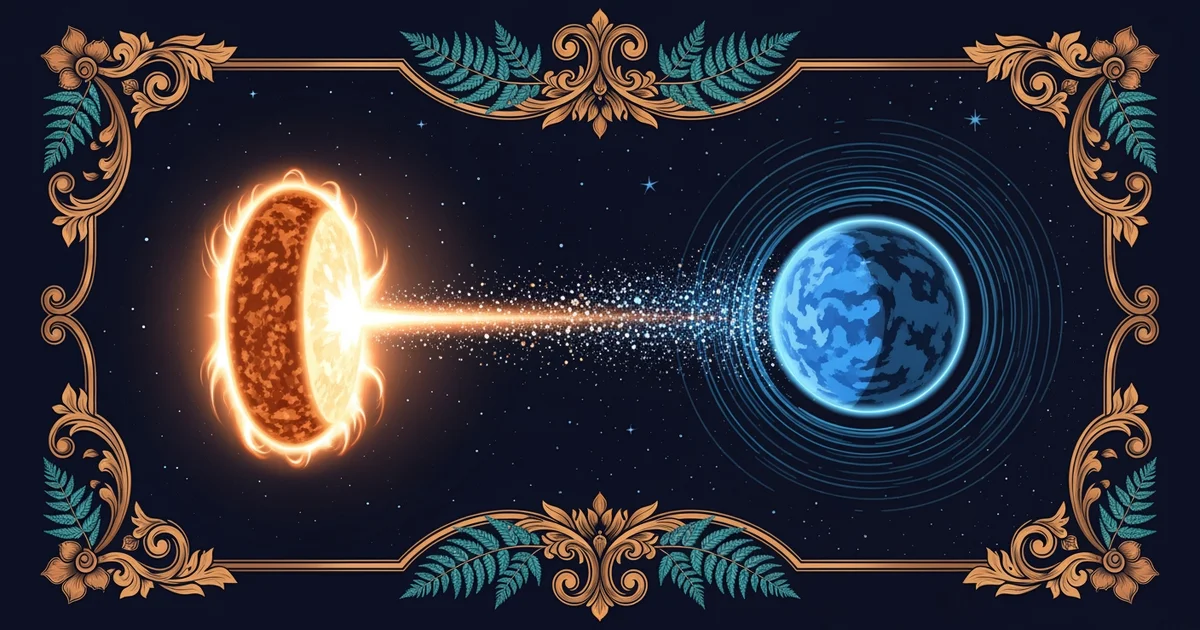
The Sun creates energy through a process called nuclear fusion deep inside its hot, dense core. This process releases massive amounts of light and heat that eventually reach our home planet. However, the Sun also ejects a constant stream of charged particles that flow outward in every direction. We call this flow the solar wind, which acts like a relentless breeze blowing from the Sun. Think of the solar wind like the exhaust from a powerful rocket engine that never shuts off. It carries magnetic fields and high-energy particles across the entire solar system every single day.
Key term: Solar wind — the continuous flow of charged particles and magnetic fields streaming outward from the Sun into space.
This stream of particles varies in speed and intensity depending on the activity level of the Sun. During quiet times, the wind blows steadily at a moderate pace across the inner solar system. During active times, the Sun launches giant clouds of plasma that travel much faster than normal. These events can hit the magnetic shield of Earth and cause significant trouble for our satellites. Without this constant flow, the solar system would feel very different, but its unpredictable nature creates major risks.
Components of the Space Environment
To understand how the Sun affects us, we must look at the primary parts of this active system. The space between planets is not empty, as it contains a complex mix of fields and particles. We can break down the primary components of this solar environment to see how they interact with Earth.
| Component | Description | Primary Effect |
|---|---|---|
| Solar Wind | Constant stream of charged protons and electrons | Shapes the magnetic field of planets |
| Solar Flares | Sudden bursts of intense radiation and light | Causes radio blackouts on the ground |
| Coronal Mass Ejections | Large clouds of plasma thrown into space | Creates geomagnetic storms in our atmosphere |
These components work together to form what we call space weather, which changes just like weather on Earth. The following list highlights why these specific solar features matter for our high-tech world:
- Charged particles carry electrical charges that can damage sensitive electronics inside satellites orbiting above our atmosphere.
- Magnetic fields from the Sun can tangle with the magnetic field of Earth to trigger bright auroras.
- Radiation bursts travel at the speed of light and can disrupt communication signals used by planes and ships.
By tracking these elements, scientists learn how to predict when the Sun might cause a disruption. We rely on these predictions to keep our power grids and navigation systems safe from harm. The Sun is a beautiful source of life, but it is also a source of constant, invisible danger. Learning to watch the Sun helps us stay ahead of these cosmic events before they impact us.
The Sun acts as a dynamic engine that fills space with a constant, invisible wind of charged particles which can directly interfere with the delicate technology we use every day.
This learning path will provide you with a comprehensive understanding of how solar activity shapes our technological stability and global safety.