
Solar Wind Dynamics
Imagine a constant, invisible gale blowing outward from the Sun that shapes the entire solar system. This relentless flow of charged particles constantly pushes against the boundaries of our planetary neighborhood every single day.
The Nature of Plasma Flow
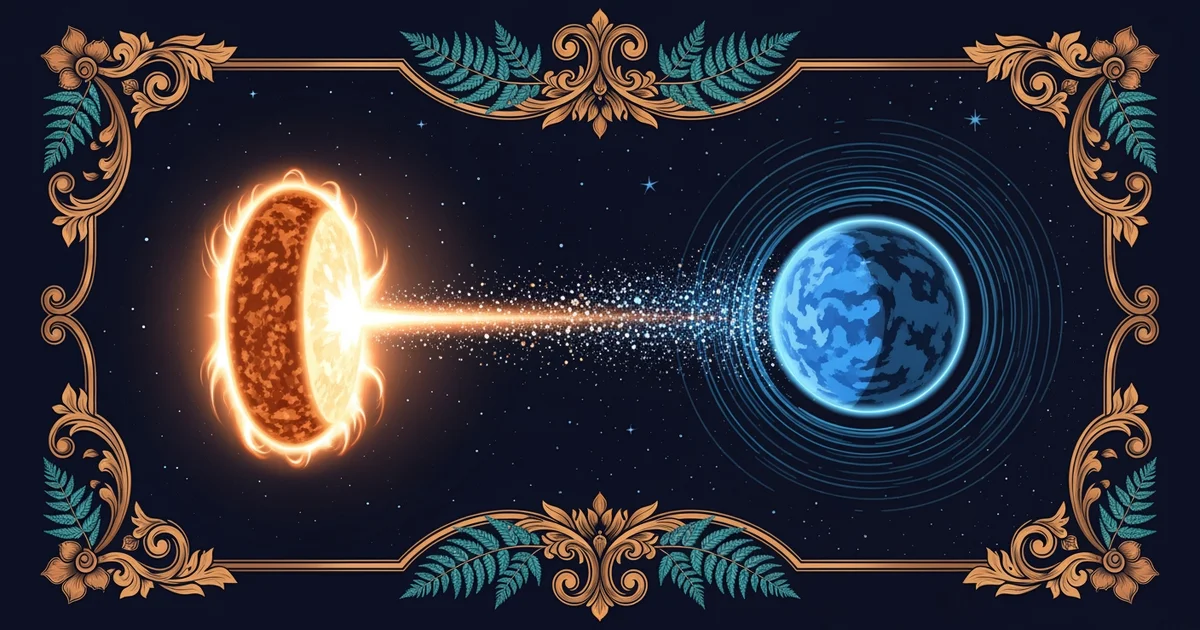
The Sun does not just emit light and heat as it burns through its vast fuel supply. It constantly releases a stream of charged particles known as solar wind that travels across the vacuum of space. This material is not a gas in the traditional sense but a hot, ionized state of matter called plasma. Because this plasma consists of free electrons and protons, it carries the magnetic field of the Sun deep into the solar system. Think of the Sun like a giant, leaking garden hose that sprays water in every direction at once. The water represents the plasma, while the constant rotation of the hose creates complex, twisting patterns in the flow. This stream acts as a medium that carries energy and magnetic information from the surface of the Sun to every planet orbiting nearby.
Key term: Solar wind — the continuous stream of charged particles and magnetic fields flowing outward from the Sun into space.
This flow is not uniform because the Sun has regions with different temperatures and magnetic strengths. Some areas of the Sun are very active, while others remain relatively quiet and stable for long periods. When the plasma escapes from these different regions, it moves at vastly different speeds across the interplanetary medium. This creates a complex environment where fast-moving streams of plasma eventually overtake slower ones. As these streams collide, they create turbulent regions that compress the plasma and amplify the local magnetic fields. This interaction is essential for understanding how the Sun influences the space environment surrounding our own planet.
Modeling Speed Variations
To track these variations, scientists categorize the solar wind into two distinct types based on their velocity. The following table highlights the differences between these two primary types of solar wind streams:
| Feature | Slow Solar Wind | Fast Solar Wind |
|---|---|---|
| Typical Speed | 300 to 500 km/s | 500 to 800 km/s |
| Source Region | Equatorial belts | Coronal holes |
| Magnetic Structure | Highly complex | Relatively uniform |
These speeds change based on the specific solar conditions present at the time of observation. Fast wind originates from large, dark regions on the surface known as coronal holes where magnetic lines open directly into space. Slow wind is more complex and often arises from the edges of active regions near the solar equator. When these streams interact, they form regions of compression that can persist for millions of kilometers. Understanding these variations helps us predict when significant energy will strike the magnetic field of the Earth. By modeling these streams, we gain a better grasp of the dynamic forces that govern our space environment.
Because the Sun rotates once every twenty-seven days, these fast and slow streams spiral outward like the water from a spinning sprinkler. This spiral pattern ensures that the solar wind does not travel in a straight line from the Sun to the Earth. Instead, the plasma follows a curved path that influences how energy is distributed throughout the solar system. This spiral, often called the Parker spiral, defines the geometry of the interplanetary medium for all orbiting planets. When we study this flow, we are essentially mapping the weather patterns of space itself. These patterns directly dictate the intensity of the forces that our modern technology must withstand to remain operational. By mastering these dynamics, we improve our ability to protect satellites and power grids from sudden, intense solar activity.
The solar wind acts as a dynamic carrier of energy and magnetic fields that constantly shapes the environment across our entire solar system.
The next Station introduces geomagnetic storm basics, which determines how these solar wind streams interact with the protective magnetic field of our planet.