
Black Hole Singularities
When a massive star runs out of fuel, it collapses under its own weight until it vanishes from sight. This process creates a singularity, which is a point of infinite density hidden deep inside a black hole. Much like a crowded elevator that suddenly shrinks to the size of a single atom, the matter inside this region is crushed beyond all recognition. This is the ultimate limit of physics where our current laws of nature simply stop working as expected. Understanding this extreme state helps us define the boundaries of space and time in our universe.
The Anatomy of a Collapse
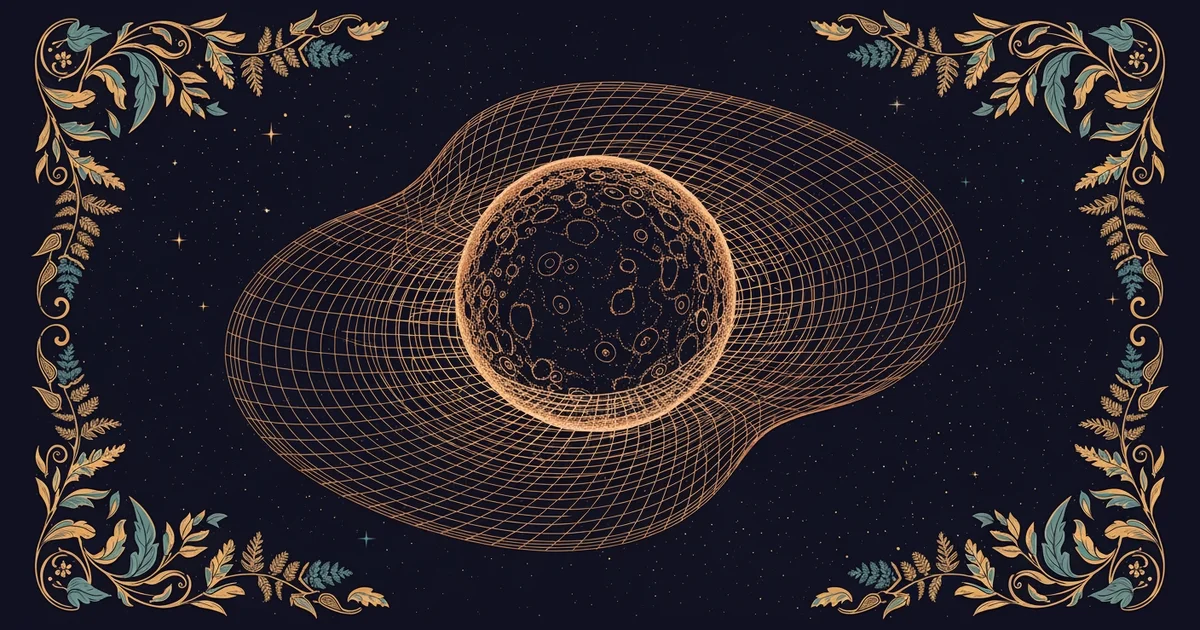
The formation of a singularity begins when a dying star can no longer support its own mass. Gravity becomes the dominant force, pulling all material toward a single, microscopic center point of infinite density. As the star shrinks, the gravitational pull becomes so strong that not even light can escape its grasp. This creates the event horizon, which serves as the final boundary between the outside universe and the unknown interior. Once anything crosses this threshold, it is pulled inward toward the central point of infinite density. Think of this as a one-way bridge where the toll is paid by losing all contact with the rest of the galaxy. This phenomenon demonstrates the extreme gravitational warping discussed in Station 12 regarding light paths.
Key term: Singularity — a point of infinite density and zero volume where the known laws of physics cease to function.
To better understand how these regions behave, scientists categorize the properties of these dark objects based on their physical traits. These traits determine how they interact with surrounding matter and energy fields in deep space.
- The mass of the object dictates the size of the event horizon, meaning larger stars create wider boundaries that consume more nearby matter.
- The spin of the singularity affects the shape of the space around it, causing nearby gas and dust to swirl into flat, glowing disks.
- The electric charge of the object influences how it attracts or repels charged particles, though most black holes in nature remain electrically neutral.
Limits of Current Science
The existence of a singularity challenges the mathematical models we use to describe the physical world. When we apply standard equations to these points, the results often yield values that are literally infinite. Because infinity does not exist in a physical, measurable sense, this indicates that our current theories remain incomplete. We need a new way to bridge the gap between gravity and quantum mechanics to solve this mystery. Just as a bank ledger cannot track money that has vanished into a void, our math struggles to account for what happens inside these regions. We are essentially looking at a blank page in the book of the universe that we have yet to write.
| Feature | Effect on Space | Influence on Matter |
|---|---|---|
| High Mass | Warps time significantly | Pulls objects into orbit |
| Rapid Spin | Drags space along | Creates complex accretion disks |
| Event Horizon | Blocks light passage | Traps all incoming energy |
This table shows how different physical properties of a black hole define the environment surrounding the singularity. By observing these effects, astronomers can detect these dark objects even though the singularities themselves remain invisible to telescopes. This indirect method of discovery allows us to map the invisible architecture of the cosmos. We are learning that these points are not just holes, but active engines that shape the evolution of entire galaxies.
A singularity represents the absolute limit of physical reality where the density of matter becomes infinite and our current laws of nature fail to provide a clear explanation.
But this model breaks down when we try to observe gravitational waves emitted during the formation of these dense structures.