
Gravitational Lensing Effects
When you look at a magnifying glass, you notice how it bends light to make tiny objects appear much larger. Astronomers use this same principle when they observe the night sky to map out distant galaxies. In 1919, solar eclipse observations confirmed that light from stars curves as it passes near the massive sun. This physical phenomenon is known as gravitational lensing and acts like a cosmic telescope for researchers. It allows us to see objects that would otherwise remain hidden behind massive structures in space. This is a direct application of the curvature of space described in Station 11. By using the mass of a foreground galaxy as a lens, we gain a clearer view of the deep universe.
The Mechanics of Light Bending
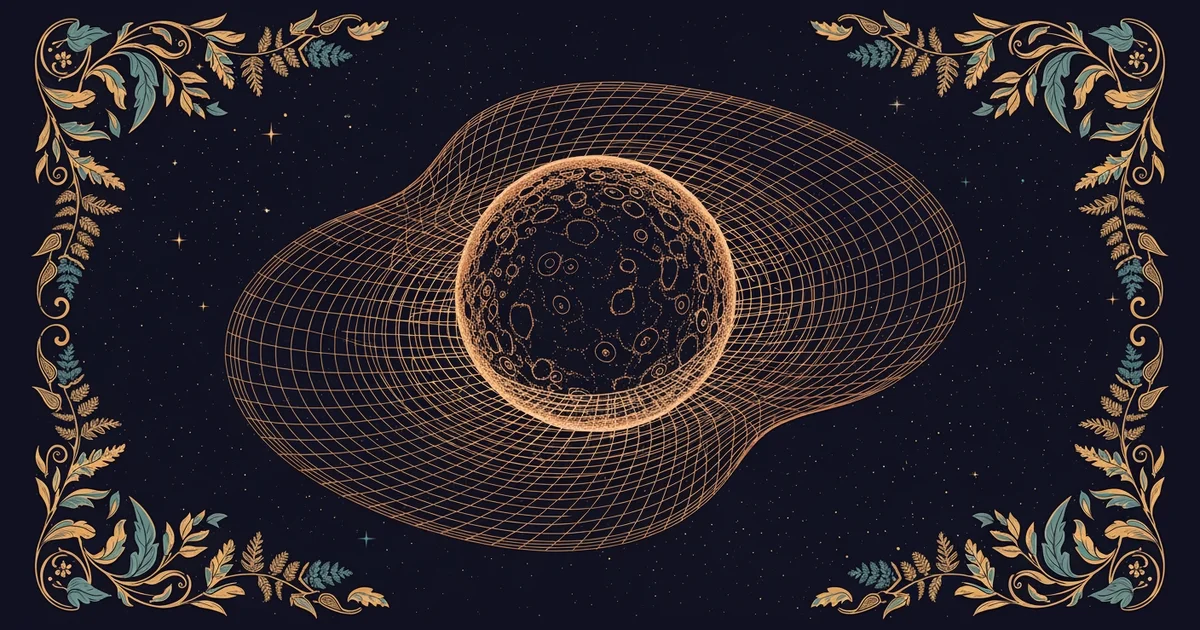
Gravity does not just pull on physical objects like planets or stars as they move. It actually warps the very fabric of space and time through which all light travels. When a massive galaxy sits directly between Earth and a distant light source, it acts as a lens. The gravity of that galaxy forces the light to follow a curved path around it. This path causes the light to focus toward our telescopes in a way that magnifies the image. Imagine a waiter carrying a tray of drinks through a crowded room of people. The waiter must navigate around every person to reach the destination without spilling any of the drinks. Light behaves in a similar way by navigating the curved paths created by massive objects.
Key term: Gravitational lensing — the process where light from a distant object is bent and magnified by the gravity of a closer, massive object.
This process does not happen in a single, simple line like a standard glass lens. The shape of the light depends on the alignment of the foreground mass and the distant source. If the alignment is perfect, the light creates a ring shape around the foreground galaxy. If the alignment is slightly off, the light might appear as multiple images or arcs. These patterns provide vital clues about the distribution of matter within the lensing galaxy. Scientists analyze these shapes to calculate how much mass is present in the foreground object. This method remains the most effective way to detect invisible matter that emits no light.
Observing Cosmic Magnification
To understand how these images form, consider the different ways that mass affects the light paths. The following list describes the common patterns that astronomers observe when they study these unique gravitational effects:
- Einstein rings occur when the source, the lens, and the observer align perfectly, creating a circle of light that surrounds the foreground object.
- Multiple images appear when the light from a single distant star or galaxy takes several paths around a lensed mass to reach us.
- Arc segments form when the alignment is less precise, resulting in stretched or distorted shapes that look like glowing ribbons in the sky.
These patterns are not just beautiful images but are essential data points for modern physics research. By measuring the distortion, we can determine the mass of galaxies that are too far away to weigh directly. This technique allows us to map the invisible structure of the universe with great accuracy. We use these natural lenses to peer back in time toward the earliest moments of cosmic history. Without this effect, many of the most distant galaxies would be far too faint for our current technology to detect. The light we see has traveled for billions of years before being bent into our view.
| Observation Type | Alignment Quality | Visual Result |
|---|---|---|
| Perfect Match | High Precision | Circular Ring |
| Slight Offset | Moderate Shift | Multiple Dots |
| Large Misalign | Low Precision | Stretched Arc |
This table summarizes the relationship between the alignment of celestial bodies and the visual patterns we observe. Each pattern serves as a fingerprint for the mass that is acting as the lens. When we see a ring, we know the mass is distributed evenly around the center. When we see multiple dots, we know the mass is clumped in specific regions. This data helps us build better models of how galaxies grow and evolve over vast time scales. The study of these lenses connects our local observations to the largest structures in the entire universe.
Gravitational lensing uses the mass of foreground objects to bend and magnify light from distant sources, revealing hidden features of the cosmos.
But this model becomes extremely complex when the lensing object is a single, infinitely dense point in space.