
GPS Satellite Synchronization
When a driver relies on a smartphone map to navigate a busy city, they rarely consider the invisible physics keeping that path accurate. Your phone connects to satellites orbiting high above the Earth, but these machines must fight the warping nature of space and time to function. This is the practical application of General Relativity and Special Relativity first introduced in Station 10. Without these constant corrections, your digital map would drift by several miles every single day, making modern navigation systems completely useless for daily travel.
The Relativistic Clock Challenge
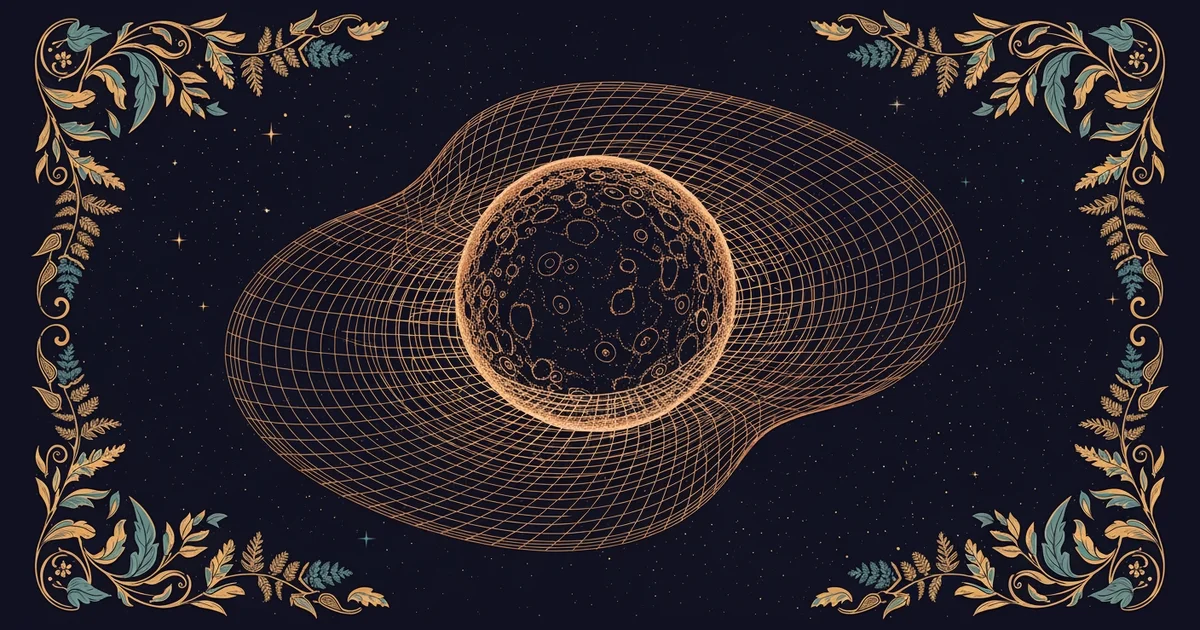
Because satellites move at high speeds relative to the ground, they experience the effects of time dilation in two distinct ways. First, the high orbital velocity of the satellite causes its onboard atomic clock to tick slightly slower than a clock resting on the planet. Second, because the satellite sits deep within the gravity well of the Earth, the weaker gravitational field in orbit actually causes the clock to tick faster. These two effects do not cancel each other out perfectly, so engineers must manually adjust the satellite clocks before launch.
Key term: Time dilation — the phenomenon where time passes at different rates for observers depending on their relative velocity or gravitational potential.
If we ignored these shifts, the timing errors would accumulate rapidly. A tiny error in a clock signal translates into a massive error in distance calculation, because the device measures location by timing how long a signal takes to travel from space. Imagine trying to pay a bill with a currency that loses value every second; you would never know the true cost of your purchase. Similarly, satellites must account for these relativistic shifts to ensure the timing data remains synchronized with the ground stations.
Synchronizing Space and Ground Systems
To manage this complexity, engineers perform precise calculations to offset the natural drift of the clocks. The following table summarizes how the two primary relativistic factors influence the timing of a satellite clock compared to a stationary observer on the surface of the Earth.
| Relativistic Effect | Primary Cause | Impact on Clock Rate | Adjustment Required |
|---|---|---|---|
| Special Relativity | Orbital Velocity | Slows down the clock | Speed up the clock |
| General Relativity | Gravity Field | Speeds up the clock | Slow down the clock |
| Net Result | Combined Forces | Faster net clock rate | Slow down the clock |
Because the gravitational effect is stronger than the velocity effect, the net result is that satellite clocks tick faster than ground clocks. To fix this, technicians set the clocks to run slightly slower before they ever leave the ground. By tuning the frequency of the atomic oscillators, the satellite effectively compensates for the warped space and time it will encounter in orbit. This ensures that when the signals reach your device, the timing remains accurate to within a few billionths of a second.
Maintaining this precision requires constant monitoring from ground control centers. Even with the initial adjustments, minor variations in the orbit or the health of the hardware can introduce new errors. Engineers update the broadcasted clock data regularly to account for these shifts, ensuring that the navigation grid stays perfectly aligned with the rotating surface of the planet. Without this continuous correction process, the entire global positioning network would become unreliable within just a few hours of operation.
Modern navigation systems rely on precise adjustments to satellite clocks to counteract the warping effects of velocity and gravity on the passage of time.
But this model of stable space-time becomes far more complex when we observe how massive objects bend the path of light itself.
Go Deeper · Amazon
Keep going with Physics
Browse Physics on Amazon ↗As an Amazon Associate we earn from qualifying purchases. #ad