
The Nature of Space and Time
Imagine you are sitting on a train while another train passes by your window slowly. You might struggle to tell which train is moving without looking at the ground. This simple confusion illustrates how motion depends entirely on the perspective of the person watching. Our world works through these relative viewpoints rather than having one fixed, universal anchor for speed. Physics relies on this core idea to explain how the universe functions across vast distances.
The Relativity of Motion
Every observation you make about the world happens from your own specific frame of reference. If you stand on a platform, a moving car has a clear speed and direction. If you sit inside that same car, the vehicle feels stationary while the world outside moves. This means that velocity is not an absolute value but a relationship between objects. Scientists use the term frame of reference to describe the coordinate system used to measure position and time. Without a shared frame, you cannot define if an object is truly at rest or in motion. This principle forms the foundation for understanding how space and time connect in our physical reality.
Key term: Frame of reference — a perspective or coordinate system used by an observer to measure the motion of objects.
When we consider how objects move, we must account for the fact that no single point in space is perfectly still. Everything in the universe exists in a state of constant motion relative to something else. Even if you stand perfectly still on the Earth, the planet rotates and orbits the sun. Your movement through space is complex because it involves multiple overlapping frames of reference simultaneously. Understanding these layers allows us to calculate the true path of objects across the cosmos. By isolating one frame, we can simplify the math needed to predict where an object will travel next.
Space and Time as a Fabric
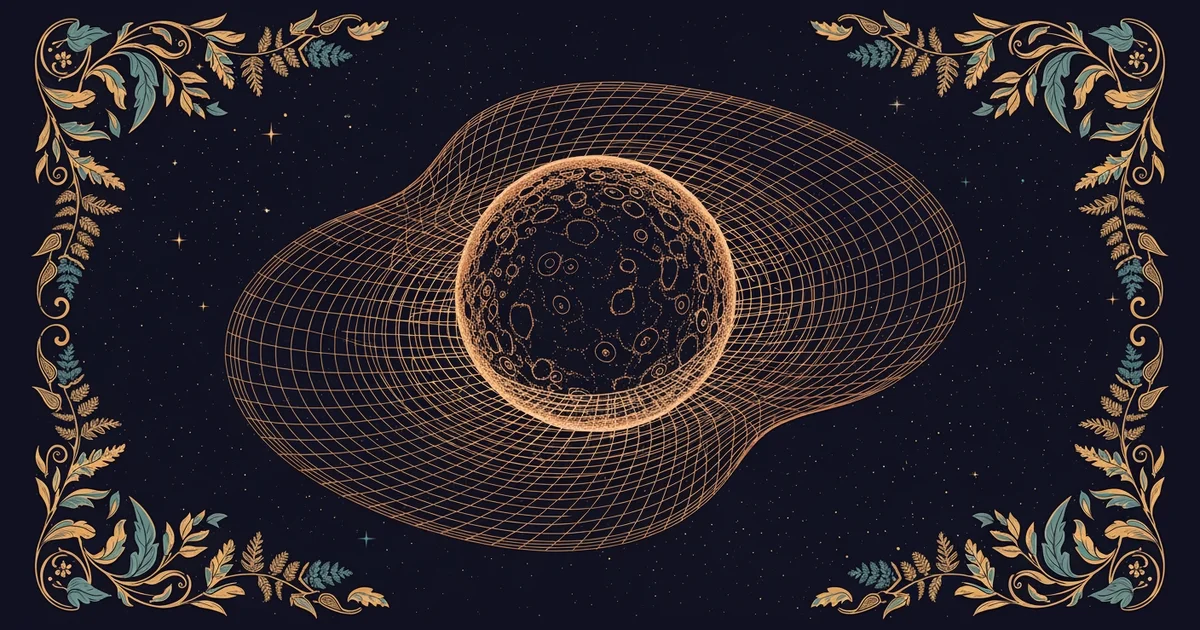
Beyond simple motion, we must view space and time as a single, flexible structure. Think of this structure like a giant, stretchy piece of fabric pulled tight across a frame. If you place a heavy ball on this fabric, the surface curves downward toward the center. This curve changes how objects move across the fabric, as they naturally roll toward the dip. In this analogy, the fabric represents the spacetime continuum that holds all matter and energy. Gravity is not just a pulling force, but the result of this curvature in the fabric of reality. The way space and time bend dictates the movement of planets and light alike.
To see how these concepts function together, we can compare the different ways that observers perceive reality:
- An inertial frame moves at a constant velocity, meaning there is no acceleration felt by the observer.
- A non-inertial frame involves acceleration, which creates forces that seem to push objects in strange directions.
- The laws of physics remain consistent in all inertial frames, ensuring that nature follows the same rules everywhere.
These distinctions help us categorize how we measure events in our universe. By applying these rules, we can better understand how gravity and motion interact on a massive scale. This path will provide you with a complete toolkit to understand the fundamental laws governing the structure of our universe.
The universe operates through relative motion where space and time form a single, flexible fabric that shapes every interaction.
This path will provide you with a complete toolkit to understand the fundamental laws governing the structure of our universe.