
Spacetime Curvature Mechanics
Imagine placing a heavy bowling ball onto a soft, stretched trampoline to watch the fabric dip. This simple visual shows how matter influences the shape of the space around it. When you place that ball on the mat, the surface curves inward toward the center point. Any smaller marbles placed on the mat will roll toward this curve, following the path created by the weight. This is how the universe works, as mass tells space how to curve and bend.
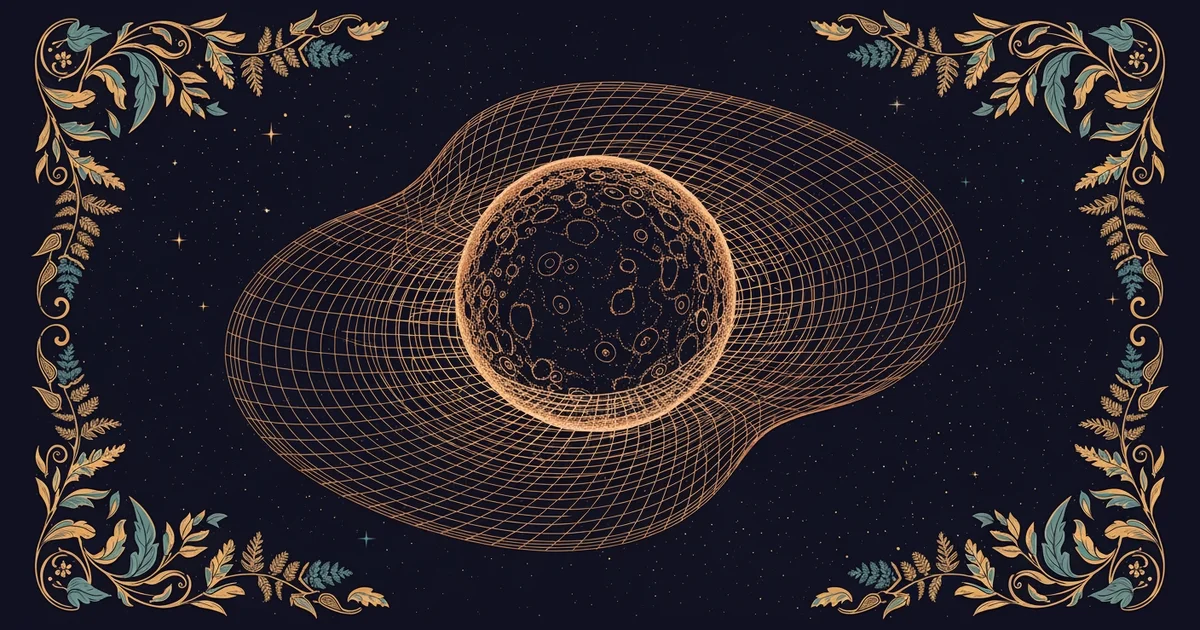
The Geometry of Gravitational Fields
Because objects like planets possess significant mass, they act like the heavy ball on the trampoline. This phenomenon is known as spacetime curvature, which describes the warping of the four-dimensional fabric of our universe. Instead of a mysterious force pulling objects together, gravity is just the result of objects following the natural paths along these curved surfaces. When an object moves, it travels in a straight line through this warped geometry, appearing to curve from our perspective.
Key term: Spacetime — the four-dimensional continuum that combines three dimensions of space with the one dimension of time.
If you were to map out these paths, you would notice that the degree of curvature depends on the density of the object. A very dense star creates a much deeper well than a small planet, forcing light and matter to bend more sharply. This geometry governs everything from the orbits of moons to the path of light traveling across vast cosmic distances. The structure of space is dynamic, changing shape whenever a massive object moves through it or rotates in place.
Mapping the Effects of Mass
To better understand how different objects impact the fabric of the cosmos, we can categorize their relative influence on the surrounding geometry. The following table highlights how varying levels of mass create distinct gravitational environments for nearby objects to navigate.
| Object Type | Mass Density | Curvature Effect | Primary Result |
|---|---|---|---|
| Small Asteroid | Very Low | Minimal Warp | Slight path shift |
| Large Planet | Moderate | Noticeable Dip | Stable orbital path |
| Massive Star | Extremely High | Deep Gravity Well | Extreme light bending |
When we analyze these effects, we see that gravity is simply the geometric response of the universe to mass. The curvature forces objects to move along curved paths called geodesics, which are the shortest distances between two points in curved space. Because space itself is curved, what we perceive as a force is actually just the object moving in the straightest possible line through a bent environment. This realization changed physics by removing the need for a mysterious invisible tether between distant bodies in space.
There are several ways that this curvature manifests in our daily observations of the night sky:
- Gravitational lensing occurs when the light from a distant galaxy bends as it passes near a massive cluster, creating distorted images of the background object for our telescopes.
- Orbital decay happens because objects lose energy while moving through the warped regions of space, causing them to slowly spiral inward toward the center of the mass.
- Time distortion happens because the deeper the curvature, the more the fabric of space and time stretches, which alters the speed at which clocks tick near massive bodies.
By viewing gravity as a shape rather than a force, we can predict how massive systems will behave over long periods of time. Every star, planet, and galaxy contributes to the overall "lumpiness" of the universe's fabric. This continuous dance of matter and geometry defines the limits of our physical reality, ensuring that all motion is dictated by the local shape of the cosmos. As we observe these interactions, we gain a deeper appreciation for the elegant way that mass organizes the vast, empty reaches of the dark, cold vacuum.
Massive objects reshape the fabric of the universe, creating geometric paths that dictate how everything else moves through space.
But what does it look like in practice when this warping affects the very flow of time itself?
Want this with sources you can check?
Premium Learning Paths for Physics & Quantum Mechanics are researched against open-access libraries — PubMed, arXiv, government databases, and more — with their distinctive claims cited to real sources and independently checked.
See what Premium includes