
Gravitational Time Dilation
Imagine you are standing near a massive planet while your friend stays far out in space. You would find that your clocks tick much slower than the clock your friend holds. This strange effect happens because gravity actually pulls on time itself, warping its flow across the universe.
The Nature of Gravitational Time Dilation
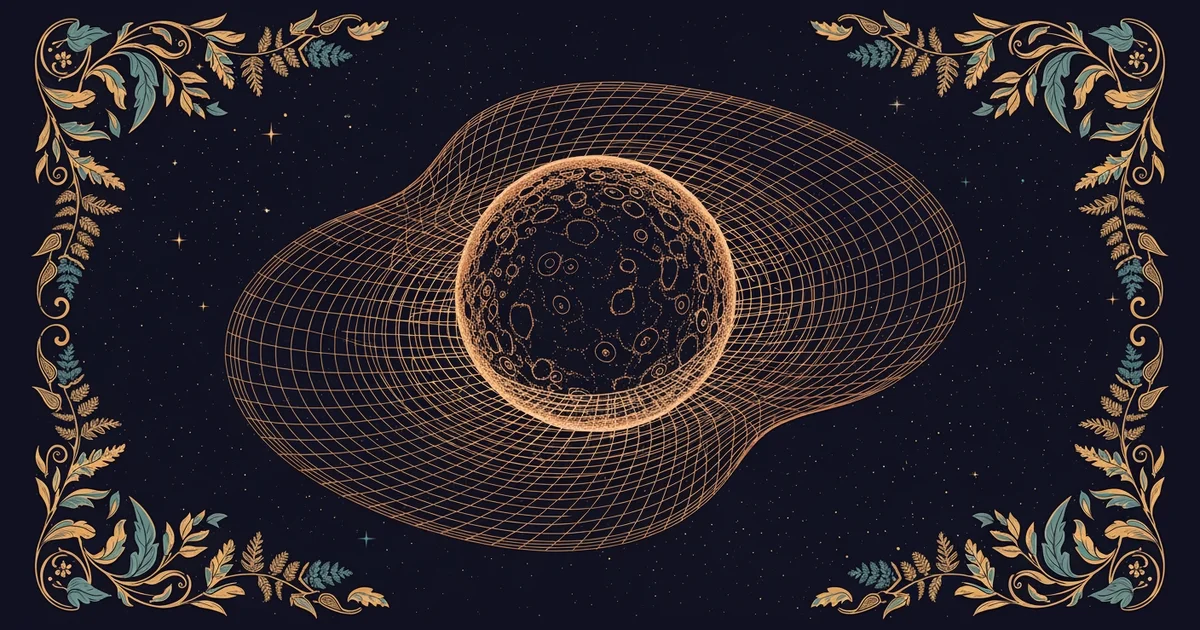
When we look at gravitational time dilation, we see that time is not a fixed constant. It flows at different speeds depending on how close you are to a massive object. A massive object like a star or planet creates a deep well in the fabric of spacetime. As you move closer to the center of this gravity well, time begins to stretch out. This means that a person standing on a planet surface ages slower than someone in deep space. The effect is small for planets but grows huge near black holes. We measure this difference using high precision clocks that track tiny fractions of a second. Scientists observe this phenomenon daily in our global satellite navigation systems. Without correcting for this time shift, our modern maps would fail to function correctly.
Key term: Gravitational time dilation — the physical phenomenon where time passes at different rates in regions of varying gravitational potential.
Think of this like an economic transaction where gravity acts as a tax on time. If you move your money into a high-interest account, it grows faster than in a low-interest account. Similarly, moving into a high-gravity zone causes your personal clock to spend time at a slower rate. You are essentially paying a tax to the gravity field by losing precious seconds. The higher the gravity, the higher the tax you pay on your own life duration. This analogy helps us visualize why time is not universal for every single observer.
Observing Time Shifts in Reality
Gravity influences the flow of time because it bends the geometry of the universe itself. We can summarize how different locations experience time through the following table of gravitational strength and its impact on the passage of time.
| Location | Gravity Strength | Time Flow Rate |
|---|---|---|
| Deep Space | Near Zero | Fastest |
| Earth Surface | Moderate | Slower |
| Black Hole Edge | Extreme | Near Zero |
When you examine this table, you see that the strength of gravity dictates the speed of the clock. As gravity increases, the rate of time slows down to accommodate the warped space. This relationship remains consistent across all known physical objects in our vast cosmos.
We must consider the following factors when we calculate how time changes for different observers:
- The total mass of the object creates a deeper well which forces time to slow down significantly more than a smaller mass would.
- Your distance from the center of mass determines how much of the dilation effect you experience compared to a distant observer in space.
- The speed of light remains constant for all observers even though time itself is stretching and contracting due to the presence of gravity.
These factors combine to ensure that the universe remains logically consistent despite these strange variations. We use these principles to build better technology that accounts for the reality of our warped spacetime. Every piece of data we collect confirms that gravity is the primary architect of time. Understanding this allows us to map the universe with much greater precision than ever before in history.
Gravity dictates the rate at which time passes by warping the very fabric of spacetime around massive objects.
But what does it look like in practice when we apply these concepts to the movement of planets?