
Orbital Motion Dynamics
Imagine you are throwing a ball across a room while the floor beneath you curves unexpectedly. Gravity acts like that shifting floor, forcing objects to follow paths that appear bent even when they move in straight lines. This simple observation changes how we view the motion of planets around the sun today. Instead of invisible forces pulling objects, we see mass shaping the very geometry of space itself.
The Geometry of Curved Spacetime
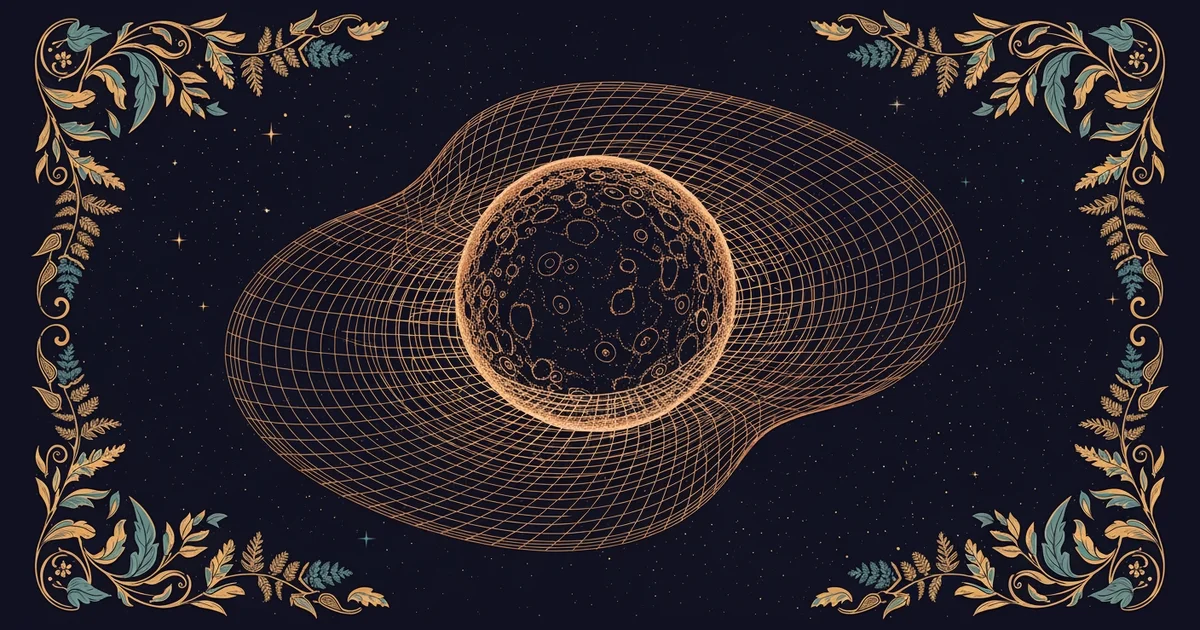
When massive objects like stars exist in space, they create a dip in the fabric of the universe. Imagine placing a heavy bowling ball onto a soft trampoline surface to create a deep depression. A smaller marble rolled nearby will not travel in a straight line across that fabric. It will instead follow the curve created by the heavy ball until it enters a stable path. This path is what we observe as an orbit around a massive center point. General relativity explains that planets do not move because of a mysterious tugging force. They move because they are following the straightest possible path through a curved environment.
Key term: Geodesic — the shortest or straightest path between two points in a curved space where objects travel freely.
Because the sun contains most of the mass in our system, it creates the largest curve in our local region. Earth travels along a geodesic path that is constantly curving around this central depression in spacetime. We perceive this as a circular or elliptical orbit around the sun over time. This motion is not a deviation from a straight path but rather the natural result of moving through warped space. If the sun were to vanish, the curvature would flatten, and Earth would move in a straight line into deep space.
Calculating Orbital Paths
Calculating these paths requires us to treat gravity as a geometric property rather than a force. We use specific equations to map how much space bends based on the density of an object. The following factors determine the shape and stability of an orbit within this geometric framework:
- The total mass of the central object determines the depth of the gravitational well that surrounding objects must navigate.
- The velocity of the orbiting body dictates how high it climbs up the curved walls of the spacetime well.
- The distance from the central mass defines the local curvature and the required speed to maintain a stable path.
These variables interact to ensure that planets remain at predictable distances from their host stars for billions of years. When a planet moves too slowly, it falls deeper into the curve and eventually crashes into the center. When it moves too quickly, it escapes the curve entirely and drifts away into the vast darkness of space. A perfect balance creates the stable loops we see in our solar system every single day.
| Feature | Newtonian View | Relativistic View |
|---|---|---|
| Gravity | Invisible force | Curved geometry |
| Motion | Action at distance | Following curves |
| Path | Elliptical orbit | Geodesic motion |
This table highlights the transition from seeing gravity as a tug to seeing it as a landscape. In the older view, gravity was a tether pulling on planets from across the void. In the modern view, the planet is simply rolling along the contours of a cosmic hill. This shift allows scientists to predict the exact position of planets with much higher precision than before. By measuring the curvature of space, we can account for tiny shifts that older models could never explain. This geometric approach is the foundation for all modern navigation and deep space exploration efforts.
Orbital motion represents the natural tendency of objects to follow the straightest possible paths through space that has been warped by mass.
But how do we use these complex geometric calculations to keep our global positioning satellites accurate in real time?