
Future of Geophysics
Deep beneath our feet lies a world that remains mostly hidden from our modern eyes. While we map the stars with ease, we struggle to peer through the thick rocky crust that shields the Earth's core. We rely on seismic waves to act like a flashlight in the dark, but this method lacks the detail needed for a true map. Scientists now look toward new ways to view the deep interior without relying solely on earthquakes. These new methods could change how we understand the forces that shift our continents and build our mountains.
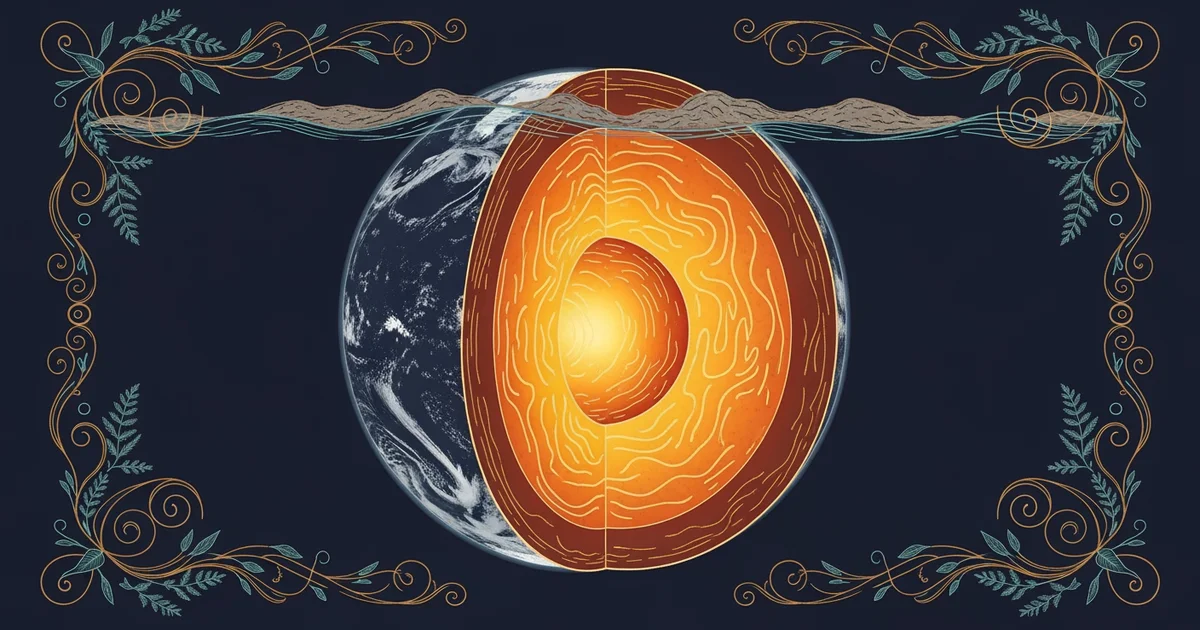
Advancing Deep Crust Observation
To see deeper into the planet, researchers are developing neutrino tomography as a powerful new tool. Neutrinos are tiny particles that pass through matter with almost no interaction at all. By measuring how these particles lose energy as they travel through the Earth, we can infer the density of the layers they cross. Think of this like checking the thickness of a wall by seeing how much a flashlight beam dims when you shine it through the structure. This approach allows us to create a high-resolution map of the core that seismic waves simply cannot provide.
Beyond these tiny particles, we are also looking at how gravity changes across the surface of the globe. Precise measurements of the geopotential field allow us to see variations in mass deep within the mantle. These variations often point to plumes of hot rock rising from the deep interior toward the surface. By combining these gravity maps with our existing seismic data, we can finally build a complete model of the planet's internal heat flow. This helps us understand why some regions are more active than others.
New technologies offer different ways to monitor these hidden movements in the crust:
- Quantum gravimeters detect tiny changes in gravity by using atoms in a state of superposition to measure acceleration with extreme precision — this allows us to track magma movement in real time.
- Fiber optic sensing turns existing telecommunication cables into massive seismic arrays that can detect faint vibrations across the entire planet — this creates a permanent monitor for deep crustal shifts.
- Muon tomography uses cosmic rays to scan the density of volcanic structures from the outside in — this provides a safe way to predict eruptions before they happen.
| Technology | Primary Metric | Best Application |
|---|---|---|
| Neutrinos | Particle Energy | Core Density |
| Gravity | Mass Variation | Mantle Plumes |
| Muons | Density Scan | Volcanoes |
These tools show that our ability to observe the Earth is reaching a new level of clarity. We are no longer limited to surface observations or earthquake data that occurs at random times. By integrating these diverse data streams, we can finally answer how the hidden physical forces inside our planet shape the world we walk upon every single day. This path from planetary comparison to deep observation shows that the future of geophysics is truly about connecting the small scale of particles to the large scale of our entire planet.
Key term: Neutrino tomography — a method of imaging the Earth's interior by analyzing how subatomic particles interact with different layers of planetary density.
Our current understanding of the Earth remains incomplete because we have never directly sampled the deep interior. The tension between our models of the mantle and the actual behavior of tectonic plates remains a major hurdle for the field. If we can master these new observation techniques, we might finally predict seismic events with the same accuracy we use to forecast the weather. This goal drives the next generation of geophysicists to look closer at the ground beneath us than ever before.
Future geophysics will rely on integrating subatomic particle tracking and high-precision gravity sensing to reveal the hidden architecture of the Earth's interior.
The ability to see through the entire planet using only passive sensors represents the final frontier in our quest to understand the dynamic forces that shape the world we inhabit.