
The Layered Earth
Imagine you are holding a hard-boiled egg and cracking the shell to reveal the layers hidden beneath the surface. Just like that egg, our planet is not a solid, uniform rock but a complex structure made of distinct, nested layers. Understanding these layers helps us grasp why the ground beneath our feet moves, shifts, and occasionally erupts with molten power. We inhabit the very top of this massive, layered sphere, which serves as the foundation for every mountain, ocean, and city we have ever built.
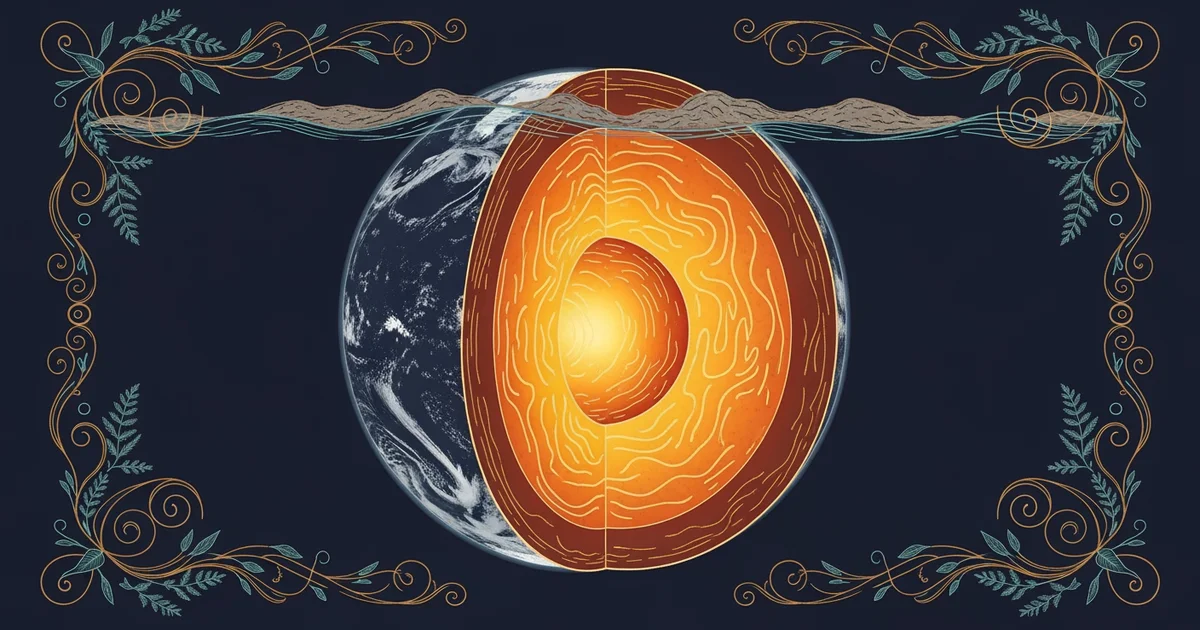
The Composition of Planetary Layers
Geologists divide the Earth into three main chemical layers based on their density and composition. The outermost layer, known as the crust, is the thin, rocky shell where all human life exists. It acts like the skin of an apple, representing only a tiny fraction of the planet's total volume. Beneath this brittle surface lies the mantle, a vast region of hot, semi-solid rock that makes up the bulk of Earth's mass. Finally, the center of the planet holds the core, a dense metallic sphere that generates the heat necessary to keep the planet active. These layers formed long ago when the planet was molten, allowing heavy materials to sink toward the center while lighter materials floated to the top.
Key term: Density — the measurement of how much mass a specific volume of material contains, which determines how layers settle inside a planet.
To visualize how these layers interact, consider a busy city transit system where different vehicles occupy different levels of depth. The surface streets represent the crust, where traffic moves quickly and the ground remains relatively cool and solid. Below the streets, the subway tunnels represent the mantle, where the environment is warmer and the materials are more plastic, allowing them to flow slowly over long periods. Deep beneath the city, the heavy machinery in the maintenance hubs represents the core, providing the essential energy and structural support that keeps the entire system functioning smoothly. This analogy helps us see that each layer performs a unique role in the overall stability of the planet.
Distinguishing Internal Characteristics
The chemical differences between these layers dictate how they behave under extreme pressure and heat. The crust consists mainly of silicate rocks, which are light and brittle compared to the deeper parts of the Earth. The mantle contains more iron and magnesium, making it denser and capable of flowing like thick, hot syrup over millions of years. At the center, the core consists primarily of iron and nickel, which are extremely heavy metals that create a massive gravitational pull. We can compare the specific properties of these layers by looking at their primary makeup and physical state:
| Layer | Primary Composition | Physical State | Relative Density |
|---|---|---|---|
| Crust | Silicate Rocks | Solid/Brittle | Low |
| Mantle | Iron/Magnesium | Plastic/Viscous | Medium |
| Core | Iron/Nickel | Solid/Liquid | High |
These differences are not just cosmetic, as they determine the physical forces that shape our world. Because the core is so dense and hot, it drives the movement of the mantle above it, which in turn pushes against the crust. This constant interaction is the reason we experience earthquakes and volcanic activity. Without this layered arrangement, the Earth would be a cold, dead rock with no internal activity to refresh its surface. The heat trapped inside the core is the engine that keeps our planet dynamic and alive, constantly recycling the materials that build our mountains and ocean floors.
The Earth functions as a dynamic system where internal heat and density differences create distinct layers that drive all geological activity.
Next, we will explore how gravity and density differences specifically dictate the movement and positioning of these massive planetary layers.