
Gravity and Density
Imagine you are holding a heavy bowling ball and a light foam ball of the exact same size. Even though they occupy the same amount of space, your muscles immediately recognize that the bowling ball pulls harder toward the ground. This simple physical reality reveals a deep truth about how mass and space interact inside our planet. Gravity is not just a uniform force pulling on everything equally across the surface of the Earth. Instead, it acts like a scale that constantly measures the hidden distribution of material deep beneath your feet.
The Relationship Between Mass and Gravity
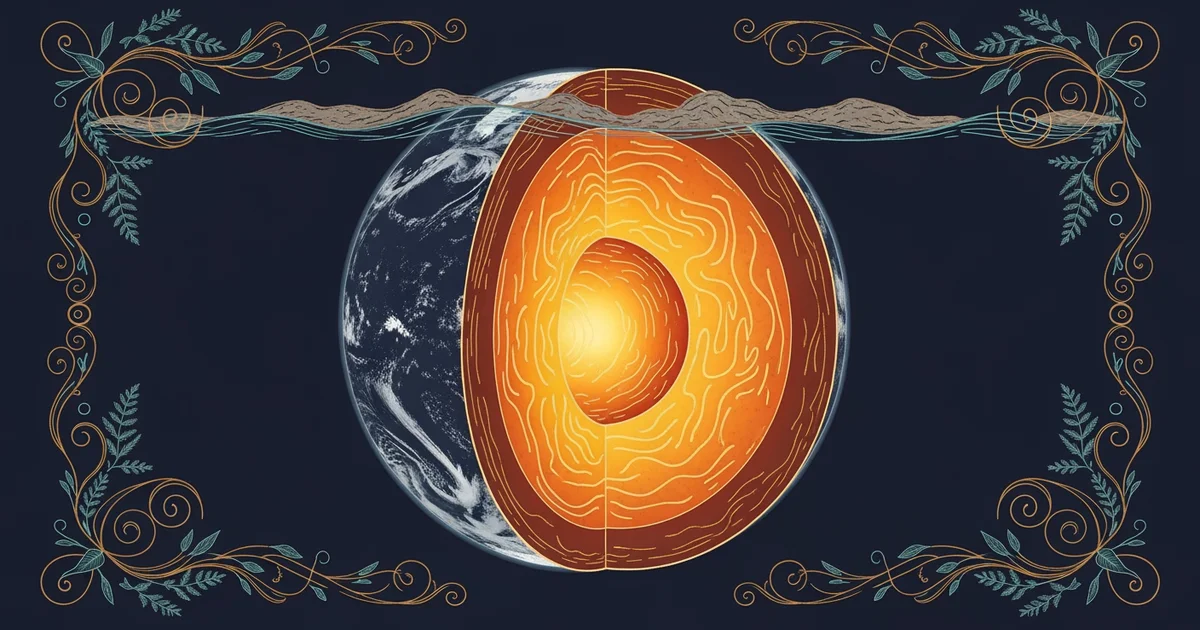
Gravity depends on the total amount of matter present within a specific volume of space. We define this relationship as density, which describes how tightly packed the atoms are inside any given object or rock layer. When you look at the Earth, you see a planet that is not uniform in its composition from the surface to the core. Dense materials like iron and nickel have sunk toward the center over billions of years. Lighter materials like silicate rocks float toward the outer crust, creating a layered structure that dictates how gravity behaves at different locations. If you were standing on a massive deposit of dense ore, the local gravitational pull would be slightly stronger than if you stood on a hollow cave or a light sediment basin.
Key term: Density — the physical measurement of how much mass is packed into a specific amount of space, calculated as .
This variation in pull is known as a gravitational anomaly, which acts like a geological fingerprint for what lies beneath the surface. Scientists use sensitive tools to map these tiny shifts in force to identify underground structures without digging. Think of this process like weighing different grocery bags to guess their contents without looking inside them. A bag filled with lead weights feels much heavier than a bag filled with feathers, even if they are the same size. By measuring the weight of the Earth at specific points, we can determine if the crust underneath contains heavy metals or lighter volcanic rock.
Measuring Rock Density and Earth Layers
When we analyze the composition of the Earth, we compare the density of different rock samples to understand the internal structure. The following table illustrates how common materials vary in their density, which helps us interpret why gravity fluctuates across the globe:
| Material Type | Average Density () | Relative Weight |
|---|---|---|
| Sedimentary Rock | 2.3 | Light |
| Igneous Rock | 2.8 | Medium |
| Metallic Core | 10.5 | Very Heavy |
These differences in density explain why the Earth acts like a massive planetary sorting machine. The heavy metallic materials are pulled toward the center by gravity, while the lighter rocky materials stay near the top. This layering process is why we have a distinct crust, mantle, and core. Every rock sample you find on the surface tells a story about its journey from the deep interior. If a rock is very dense, it likely originated from deeper within the mantle or was pushed up through volcanic activity. If a rock is light, it probably formed near the surface through cooling magma or sediment layers.
Understanding these density differences allows us to model the entire planet as a series of nested spheres. Each sphere exerts its own gravitational influence based on how much mass it contains. Because the core is so incredibly dense, it provides the vast majority of the gravitational force that holds the planet together. Without this specific arrangement of dense and light materials, the Earth would not maintain its stable shape or its magnetic field. We rely on these physical properties to map the hidden interior of our world, turning gravity into a tool for exploration. By studying how gravity changes from one mile to the next, we uncover the complex history of the ground we walk upon every single day.
The distribution of mass within the Earth creates local variations in gravity that allow us to map the hidden layers beneath the surface.
Seismic waves travel through these dense and light layers at different speeds, which helps us map the interior further.