
Thermal Heat Flow
Imagine holding a metal spoon inside a hot cup of tea to feel the handle grow warm over time. This simple kitchen experience shows how energy travels through a solid object from a hot source to a cooler area. Our planet operates in a similar way because the intense heat trapped deep within the Earth must reach the surface. This movement of energy is known as thermal heat flow and it acts as the primary engine for all geological activity. Without this constant release of internal energy, our world would become a cold and stagnant rock floating in space without any shifting landscapes.
The Mechanics of Planetary Cooling
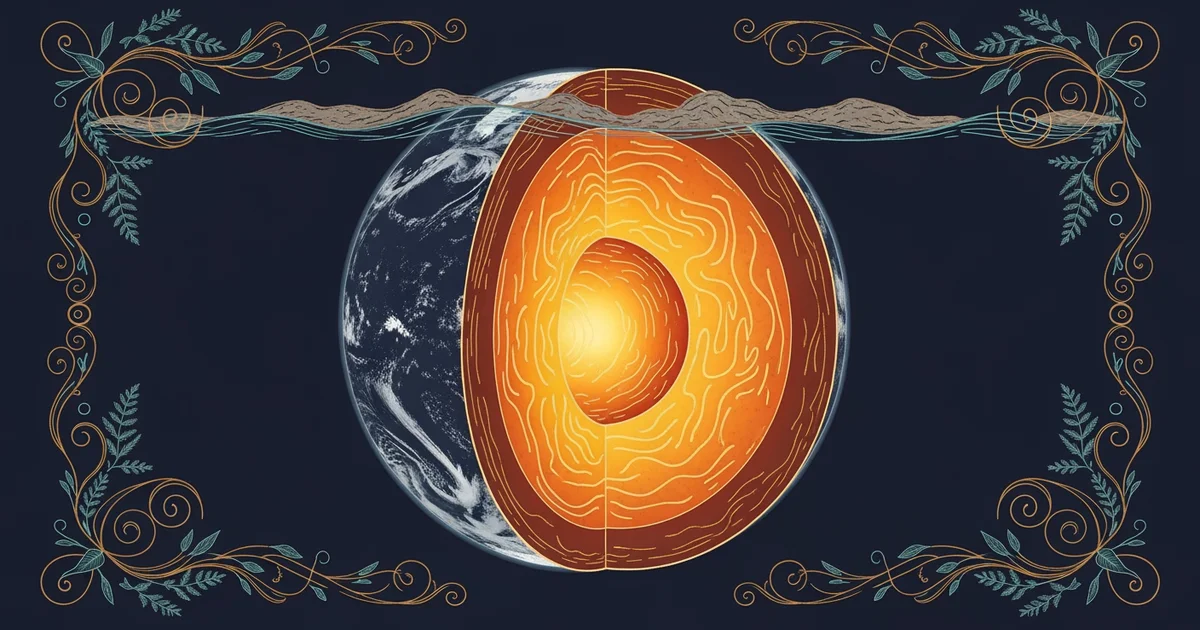
To understand how the Earth loses heat, you must think of the planet as a massive, cooling thermal battery. The core holds immense temperatures left over from the formation of the solar system and radioactive decay. This heat energy moves outward through the mantle by a process called convection, where hot rock rises and cooler rock sinks. Once this heat reaches the rigid outer shell, it must travel through solid rock by conduction. Conduction is the process where atoms vibrate and pass their kinetic energy to neighbors without moving the actual material. Think of this like a bucket brigade where people pass water along a line without leaving their spots.
Key term: Thermal conductivity — the measure of how easily a material allows heat energy to pass through its physical structure.
Different types of rock beneath your feet have varying levels of thermal conductivity, which changes how fast heat reaches the surface. Dense igneous rock transfers heat much faster than loose sediment or porous volcanic ash layers. Scientists map these differences to understand what lies beneath the surface in specific tectonic settings. By measuring the geothermal gradient, researchers calculate the exact rate of heat loss across the crust. This calculation follows the fundamental law of heat transfer, which can be expressed as . In this equation, represents the heat flow, is the thermal conductivity of the material, and is the change in temperature over depth.
Mapping Heat Across Tectonic Settings
When we look at different regions of the Earth, we see that heat flow is not uniform across the entire surface. Areas near mid-ocean ridges show very high heat flow because magma rises close to the surface to create new crust. Conversely, the interiors of old continents show very low heat flow because the crust there is thick and stable. We can compare these settings to understand the energy budget of the planet:
- Oceanic ridges exhibit high heat flow values because thin crust allows magma to release heat directly into the ocean water.
- Subduction zones show variable heat flow patterns because the cold sinking slab absorbs energy while volcanic arcs release intense heat nearby.
- Stable continental cratons display the lowest heat flow levels as the thick, ancient rock acts like a heavy blanket trapping internal energy.
| Tectonic Setting | Relative Heat Flow | Primary Energy Mechanism |
|---|---|---|
| Mid-Ocean Ridge | Very High | Magma upwelling |
| Subduction Zone | Variable | Friction and melting |
| Continental Core | Low | Radioactive decay |
This data helps us build a complete model of how the planet loses its internal energy over millions of years. If we know the thickness of the crust and the conductivity of the rocks, we can predict how much heat escapes. Every measurement tells a story about the hidden engine working deep beneath the ground we walk on. By studying these patterns, we gain a clear view of how the internal temperature dictates the behavior of the crust.
Thermal heat flow describes the constant movement of energy from the hot interior to the surface, which dictates the structural evolution of our planet.
The next Station introduces Tectonic Plate Motion, which determines how thermal heat flow forces the crust to shift and deform over time.