
Mantle Convection
Imagine a thick pot of soup heating slowly on a stove while you watch the bubbles rise and fall. Deep inside our planet, the hot, semi-solid rock of the mantle behaves in this exact same way. This slow motion creates the hidden engine that moves the massive plates of the Earth's crust across the surface. Without this constant churning, the world beneath our feet would be a cold, dead, and stagnant place where nothing ever changes.
The Mechanics of Thermal Buoyancy
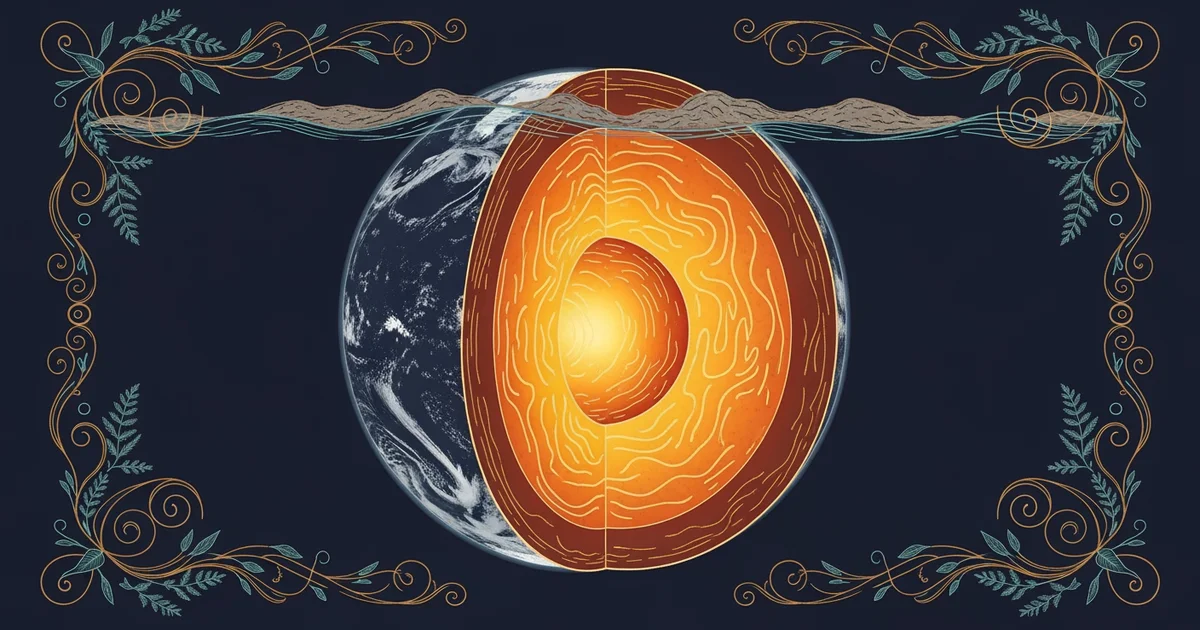
When the core of the planet heats the base of the mantle, the rock becomes slightly less dense than the cooler material above it. This difference in density causes the warmer rock to slowly rise upward toward the crust in a process called mantle convection. Think of it like a budget that moves through an economy; as money warms up in the hands of consumers, it flows upward to stimulate new growth. As the rock reaches the cooler upper mantle, it loses its heat and becomes denser once again. This denser rock then sinks back down toward the core to begin the cycle over again. This cycle is driven by the internal heat of the planet, which comes from radioactive decay and leftover energy from the birth of the Earth.
Key term: Mantle convection — the slow, circular movement of rock in the Earth's mantle caused by heat transfer from the core.
Because the mantle is made of solid rock that flows like thick syrup over millions of years, the movement is incredibly slow. We can model these patterns of flow using the principles of fluid dynamics to understand how the internal heat distributes itself. The process creates large, circular patterns known as convective cells that span thousands of kilometers from the core to the surface. These cells act like giant conveyor belts that carry heat away from the center of the planet. The speed of this movement is roughly as fast as the speed at which your fingernails grow every year. Even though this speed seems trivial, the sheer mass of the moving rock exerts enough force to shift entire continents over long periods.
Observing Convective Cell Patterns
To visualize how these cells behave, we can look at the characteristics of high-viscosity fluids under stress. High-viscosity fluids resist flow, meaning they require massive amounts of energy to move even a small distance. The mantle behaves as a solid on short timescales but acts as a fluid over geological time. We can categorize the behavior of these convective cells based on their temperature and their viscosity:
- Upwelling plumes: These are narrow, hot columns of rock that rise rapidly from the core-mantle boundary to deliver heat directly to the lithosphere.
- Downwelling slabs: These are cold, dense pieces of the crust that sink back into the mantle at subduction zones to complete the convective cycle.
- Lateral flow zones: These areas represent the horizontal movement of material that occurs when rising plumes hit the base of the rigid crust and spread out.
| Feature | Temperature | Movement Direction | Density Level |
|---|---|---|---|
| Plume | Very Hot | Upward | Low |
| Slab | Very Cold | Downward | High |
| Mantle | Moderate | Horizontal | Medium |
These patterns are not perfectly uniform because the temperature inside the Earth is not spread out evenly. Some regions are much hotter than others, which causes the convective cells to change shape and size over time. When a plume reaches the surface, it can create massive volcanic activity or build large mountain ranges. When a slab sinks, it pulls the crust down with it, which creates deep ocean trenches. The interplay between these rising and sinking forces is what defines the structure of our planet's surface. Understanding these movements helps us predict where earthquakes might occur and where new land might form in the future.
The slow internal movement of hot rock acts as a conveyor belt that physically reshapes the surface of the Earth over millions of years.
But what happens when this internal flow interacts directly with the rigid boundary of the core?