
Core-Mantle Coupling
Imagine a spinning top that wobbles on a table because the surface below it shifts. The Earth behaves in a similar way as its liquid outer core rubs against the solid mantle above it. While we stand on the ground, massive forces move beneath our feet in a constant, complex dance. This interaction between the iron-rich core and the rocky mantle is known as core-mantle coupling. It dictates how our planet spins and how its magnetic field changes over time.
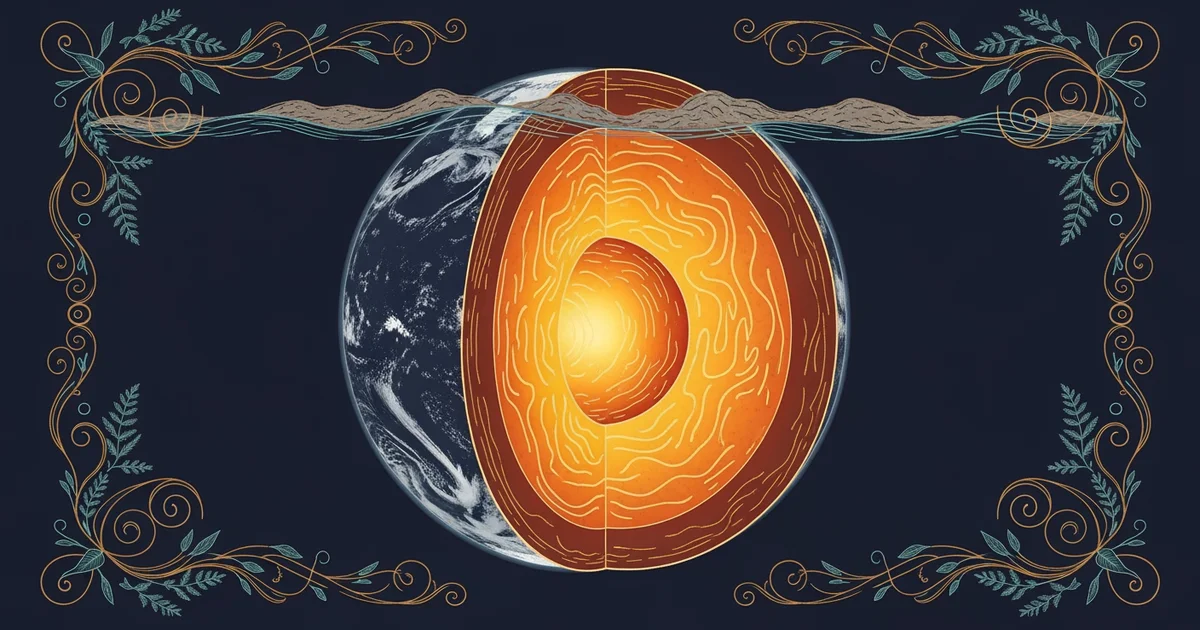
The Physics of Boundary Friction
When we consider the interface between the core and the mantle, we must look at how energy transfers across this boundary. The outer core consists of liquid metal that flows in turbulent patterns due to heat. This liquid brushes against the rough, rocky base of the mantle. Think of this like a thick syrup being stirred inside a glass bowl with a textured interior. The friction created by this contact slows or speeds up the movement of the core. This process acts as a brake on the planet’s internal rotation, influencing the length of our days.
Key term: Core-mantle coupling — the physical interaction where friction and magnetic forces transfer momentum between the liquid outer core and the solid mantle.
Because the core is made of conductive metal, it also interacts with the mantle through magnetic fields. These fields create a magnetic lock between the two layers. If the core attempts to spin faster than the mantle, the magnetic field exerts a force to pull it back. This creates a drag effect that keeps the two layers moving in a coordinated, yet slightly independent, fashion. It is much like a gear system where the teeth do not quite touch but pull each other along through magnetic tension.
Impacts on Planetary Rotation
The way these layers interact determines the stability of our planet's rotation over very long periods. Small changes in the flow of the core lead to variations in the speed of the Earth's rotation. These variations are measurable by satellites that track the exact length of a single day. When the core gains momentum, the mantle must adjust to maintain the planet's total angular momentum. This leads to subtle shifts in the time it takes for the Earth to complete one full turn on its axis.
| Interaction Type | Primary Mechanism | Resulting Effect |
|---|---|---|
| Viscous Drag | Direct friction | Rotational slowing |
| Magnetic Torque | Field alignment | Momentum transfer |
| Topographic | Boundary bumps | Flow redirection |
These three mechanisms ensure that the Earth remains a dynamic and changing system rather than a static rock. The topography at the boundary, which features massive mountains and valleys made of solid rock, further complicates these flows. As the liquid core hits these deep geological obstacles, it is forced to change direction. This adds another layer of complexity to the fluid dynamics inside the planet. Each interaction helps distribute heat from the core into the mantle, which eventually drives the plate tectonics we see on the surface.
The interaction between the core and mantle creates a magnetic and frictional drag that stabilizes Earth's rotation while distributing internal heat.
But what does this look like in practice when we use seismic waves to map the deep interior of our world?