
Cloud Formation Physics
When a pilot flies a small plane through a thick morning fog, the aircraft seems to move through a solid wall of white mist. This experience demonstrates how invisible water vapor suddenly transforms into visible clouds during a flight through changing air temperatures. This physical transition happens because the air reaches a point where it can no longer hold all its moisture in a gas state. The process relies on the relationship between temperature, pressure, and the presence of tiny particles floating in the sky. Understanding this mechanism explains why clouds form in specific shapes and altitudes across the global landscape.
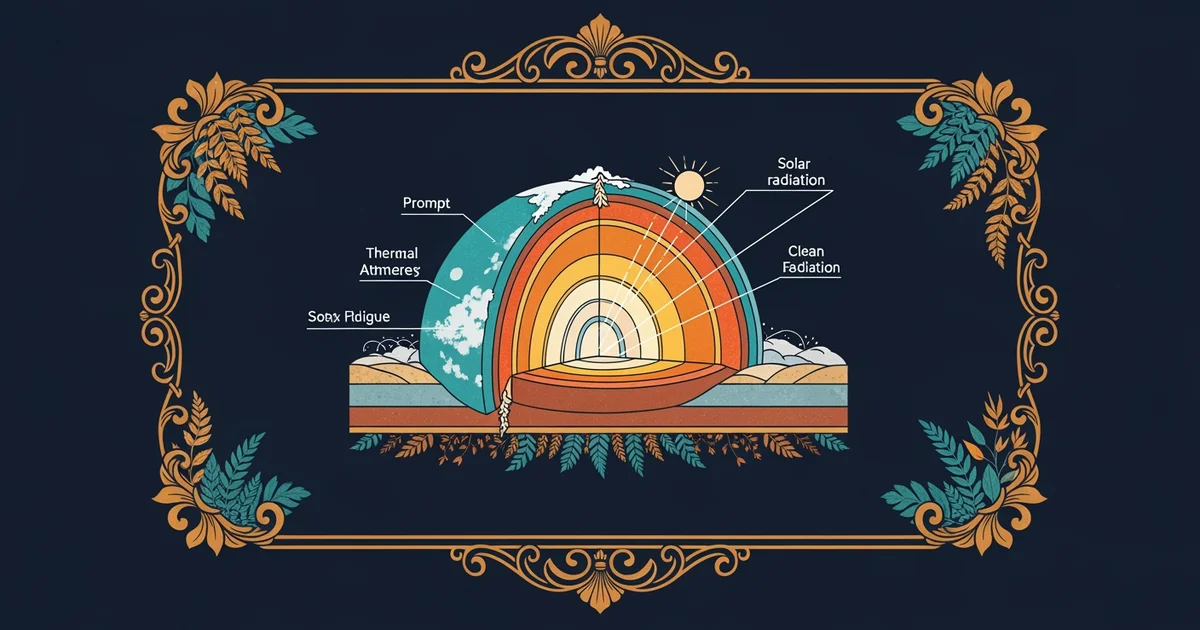
The Physics of Phase Change
Cloud formation begins when moist air rises and encounters lower pressure at higher altitudes in the atmosphere. As the air parcel expands due to the drop in external pressure, it undergoes an adiabatic process that causes its temperature to decrease rapidly. The air eventually reaches the dew point, which is the specific temperature where the air becomes fully saturated with water vapor. At this stage, the water molecules lose enough kinetic energy to transition from a gas into liquid droplets. This phase change requires a surface to facilitate the transition, which is why clouds do not simply appear in empty space. The transformation is similar to how a business must find a physical storefront to sell goods when the digital marketplace reaches full capacity for new vendors.
Key term: Condensation — the physical process where water vapor loses heat energy and transforms into liquid water droplets.
Once the air reaches saturation, the water vapor needs a place to gather so it can begin forming liquid droplets. Atmospheric aerosols, known as cloud condensation nuclei, act as the essential gathering points for these water molecules. These tiny particles include dust, smoke, salt from oceans, or even chemical pollutants floating in the air current. Without these microscopic anchors, the water vapor would remain in a gaseous state even if the air temperature dropped far below the standard dew point. The particles provide a solid surface area that lowers the energy barrier required for liquid droplets to start growing from the vapor phase.
Factors Influencing Cloud Development
Several environmental variables dictate whether these droplets will grow into visible clouds or evaporate back into the atmosphere. The concentration of available nuclei often determines the size and density of the droplets within a forming cloud structure. If the air contains many nuclei, the water vapor spreads across them to create many small droplets. Conversely, fewer nuclei allow each droplet to grow larger because the available moisture is not divided among as many points. The following table highlights how different atmospheric conditions impact the resulting cloud characteristics during the early phase of formation:
| Variable | Condition | Resulting Effect |
|---|---|---|
| Humidity | High | Faster droplet growth |
| Nuclei Count | Low | Larger individual drops |
| Cooling Rate | Rapid | Dense cloud formation |
These factors work together to shape the visual appearance and vertical extent of the clouds we see from the ground. The interaction between rising air currents and the available moisture supply defines the life cycle of every cloud system. When the updraft speed is strong, it pushes more water vapor into the cooling zone to sustain the growth of the cloud. This process maintains the structure of the cloud as long as the physical conditions remain stable and the moisture supply continues to feed the system. If the updraft weakens or the air warms up, the droplets evaporate and the cloud structure begins to dissipate into the surrounding atmosphere.
Visible clouds emerge when invisible water vapor cools and clings to microscopic atmospheric particles to form liquid droplets.
But this model of simple condensation fails to explain why some clouds produce heavy rain while others remain light and fluffy.