
Thermal Energy Transfer
When you touch a cold metal handle on a winter morning, your hand loses heat to the object almost instantly. This sudden sensation of cold happens because your body transfers thermal energy directly into the solid metal surface through physical contact.
The Mechanisms of Energy Transfer
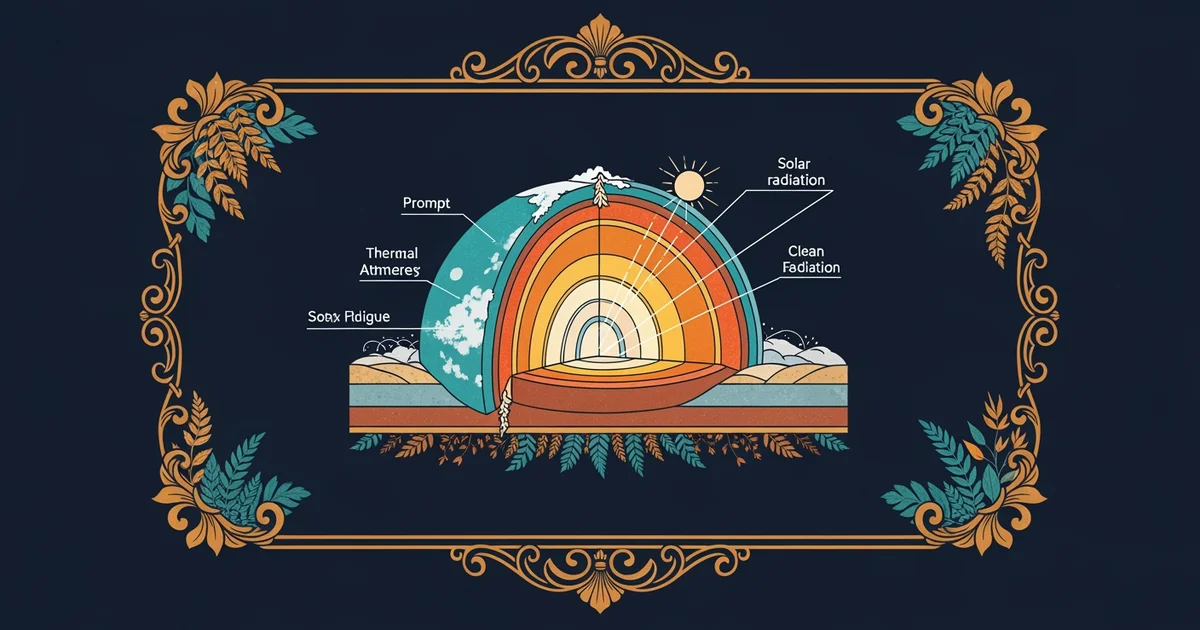
Thermal energy always moves from warmer areas toward cooler areas until the system reaches a balance. This movement happens through different physical processes that depend on the state of the matter involved in the transfer. In the atmosphere, we primarily observe two distinct methods for this energy movement. The first method is conduction, which involves the transfer of energy through direct molecular collisions within a solid or stationary fluid. When molecules vibrate with higher kinetic energy, they bump into slower neighbors and pass that energy along the chain. This process is very efficient in dense materials like metals, but it is actually quite slow in gases like air because air molecules are spaced far apart from each other.
To visualize how these transfers differ, imagine a busy train station during a crowded morning rush hour. If people move by slowly bumping into their immediate neighbors to push forward, that represents the slow, steady process of conduction. If a group of people instead gathers onto a moving express train to travel across the station quickly, that represents the much faster process of convection. In the atmosphere, air does not conduct heat well, so it relies on the second method to move energy over long distances. This second method is convection, which involves the physical movement of warm air masses from one location to another. As air warms up near the surface, it becomes less dense and begins to rise upward, carrying its heat energy with it.
Atmospheric Convection and Fluid Dynamics
Because the atmosphere acts as a giant fluid, convection serves as the primary engine for distributing heat globally. When sunlight warms the ground, that surface heat warms the thin layer of air immediately touching it. That air expands, becomes lighter than the surrounding environment, and starts to rise through the cooler, denser air above it. This vertical movement creates a continuous cycle where cool air sinks to replace the rising warm air near the ground. This cycle is essential for weather patterns because it moves energy from the hot tropical regions toward the colder polar regions of our planet.
| Process | Movement Type | Primary Medium | Efficiency in Air |
|---|---|---|---|
| Conduction | Particle collision | Solids or gases | Very low |
| Convection | Bulk fluid flow | Liquids or gases | Very high |
| Radiation | Electromagnetic wave | Vacuum or gases | High |
We can summarize the way these processes function in the atmosphere using the following key observations:
- Conduction only transfers heat across tiny distances where air touches a warm surface like the ground, meaning it cannot move heat through the deep atmosphere.
- Convection requires a fluid medium like air or water to transport heat through bulk movement, which makes it the dominant way our weather systems move energy.
- Radiation functions differently than the other two because it does not require any physical matter to travel, allowing solar energy to reach the ground initially.
These processes work together to ensure that the air near the surface stays warm enough for life while also driving the global wind patterns we experience every day. Understanding this balance is the key to predicting how temperature changes influence our local climate and storm systems. By studying how air moves and reacts to heat, scientists can better model the complex interactions that create our daily weather patterns and long-term climate trends.
Thermal energy moves through the atmosphere by using slow molecular contact for surface interactions and rapid bulk fluid movement for global heat distribution.
The next Station introduces the role of water vapor, which determines how latent heat transfer changes the way air masses move throughout the atmosphere.