
The Vertical Layers
Imagine standing on a mountain peak where the air feels thin, cold, and strangely quiet. You are experiencing the first layer of our atmosphere, which is the thin blanket protecting all life. This layer holds the air we breathe and contains almost all the weather we see every day. Gravity pulls these gas molecules close to the surface, creating the pressure that keeps our world functioning correctly. Understanding how these layers stack up helps us see why the sky changes from the ground to space.
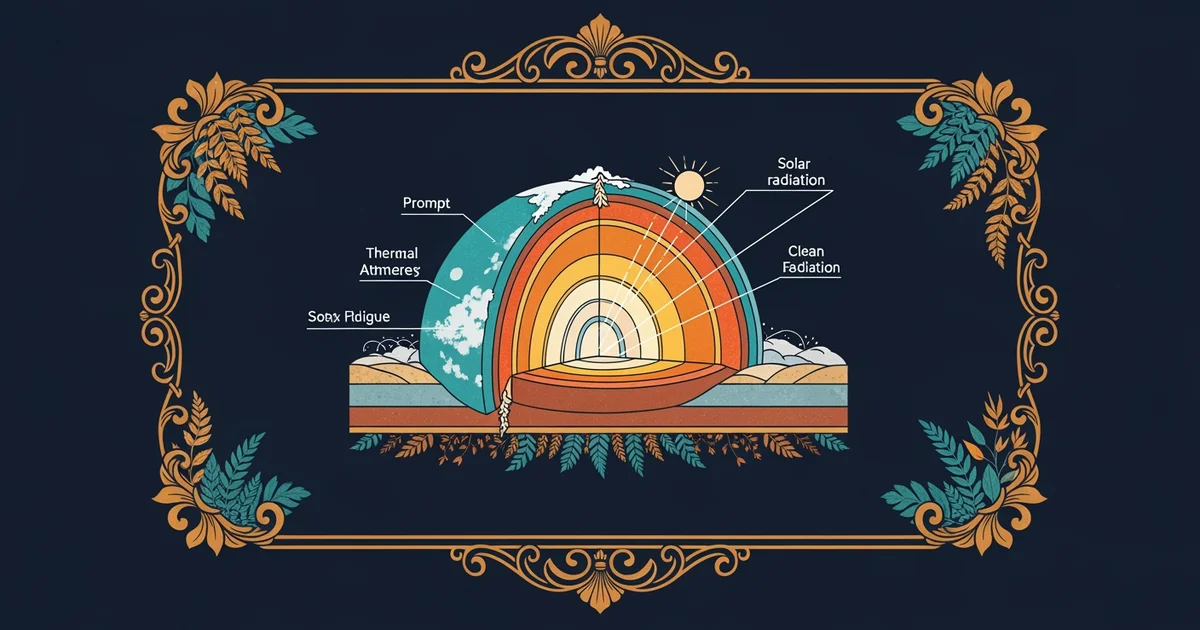
The Lower Atmosphere Layers
We live inside the troposphere, which is the lowest layer of the atmosphere where all clouds form. Air temperature in this region drops as you climb higher, moving away from the warm surface heat. Think of this like an office building where the heating system is located only in the basement. The further you walk up the stairs from the basement, the colder the air becomes for you. This temperature change creates instability, which drives the wind, storms, and rain cycles we experience daily. Almost all the mass of the atmosphere stays trapped within this first layer of roughly twelve kilometers.
Key term: Troposphere — the dense lowest layer of the atmosphere that contains most weather and water vapor.
Above this turbulent region lies the stratosphere, a calm area that behaves very differently from the lower air. Instead of getting colder with height, the air in this layer actually warms up as you ascend. This happens because ozone molecules absorb incoming ultraviolet light from the sun and turn it into heat. The stratosphere acts like a stable lid on top of the weather-filled troposphere, keeping everything below contained. Because the air here is so stable, commercial airplanes often fly in the lower stratosphere to avoid turbulence.
| Layer | Temperature Trend | Key Feature |
|---|---|---|
| Troposphere | Decreases with height | Weather systems |
| Stratosphere | Increases with height | Ozone layer |
| Mesosphere | Decreases with height | Meteor burning |
Comparing Atmospheric Dynamics
When we compare these layers, we notice that the boundary between them acts as a physical barrier. The tropopause serves as the transition zone where the temperature stops dropping and begins to level off. This boundary prevents most clouds from growing taller, which is why storm clouds often flatten out at the top. Understanding these boundaries is critical for predicting how heat moves from the ground into the higher reaches. If the atmosphere were just one giant, uniform block of gas, our weather would be predictable and dull. Instead, the layered structure creates a complex engine that moves energy around the entire planet surface.
Each layer possesses unique physical properties that dictate how gases behave under different amounts of pressure. The density of the air drops rapidly as you move upward, meaning fewer molecules are available to hold heat. This vertical stacking explains why climbing a mountain feels like traveling through different climate zones in hours. Scientists use these thermal layers to map out how solar energy interacts with our planet every single day. By studying these distinct zones, we can better understand the delicate balance required to maintain our global climate. This knowledge forms the foundation for everything we will discuss regarding radiation and energy transfer in the next steps of our journey.
The atmosphere is divided into distinct thermal layers that regulate how heat moves and how weather patterns develop.
Next, we will explore how solar radiation interacts with these layers to power the climate system.