
Percussion Dynamics
When you strike a drumhead with a wooden stick, the surface does not simply move up and down as one solid piece. Instead, the flexible material ripples across its entire face like a stone dropped into a calm pond. This complex motion creates the specific tone and pitch we hear when a drummer plays a rhythm. Understanding these movements helps us see how physical force turns into musical energy.
Understanding Membrane Vibration
Every drumhead functions as a stretched membrane that vibrates in specific patterns called modes. When you hit the center of the drum, the entire surface moves in a single, large wave pattern. This primary mode produces the lowest pitch, which is known as the fundamental frequency of the instrument. If you strike the drum near the edge, you force the membrane to vibrate in smaller, more complex segments. These secondary modes create higher overtones that add color and texture to the basic sound of the drum. Think of these vibrations like a trampoline; if one person jumps in the center, the whole mat sinks down evenly. If two people jump on opposite sides, the mat ripples in a way that prevents a single, smooth descent. This interaction between different points of contact determines the final sound quality of the drum.
Mapping Vibration Patterns
Scientists often map these patterns using a grid to show where the membrane moves most and where it stays still. These stationary areas are called nodes, and they are vital for controlling the character of the sound. If you place your finger on a node while striking the drum, you stop the vibration in that specific area. This action changes the way the rest of the surface can move, effectively filtering out certain overtones. By knowing where these nodes exist, musicians can manipulate the drum to produce a wide range of musical effects. The way a drumhead reacts to force depends on several physical factors that change how the waves travel across the surface.
| Feature | Center Strike | Edge Strike |
|---|---|---|
| Wave Type | Wide and deep | Narrow and fast |
| Pitch | Fundamental | High overtone |
| Motion | Uniform ripple | Complex segment |
This table shows how the location of your strike changes the physical behavior of the drumhead. A strike in the center creates a deep, resonant sound because the entire surface moves in unison. A strike near the edge creates sharp, bright sounds because the membrane is forced into faster, fragmented patterns. These different modes exist simultaneously during every strike, but the intensity of each mode shifts based on where the stick makes contact.
Learning to control these modes requires practice because the drumhead is sensitive to the angle and speed of the impact. The energy from your hand travels through the stick and into the membrane as a sudden pulse. This pulse then radiates outward until it reaches the metal rim of the drum. Once the pulse hits the rim, it reflects back toward the center, creating interference patterns that define the sound. If the drumhead is too loose, these waves move slowly and sound muddy or flat. If the drumhead is too tight, the waves move rapidly and create a high, piercing tone that lacks deep resonance. Balancing these physical properties allows the player to shape the sound to match the needs of the music. Every strike is a negotiation between the force of the player and the physical limits of the drum material.
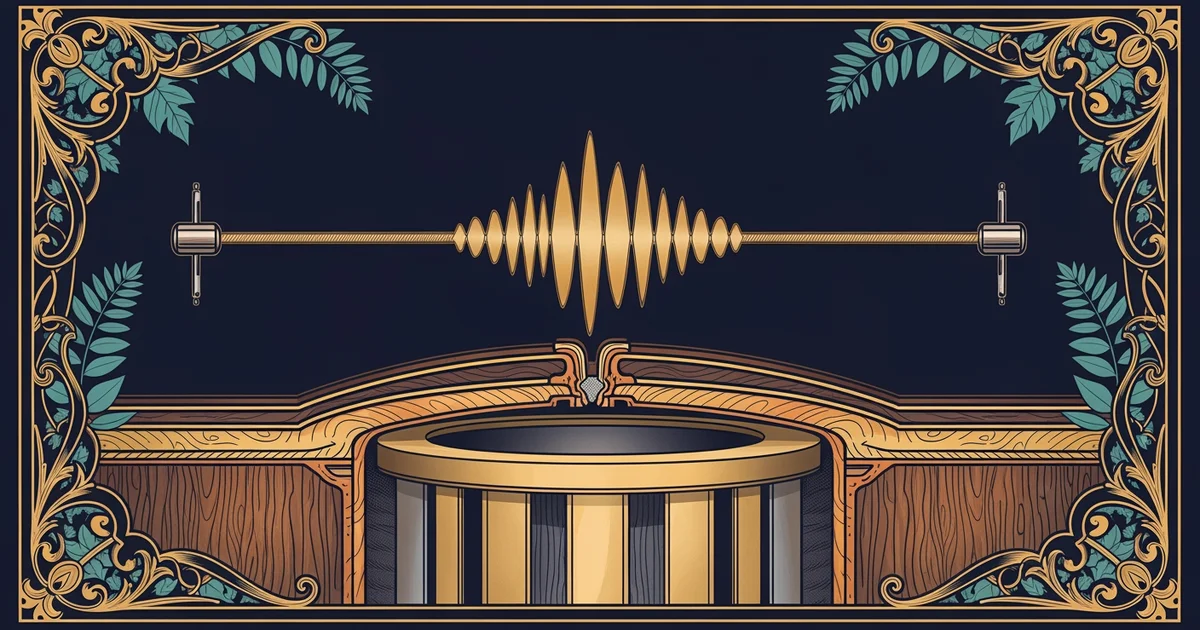
The complex sound of a drum is created by the combination of different vibration modes that form when a strike triggers waves across a stretched membrane.
The next Station introduces material density effects, which determine how the composition of the drumhead influences the speed and quality of these vibration waves.