
The Physics of Sound Waves
Imagine you are standing at the edge of a quiet pond holding a small stone. If you drop that stone into the water, you will see ripples spread out from the point of impact. These ripples move across the surface even though the water itself does not travel to the other side. Sound behaves in a very similar way when it travels through the air around us. Every musical note we hear is actually a series of invisible ripples moving through the space between an instrument and our ears.
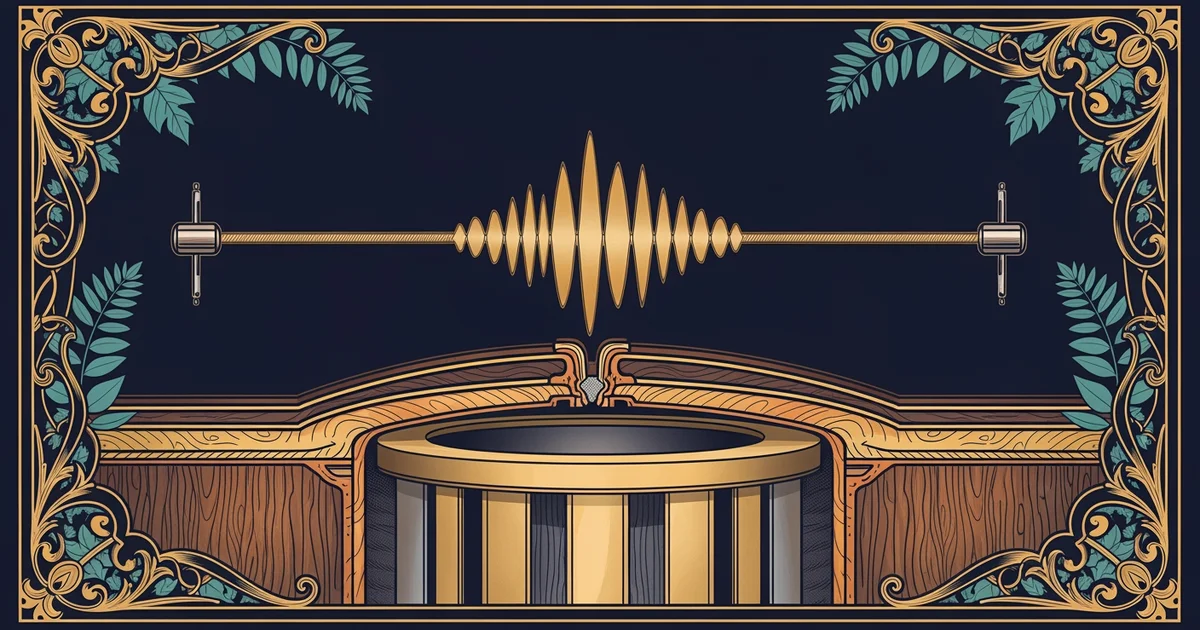
The Nature of Mechanical Waves
Sound is classified as a mechanical wave because it requires a physical medium to travel. Unlike light, which can pass through the empty vacuum of space, sound must have particles to push against. Think of these air particles as a long line of people waiting to enter a crowded concert hall. When the person at the back of the line gets pushed, they bump into the person in front of them. That person then bumps into the next person, and the energy moves forward through the line. The individuals themselves do not move across the room, but the push travels from the back to the front.
This movement of energy creates a pattern of pressure changes that we perceive as sound. When an object vibrates, it pushes the nearby air molecules together, creating a zone of high pressure. These molecules then push into their neighbors, creating a chain reaction that carries the sound energy away from the source. The air molecules eventually return to their original positions after the energy has passed through them. This process happens thousands of times every second for even the simplest musical notes.
How Air Particles Carry Energy
We can break down the movement of these particles into specific zones of pressure. As a source vibrates, it creates a repeating cycle of compression and expansion in the surrounding air. These cycles are what allow our ears to detect the energy and turn it into signals for our brain. Understanding these zones helps us see how music is essentially a physical force acting on the environment.
| Zone Type | Particle Behavior | Pressure Level | Effect on Air |
|---|---|---|---|
| Compression | Pushed together | High pressure | Dense cluster |
| Equilibrium | Resting state | Normal pressure | Even spacing |
| Rarefaction | Pulled apart | Low pressure | Sparse spread |
This table shows how the air changes as a wave moves through space. The particles do not stay in one state for long because the energy is constantly pushing them forward. The cycle of high and low pressure repeats rapidly as long as the sound source continues to vibrate. This constant motion is what maintains the stream of music reaching your ears from a distance. If the vibration stops, the chain reaction ends, and the sound disappears instantly from the air.
Key term: Medium — the physical substance, such as air, water, or solid material, that carries sound waves from a source to a listener.
By understanding how these invisible waves move, you gain the ability to visualize the mechanics behind every melody you hear. This foundation will eventually allow you to explore how specific instruments manipulate these waves to change the pitch and tone of the music you play. You are now ready to see how these vibrations translate into the musical sounds that define our daily lives.
Sound is a form of energy that moves through the air by pushing particles in a repeating chain reaction.
Next, we will explore how the speed and shape of these vibrations determine the specific pitch and frequency of musical notes.