
Urban Mining Concepts
When a gold-plated circuit board from an old smartphone reaches a landfill, it represents a missed economic opportunity for the planet. This is the urban mining concept, which treats our growing piles of electronic waste as rich, untapped mineral deposits. Instead of digging deep into the earth for raw materials, engineers view city trash as a stable, concentrated supply of precious metals. By applying the principles of the circular economy from Station 12, we can reclaim valuable elements like copper, gold, and silver. This shift reduces the need for destructive mining practices while securing resources for future manufacturing needs through systematic recovery processes.
The Engineering Process of Resource Recovery
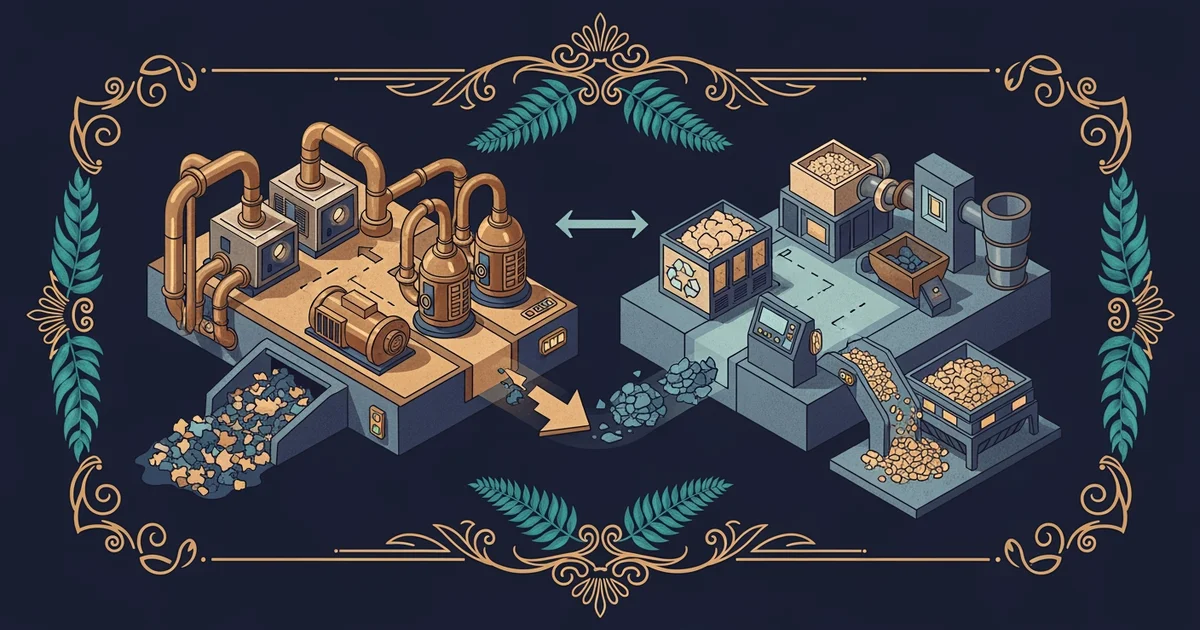
Recovering gold from a discarded circuit board requires a precise, multi-stage engineering approach to ensure maximum material purity. The process begins with mechanical shredding, where large devices are broken down into small, manageable particles of mixed plastic, metal, and glass. Once shredded, engineers use magnetic separation to pull out ferrous metals, followed by eddy current separators to isolate non-ferrous aluminum and copper. This mechanical stage creates a concentrated feedstock that allows chemical or thermal processes to function with much higher efficiency. Think of this like sorting a giant bin of mixed Lego bricks by color before you start building your final, complex model.
Key term: Urban mining — the systematic process of recovering raw materials from discarded products and waste streams to create a sustainable supply chain.
After the mechanical sorting is finished, the remaining material undergoes hydrometallurgy to isolate the precious metals from the base materials. This method involves using specific chemical solutions to dissolve metals, allowing them to be extracted as high-purity liquid concentrates. Engineers carefully control the acidity and temperature of these baths to ensure that gold stays in the solution while impurities are filtered away. Once the gold is isolated, it is precipitated out and melted into small bars for reuse in new electronics. This cycle transforms a dead smartphone into a fresh component, proving that our waste is actually a high-grade resource.
Challenges and Future Scaling
While the technology for urban mining exists, scaling these operations to handle global waste volumes presents significant engineering hurdles. Electronic devices are becoming smaller and more complex, making it harder to separate the tiny amounts of gold found in individual components. Furthermore, the presence of hazardous materials like lead or flame retardants requires extra safety steps to prevent environmental contamination during the recovery phase. Engineers must design new modular machines that can handle diverse waste types without requiring manual labor for every single piece. The following table highlights the primary material recovery steps used in modern facilities:
| Recovery Phase | Primary Goal | Technology Used |
|---|---|---|
| Mechanical | Size reduction | Shredders and grinders |
| Magnetic | Iron removal | Electromagnets |
| Chemical | Metal isolation | Hydrometallurgy |
By optimizing these steps, we can lower the energy costs associated with traditional mining. This transition requires better design at the manufacturing stage to make devices easier to disassemble later. As we refine these systems, the economic value of our urban mines will grow, making it cheaper to recycle than to mine virgin ores. This is the core logic of resource management that allows us to move away from linear consumption. But this model breaks down when global supply chains lack the infrastructure to aggregate waste efficiently.
Urban mining transforms discarded electronic waste into a reliable source of precious materials by using specialized mechanical and chemical engineering techniques.
But this model faces significant pressure as the complexity of modern consumer electronics makes automated component separation increasingly difficult.