
Hotspot Volcanism Basics
Imagine you are standing on a conveyor belt that moves slowly across a giant, burning stove. As the belt moves forward, the heat from the stove creates a trail of melted wax patterns beneath your feet. This simple movement creates a long line of shapes that trace the path you traveled over the heat source. Hotspot volcanism works in a very similar way to this conveyor belt analogy, as it shapes the geography of our planet.
The Mechanics of Mantle Plumes
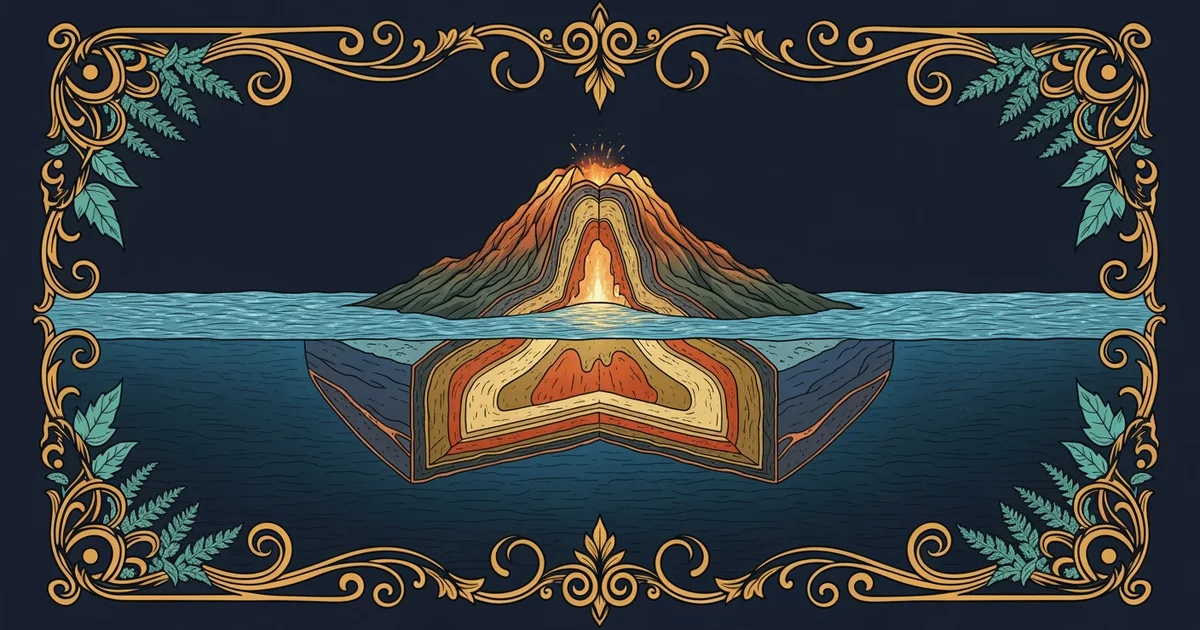
Deep beneath the solid outer layer of the Earth, intense heat builds up in the mantle. This heat creates a mantle plume, which is a narrow column of superheated rock rising upward. When this plume reaches the base of a tectonic plate, it melts the rock above it to form magma. This magma then pushes through the crust to create a volcano on the surface. Because the mantle plume stays in one fixed location, it acts like a stationary blowtorch burning through a moving metal sheet. As the tectonic plate slowly drifts over this spot, the volcano moves away from the heat source and eventually stops erupting.
Key term: Mantle plume — a column of intense heat rising from deep within the Earth that creates volcanic activity at a specific, stationary point on the crust.
Once the first volcano moves away from the plume, the heat source remains behind to start the process again. A new volcano forms in the exact spot where the first one began its life. Over millions of years, this cycle creates a long chain of volcanic islands stretching across the ocean floor. The islands closer to the current heat source are always younger than the islands located further away. By measuring the age of these island rocks, scientists can track exactly how fast the tectonic plate is moving. This process provides a clear history of Earth's crustal movement through time.
Mapping Island Chains Through Time
When we look at these island chains, we see a clear pattern of growth and aging. The following table explains how these features change as they drift away from the active volcanic center:
| Feature | Active Island | Distant Island |
|---|---|---|
| Age | Very young | Very old |
| Activity | Currently erupting | Long extinct |
| Elevation | High and steep | Low and eroded |
Because the plate moves at a steady pace, the distance between islands reveals the speed of the plate. If the islands are spaced far apart, the plate is moving quickly across the mantle plume. If the islands are bunched closely together, the plate is moving much more slowly. This system acts like a natural clock that records the history of the Earth's shifting surface. We can observe how the direction of the island chain might change if the plate shifts its path. This evidence allows researchers to reconstruct the past paths of continents that moved long ago.
It is important to remember that these islands do not last forever after they leave the hotspot. Once the supply of magma is cut off, the forces of wind and water begin to break the island down. The rock cools and shrinks, causing the island to sink slowly into the ocean. This explains why the oldest islands in a chain are often just flat reefs beneath the waves. The cycle of birth and death for these islands is a constant feature of our planet. This process demonstrates how deep internal heat creates the physical landmasses that support life on the surface. Understanding these cycles helps us learn how isolated landmasses evolve and change over vast periods of time.
Hotspot volcanism creates a chronological record of tectonic movement by leaving a trail of volcanic islands as a plate drifts over a stationary mantle plume.
The next Station introduces Eustatic Sea Level Changes, which determines how these volcanic islands are eventually submerged by rising global water levels.