
Synthesis of Impact Science
A massive space rock hits the surface of a planet with the force of many nuclear bombs. This violent event leaves a permanent scar on the landscape while changing the future of life on that world forever. We must look at how these impacts act as both destroyers of existing systems and architects of new biological pathways. By blending physics, geology, and biology, we see a complete picture of solar system evolution.
The Mechanics of Planetary Impacts
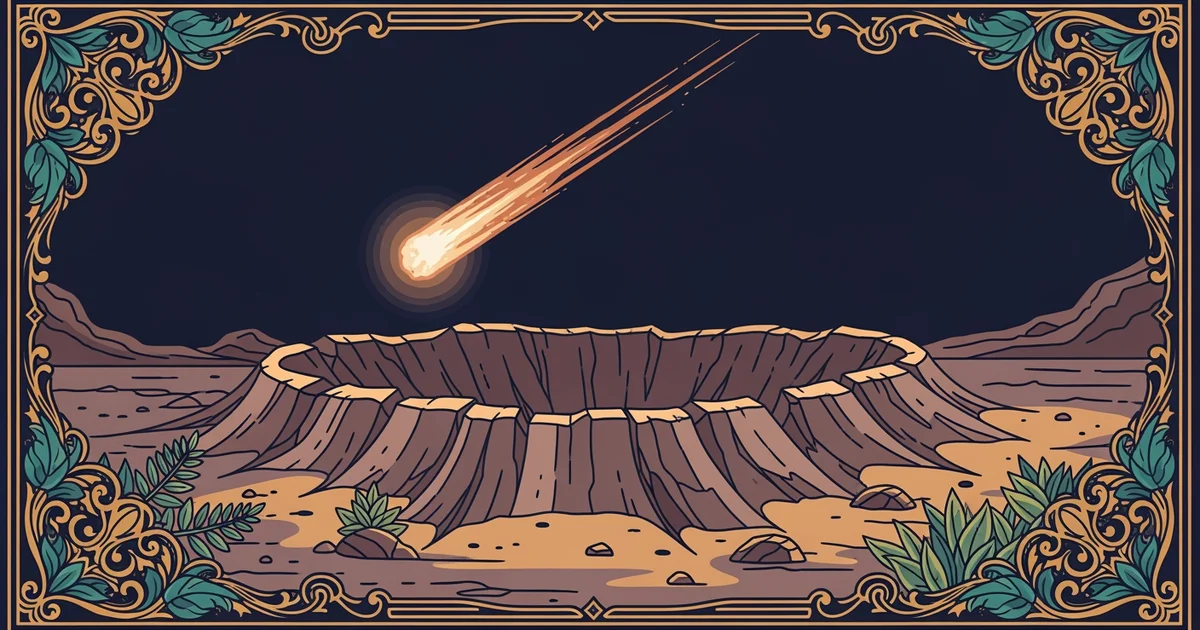
When a large asteroid strikes a planet, the energy released depends on its mass and its speed. The kinetic energy follows the simple physics formula , which shows that velocity matters more than mass. A small object moving at high speed creates a crater much larger than its own physical size. This process turns solid rock into liquid and gas in a fraction of a second. The ground behaves like a fluid during the initial shock wave of the crash. This movement creates a bowl-shaped hole that defines the surface of many moons and planets.
Key term: Impact cratering — the geological process where a high-velocity collision creates a depression on a planetary body.
Think of this process like dropping a heavy stone into a bucket of wet sand. The sand splashes outward and creates a distinct rim while leaving a deep hole behind. Planetary surfaces act just like that sand when they face high-speed visitors from deep space. These craters provide a historical record of how many rocks have bombarded a world over time. By counting the craters, scientists can estimate the age of a surface on a moon or planet.
Integrating Geology and Biology
Impacts do more than just reshape the landscape; they fundamentally alter the environment for every living thing present. A major strike can throw enough dust into the atmosphere to block the sun for many years. This shift in the climate forces rapid changes in how plants and animals survive or perish. We can see how the physical force of a collision triggers a biological cascade that leads to mass extinction events. This interaction proves that space rocks are a primary driver of evolutionary change on Earth.
| Impact Factor | Physical Effect | Biological Consequence | Timeframe |
|---|---|---|---|
| Shock wave | Crushing rocks | Immediate habitat loss | Seconds |
| Dust cloud | Cooling climate | Global food failure | Decades |
| Water shift | Tsunami waves | Coastal ecosystem death | Days |
These factors show that a single event creates a ripple effect across the entire planet. The table above highlights how physical energy transforms into a wide range of biological pressures. We can trace the history of life by looking for layers of material left behind by these massive strikes. These layers act as a timeline for when the environment changed due to external forces from space.
We must also consider how impacts might deliver the building blocks of life to a barren world. Some theories suggest that early collisions brought water and carbon compounds to Earth when it was still young. This creates a fascinating tension between the destructive power of impacts and their role as life-givers. We are currently debating whether these events were the primary reason life started here or just a barrier to its growth. This mystery remains a central focus for researchers studying the origins of our own solar system.
The history of our solar system is a cycle of destruction and creation where high-speed impacts dictate the survival and evolution of life on Earth.
Understanding the role of space rocks allows us to view planetary evolution as a dynamic process rather than a static history.