
Cosmic Time Perspective
Imagine you are standing on a train platform while a high-speed express train rushes past you. You notice that the clock on the train seems to tick differently than the one on your wrist. This is not a mechanical error or a trick of your eyes. It is the fundamental reality of how gravity and velocity shape the flow of time itself. As you move through the cosmos, your position relative to massive objects changes your experience of every passing second. This concept of relative time forces us to rethink our place in a universe where duration is never truly fixed or universal.
The Gravity of Time
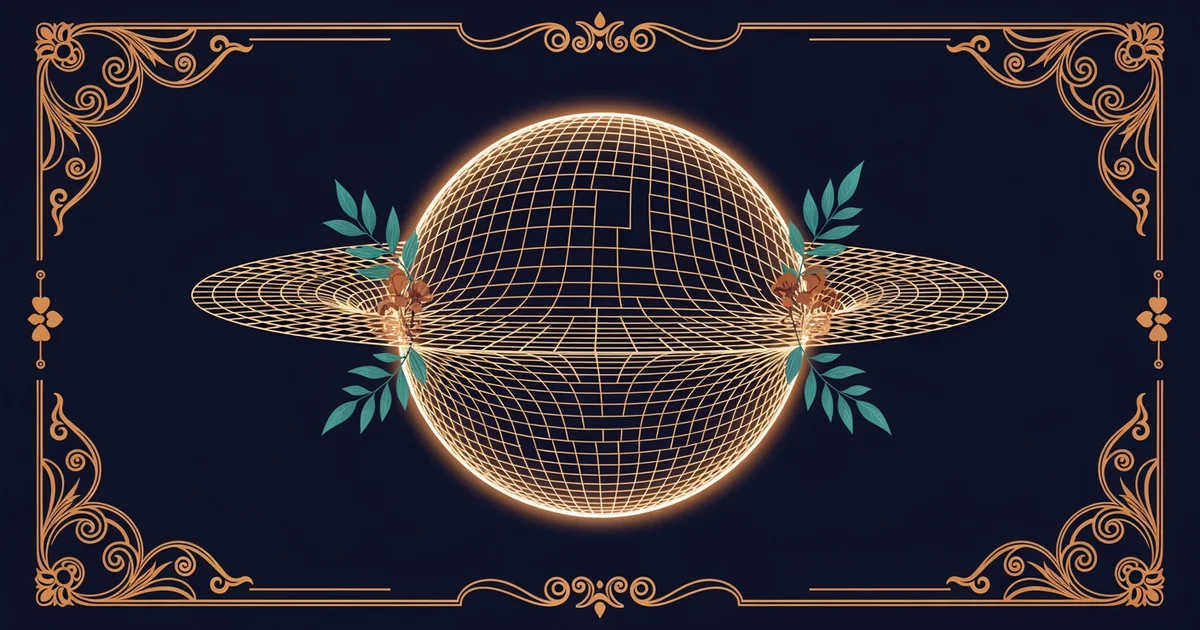
Gravity acts like a thick fluid that slows down the movement of time around massive objects. When an object has a large mass, it curves the fabric of space and time around it. This curvature forces time to stretch, a phenomenon we call time dilation. Think of this like a person walking through deep water versus walking on dry land. The water represents the gravitational field, and your movement through it feels sluggish compared to the open air. Because the earth has mass, time moves slightly slower for you than for someone in deep space. This effect is tiny for us on the surface, but it becomes massive near dense objects.
Key term: Time dilation — the physical phenomenon where time passes at different rates for observers depending on their gravitational environment or speed.
We can see how this interaction works by comparing how different environments affect the passage of time. The following table shows how gravity influences our perception of time across various cosmic locations:
| Location | Gravitational Strength | Time Flow Rate |
|---|---|---|
| Deep Space | Near Zero | Fastest possible rate |
| Earth Surface | Moderate | Slightly slowed down |
| Near Black Hole | Extremely High | Significantly stretched |
Perspective in the Cosmos
This gravitational influence connects back to the unified relativity model we explored in our previous studies. That model explains that space and time form a single four-dimensional fabric. When you add mass to this fabric, you create a ripple that dictates how time flows. Your experience of time is tied to your specific location within this cosmic landscape. If you were to travel near a dense object, your internal clock would fall behind the clocks left on Earth. You would return to find that much more time had passed for your friends than for you during your journey.
This reality implies that time is not a steady beat for the entire universe. It is a personal experience that depends entirely on your current gravitational surroundings and speed. We often think of time as a constant, but it is actually a flexible dimension that bends under pressure. Gravity acts as the regulator of this flow, ensuring that every observer sees the universe from a unique temporal frame. This perspective shift changes how we view the history of the stars and the future of our own exploration.
- Gravitational slowing occurs because massive objects pull on the fabric of space and time, creating a deeper curve that forces clocks to tick slower compared to those in empty space.
- Relativistic speed also contributes to this effect by adding kinetic energy to the system, which further stretches the duration of each second for the moving object.
- Cosmic synchronicity is impossible because every point in the universe has a different gravitational pull, meaning no two observers can ever truly share the exact same temporal rhythm.
Understanding this allows us to see that our perception of a second is just one version of reality. The universe is a collection of countless clocks, each ticking at its own pace based on its local gravity. This realization is the final piece of our journey into the mechanics of the cosmos. We no longer see time as a rigid line, but as a dynamic landscape that we navigate through our movement. The stars are not just lights in the sky, but markers of different temporal zones.
Time is not a universal constant but a flexible dimension that bends and stretches depending on the gravitational influence of nearby massive objects.
Understanding that gravity shapes our experience of time is essential for future space travel and deep space navigation.