
Spacetime Geometry
Imagine you are drawing a map that needs to track both where you are and when you arrive. You realize that a standard flat piece of paper cannot capture the full truth of your journey across the universe.
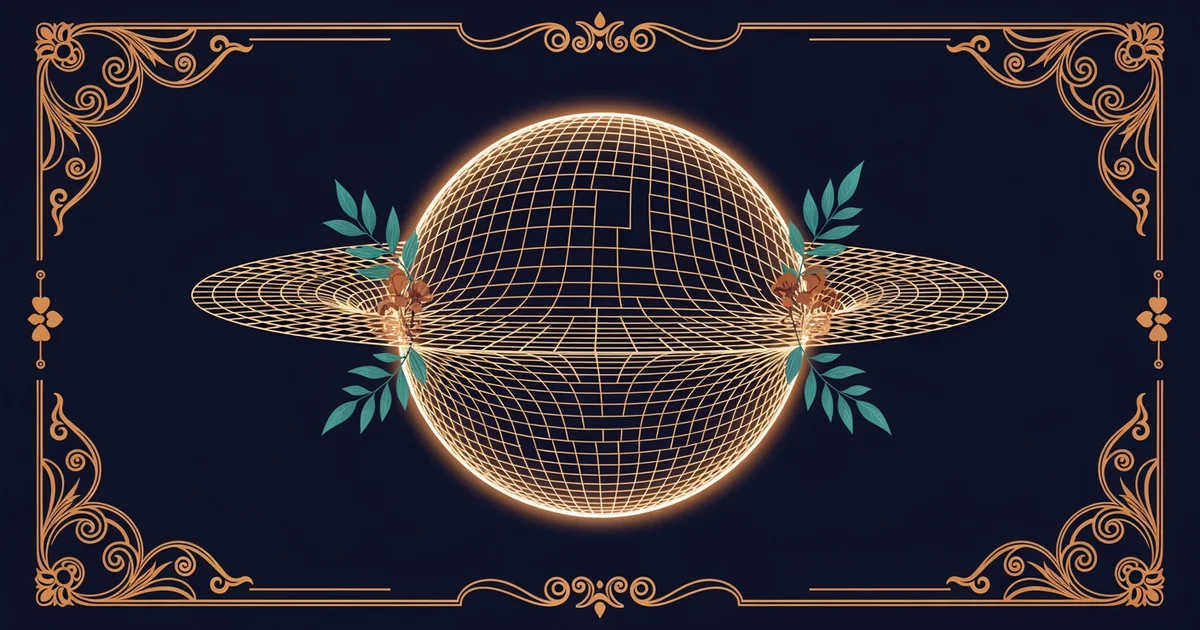
Visualizing the Four Dimensional Grid
To understand the universe, we must think about spacetime, which combines the three dimensions of space with the single dimension of time. Think of it like a giant, invisible scaffolding that holds every event that has ever happened in history. In our daily lives, we usually treat space and time as separate things, but they are woven together into one fabric. If you want to meet a friend, you must provide a location and a time, or the meeting cannot occur. This four dimensional coordinate system acts as the ultimate reference point for every object, star, or galaxy in existence.
Key term: Spacetime — the four dimensional framework that merges three spatial dimensions with the dimension of time.
Just as you need a GPS to find a specific street corner on a map, you need coordinates to identify an event in the universe. Scientists use these four numbers to pinpoint exactly where and when something happens. Because gravity interacts with this fabric, the grid itself can stretch or shrink depending on the mass nearby. Imagine a sheet of rubber that you pull tight, where placing a heavy ball in the center creates a deep dip. This dip changes the distance between two points on the sheet, which is exactly how gravity alters the geometry of our universe.
Mapping Events in Space and Time
When we map events, we are really describing the history of an object as it moves through this complex, flexible grid. Consider a traveler moving through a city, where their path is a line on a map that shows their location at every moment. In the universe, this path is called a worldline, and it represents the entire history of an object from start to finish. If the grid is warped by a massive star, the path taken by light or matter will appear to bend, even if the object is moving in a straight line through its own local space.
To keep track of these events, we often use a standardized way to measure distances within this grid:
- The first three coordinates represent the spatial position, which tells us the exact X, Y, and Z location in the cosmos.
- The fourth coordinate represents the temporal position, which marks the exact moment the event takes place on a cosmic clock.
- The relationship between these four values determines the interval between two events, which remains consistent for all observers in the universe.
These measurements allow us to see how gravity influences the flow of time by changing the shape of the grid itself. When you stand near a massive object, the grid lines are stretched, which forces time to tick at a different rate compared to someone in empty space. This is not a mechanical error in our clocks, but a fundamental property of the geometry of the universe. By viewing the cosmos as a four dimensional map, we can finally see why time is not a constant, universal beat, but a flexible value that shifts based on the curvature of the space around us.
The geometry of the universe functions as a flexible four dimensional grid where mass dictates the shape and the flow of time.
The next Station introduces mass and curvature, which determines how gravity actually warps the fabric of our reality.