
The Equivalence Principle
Imagine you are standing inside a closed elevator that suddenly begins to accelerate upward through deep space. Even without seeing outside, you would feel a heavy force pressing your feet firmly against the floor. This sensation feels exactly like the weight you experience while standing on the surface of our planet. This simple, everyday experience reveals a profound truth about the nature of our universe and how gravity operates. By comparing these two experiences, we can begin to understand the hidden connections between movement and the fundamental force of gravity.
The Logic of Acceleration
When an object accelerates, it changes its velocity over a specific period of time. Inside our elevator, the floor pushes against your feet to create this upward change in speed. Because the floor must push you to keep up with the rising elevator, you feel a distinct pressure against your body. This pressure is indistinguishable from the force of gravity that pulls you toward the ground while you stand still. If you dropped a ball in this moving elevator, it would appear to fall toward the floor at the same rate as it would on Earth. This observation forms the basis of the Equivalence Principle, which states that the effects of gravity are identical to the effects of acceleration.
Key term: Equivalence Principle — the physical law stating that gravitational forces and acceleration are locally indistinguishable to an observer.
This principle suggests that gravity is not just a mysterious pulling force acting at a distance. Instead, gravity behaves exactly like the inertial forces we feel when we speed up in a car or elevator. If you were trapped in a windowless room, you could never perform an experiment to tell if you were sitting on a planet or accelerating through a vacuum. This lack of difference implies that gravity and acceleration are two sides of the same coin. Understanding this link allows us to see how mass shapes the environment around it in ways that mirror simple motion.
Gravity as a Geometric Effect
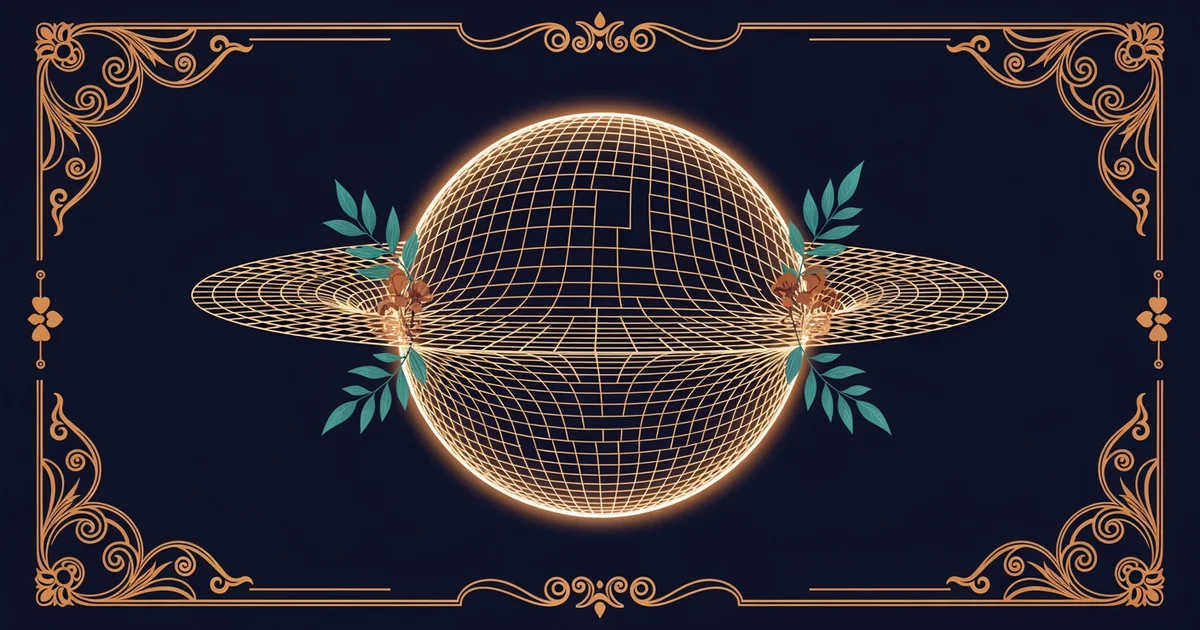
Since acceleration creates the same physical outcomes as gravity, we must rethink how we view heavy objects. If a rocket engine can create a force that mimics gravity, then gravity itself must be a result of the way space and time are structured. Imagine placing a heavy bowling ball onto a soft, stretched rubber sheet to see how it curves the surface. The ball causes the sheet to dip, forcing any smaller marbles placed nearby to roll toward the center. This analogy helps us visualize how mass influences the path of objects, even though space itself is not a physical fabric like rubber.
| Feature | Accelerating Elevator | Standing on Earth |
|---|---|---|
| Sensation | Heavy pressure on feet | Heavy pressure on feet |
| Object drop | Falls toward the floor | Falls toward the floor |
| Source | Mechanical engine push | Massive planetary body |
| Outcome | Identical physics | Identical physics |
This table shows why the two situations are functionally the same for anyone inside the system. Whether you are moving through space or resting on a planet, your local experience remains constant. If the physics are the same, the underlying cause must also be related in a fundamental way. This realization leads us to consider how time itself might be affected by these conditions. If gravity is just a form of acceleration, then the way time passes must also change when we are near heavy objects. We can now see that the flow of time is tied to the way we move and the way mass shapes our surroundings.
Gravity creates the exact same physical effects as acceleration, meaning that being stationary on a planet is locally identical to moving through space at a constant rate of change.
Next, we will explore how this connection between gravity and acceleration forces us to view the shape of spacetime as a flexible, dynamic stage for all physical events.