
The Nature of Gravity
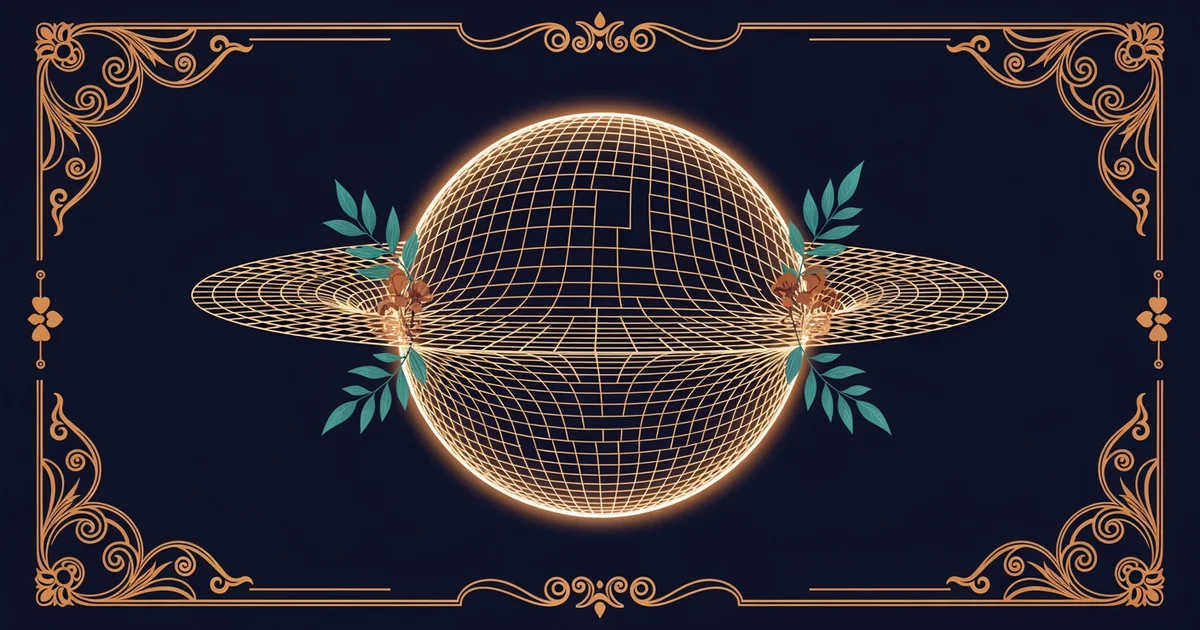
Imagine you are standing on a trampoline while a heavy bowling ball sits in the center. The fabric curves downward around the ball, creating a deep dip that pulls smaller marbles toward the center. This simple scene explains how gravity works in our vast universe. Gravity is not a mysterious force pulling objects together like a magnet. Instead, it is the actual shape of space itself bending under weight. Massive objects like stars and planets warp the fabric of space, causing other objects to roll toward them. This invisible geometry is what we experience as the weight keeping our feet on the ground.
The Geometry of Massive Objects
Space is not just an empty void where stars and galaxies happen to float. It is a flexible, physical fabric that interacts with every single object in existence. When a massive body like the Sun exists, it creates a depression in this fabric known as spacetime. Think of this like a heavy weight placed on a stretched rubber sheet. Anything nearby will naturally follow the curve of that sheet toward the center. This explains why planets orbit the Sun without needing a tether or invisible rope. They are simply following the natural path created by the Sun's immense mass.
Key term: Spacetime — the four-dimensional combination of three spatial dimensions and one time dimension that forms the physical fabric of the universe.
This curvature explains the motion of every object in the sky, from small rocks to giant galaxies. Because the fabric of space is curved, straight lines actually become curved paths over long distances. An object moving through this space does not need to be pulled by a force. It only needs to follow the shortest path through the distorted geometry of its environment. This concept replaces the older idea of gravity as a direct tugging force between two distant objects. By viewing gravity as geometry, we gain a much clearer picture of how the universe maintains its structure.
Understanding Gravitational Attraction
Objects appear to fall toward massive bodies because they are following the shortest path in curved space. If you were to roll a marble across that trampoline, it would circle the bowling ball. It does not circle because the ball is pulling it with a force. It circles because the surface is no longer flat, forcing the marble to change direction. The following table highlights how different levels of mass influence the surrounding space:
| Mass Level | Curvature Effect | Typical Result |
|---|---|---|
| Low Mass | Very shallow dip | Minimal orbital effect |
| High Mass | Deep, wide curve | Strong gravitational pull |
| Extreme Mass | Intense distortion | Light cannot even escape |
This geometric view of gravity helps us explain why massive stars dominate their local regions of space. The deeper the curve, the more energy is required for an object to escape that path. We see this effect everywhere, from the way moons orbit planets to how galaxies spin. Every motion we observe in the cosmos is just a dance along the curves of space. By understanding this shape, we can predict exactly how objects will move through the dark, empty reaches of the night sky.
Gravity is the natural curvature of the fabric of space caused by the presence of mass.
This path will show you how that same curvature of space also affects the speed at which time flows for different observers.