
The Time Dilation Effect
Imagine you are standing on a giant scale that measures the passage of time instead of your weight. When you move closer to a massive object like a planet, your clock actually ticks slower than a clock located far away in empty space. This strange phenomenon happens because gravity does not just pull on objects, but it also warps the very fabric of time itself.
The Nature of Gravitational Time Dilation
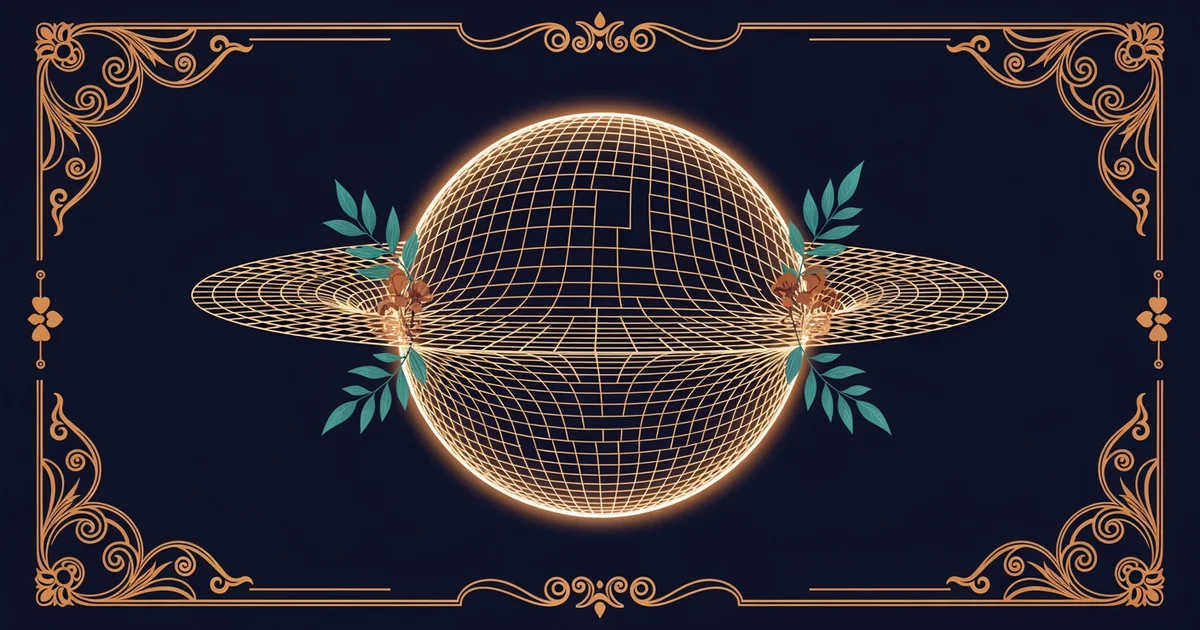
Gravity acts like a thick syrup that slows down the flow of everything passing through its field. When you are deep within a gravitational well, you experience gravitational time dilation, which describes how clocks run slower near heavy masses. Think of this process like walking through a busy shopping mall with a heavy backpack full of gold coins. You move much slower than someone walking without any weight because the burden forces you to take smaller, more deliberate steps. In this analogy, the gravity of a massive object is the weight that forces time to progress at a slower rate for those nearby.
Key term: Gravitational time dilation — the physical effect where time passes at different rates depending on the strength of the local gravitational field.
This effect is not a mechanical error within your clock, but a fundamental change in the nature of reality. Every process, from the ticking of a mechanical gear to the rapid firing of neurons in your brain, slows down by the same amount. Because you are moving along with the rest of your environment, you would never notice that your time is moving differently. You would only realize the change if you compared your local clock against a clock located in a weaker gravity field. This comparison reveals that time is not a universal constant that ticks the same for everyone across the entire universe.
Measuring the Shift in Time
To understand how we measure these shifts, we must look at how gravity influences the path of energy. The intensity of the field creates a measurable difference in the duration between two events. If you placed a clock on the surface of a neutron star, it would tick significantly slower than a clock orbiting high above the surface. We can categorize the intensity of these effects based on the mass and density of the object involved in the experiment.
| Object Type | Gravity Strength | Time Dilation Effect |
|---|---|---|
| Earth | Relatively Low | Extremely tiny shift |
| White Dwarf | Very High | Noticeable difference |
| Black Hole | Extreme | Massive time slowing |
These variations occur because the strength of the gravitational field changes how space and time are stretched. Near a massive object, the curvature of space becomes so intense that the flow of time must compensate to maintain consistency. We observe this by tracking signals sent between space probes and ground stations on Earth. The signals take slightly longer to arrive than expected because the gravity of the planet actually stretches the interval of time itself as the signal travels upward.
Scientists use precise atomic clocks to detect these minute differences in the flow of time. Even on our own planet, the clock on the floor of a laboratory ticks slower than a clock placed on a tall shelf. While the difference is too small for humans to perceive, it is large enough to disrupt the accuracy of global positioning systems. Engineers must program satellites to adjust for this time shift, or our navigation maps would fail within a single day. Gravity is essentially a tax on the speed of time, and the more massive the object, the higher the rate you must pay to exist near it.
Time flows more slowly in regions of stronger gravity because massive objects warp the fabric of space and time around them.
But if gravity changes how time passes, how does it affect the light that travels through that same warped space?
Want this with sources you can check?
Premium Learning Paths for Astronomy & Space Exploration are researched against open-access libraries — PubMed, arXiv, government databases, and more — with their distinctive claims cited to real sources and independently checked.
See what Premium includes