
The Flow of Time
Imagine you are holding two identical stopwatches while standing on a high mountain and at the beach. You might expect that both devices would show the exact same time as the seconds tick away. However, the laws of physics suggest that time is not a steady, universal rhythm that beats for everyone equally. Instead, time acts like a flexible coordinate that stretches or shrinks depending on where you are located. Understanding this change helps us grasp how the massive objects in our vast universe shape the reality we experience every single day.
The Nature of Time as a Dimension
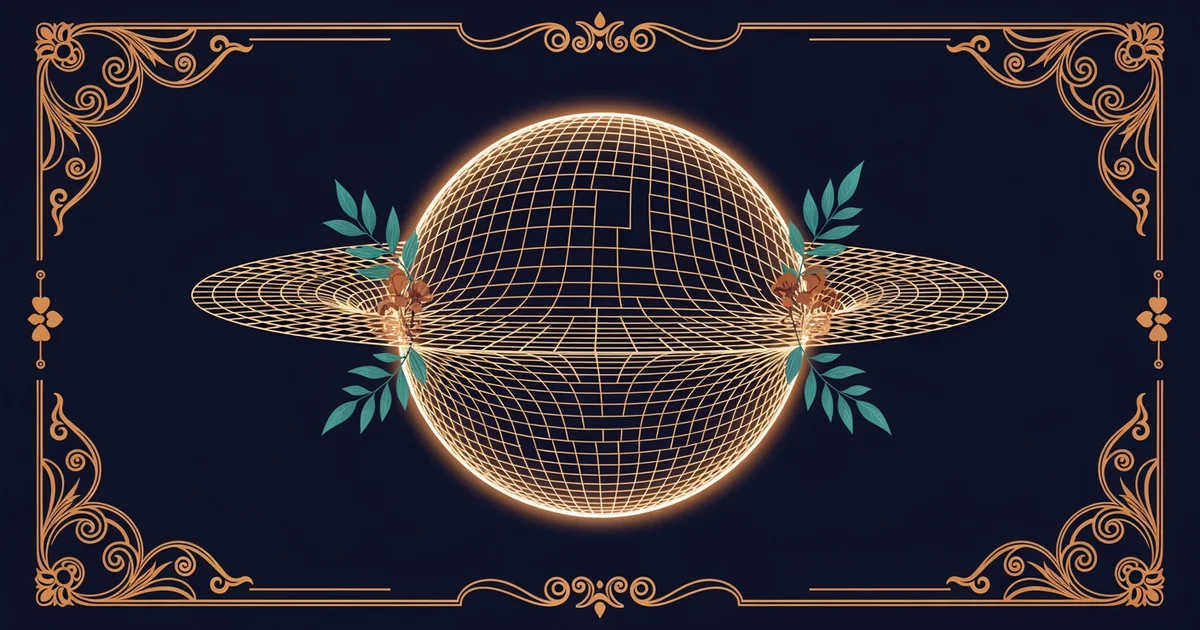
When we think of dimensions, we often picture length, width, and height as static markers for space. Scientists view time as a fourth dimension that connects to these three spatial coordinates to form a fabric called spacetime. This framework suggests that time is not a background stage where events happen but a physical layer that can bend and warp. Just as a piece of elastic fabric stretches when you pull on the edges, the geometry of our universe changes based on the presence of matter. This means that your personal experience of time depends entirely on your specific position within the gravitational field of a massive object.
Key term: Spacetime — the four-dimensional combination of space and time that creates the structural framework for all physical events in our universe.
This concept of time as a variable dimension might seem strange because our daily lives suggest that time is constant. If you look at a clock on your wall, it seems to move at the same speed as a clock in another room. We do not notice these tiny shifts in time because the gravity on Earth is relatively weak compared to the massive forces found near stars. Even though we cannot feel these changes, they are measurable with highly precise instruments that track the flow of time across different altitudes. These small differences confirm that time is a dynamic property that responds to the influence of nearby massive bodies.
Gravity and the Stretching of Time
To understand how gravity influences this flow, consider the analogy of a busy city traffic system with different speed limits. Imagine a highway where the speed limit drops significantly as you enter a crowded downtown area filled with heavy traffic. Cars in the dense, crowded center must travel much slower than those on the open roads in the quiet suburbs. In this analogy, the massive object represents the crowded city center, while the open space represents the suburbs. Gravity acts like that heavy traffic, slowing down the passage of time for anyone caught within the influence of a large mass.
| Location Type | Gravitational Strength | Flow of Time |
|---|---|---|
| Deep Space | Extremely Low | Fastest |
| Earth Surface | Moderate | Slower |
| Black Hole | Extremely High | Slowest |
This table illustrates how the strength of gravity dictates the relative speed of time for an observer at any location. When you move closer to a massive body like a star, the gravitational pull becomes much stronger and more intense. This intensity effectively drags on the fabric of time, causing it to pass at a slower rate compared to regions with less gravity. This phenomenon is why astronauts on a space station experience time slightly differently than people living on the surface of the Earth. While the difference is too small to notice without special tools, the effect is a fundamental reality of our physical universe.
When we analyze these shifts, we see that time is not a fixed constant but a flexible measurement that changes. If you were to travel near a black hole, the gravitational force would be so strong that time would slow down dramatically. An observer watching you from a distance would see your movements become sluggish, almost as if they were watching a slow-motion video. Meanwhile, your own watch would seem to tick perfectly normally to you because your local reality is tied to your specific position. This reveals that time is always relative to the observer and the gravitational environment where they are currently located.
Time functions as a flexible dimension that changes its rate of flow based on the strength of the gravitational field at your current location.
Next, we will explore how the equivalence principle helps us understand why acceleration and gravity produce these identical effects on the flow of time.