
Mass and Curvature
Imagine placing a heavy bowling ball onto a soft, stretched rubber sheet. The fabric dips down, creating a deep curve that forces nearby marbles to roll toward the center.
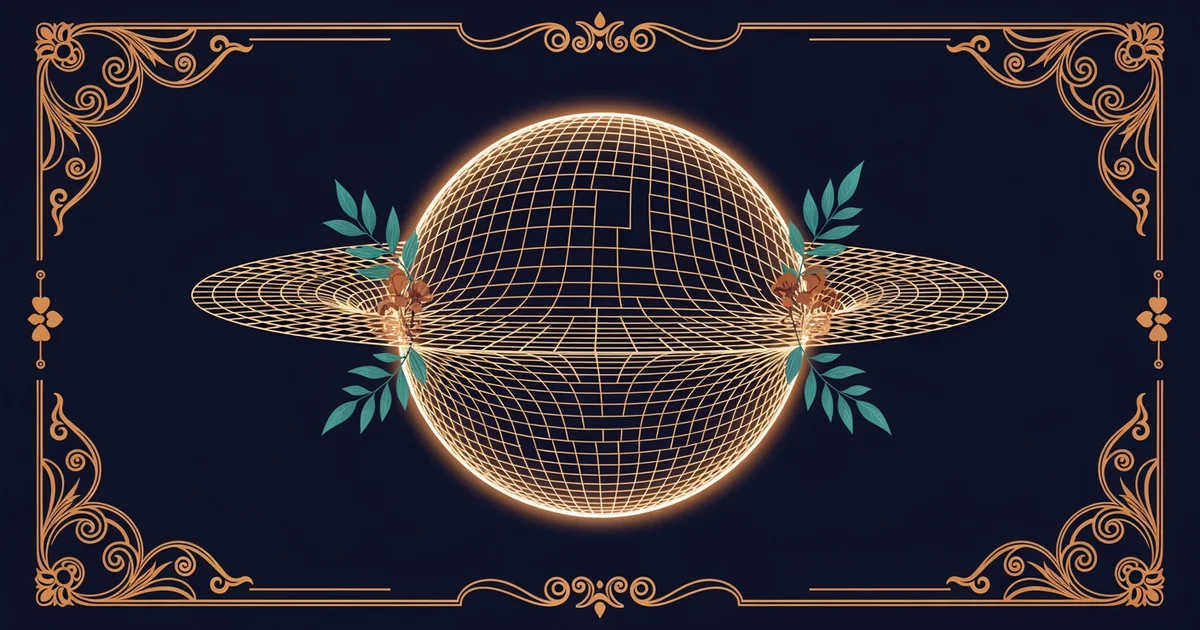
The Nature of Spacetime Curvature
Gravity behaves much like that rubber sheet, where massive objects influence the geometry of the surrounding area. We define this phenomenon as spacetime curvature, which describes how mass and energy dictate the shape of space. Because space is not a flat, empty void, it reacts physically to the presence of matter. Every star, planet, and galaxy acts like an anchor point that pulls the fabric of reality inward. This warping effect is not just a visual trick, but a fundamental property of our universe that dictates how objects move through the void. When you observe a planet orbiting a star, you are seeing it follow a path carved by this curvature. The mass of the star creates a deep well, and the planet travels along the curved edge of that well indefinitely. Without this curvature, objects would simply move in straight lines across the infinite expanse of space forever.
Key term: Spacetime curvature — the physical distortion of the four-dimensional fabric of the universe caused by the presence of mass.
To understand this better, think of a massive anchor placed on a trampoline that is pulled tight. The weight of the anchor forces the surface to sink, creating a slope that changes the path of any object placed nearby. If you roll a ball across the trampoline, it will veer toward the anchor because the surface itself has changed shape. This analogy shows why gravity is not a traditional pulling force, but rather a geometric consequence of matter. The more mass an object contains, the deeper the curvature it produces in the local region of space. This relationship between mass and geometry remains consistent across the entire observable universe, from small asteroids to massive black holes.
Measuring the Effects of Mass
The intensity of this warping effect depends entirely on the density and total mass of the object involved. We can compare how different cosmic entities influence the space around them by looking at their physical properties. The following table illustrates how mass dictates the severity of the warp in the surrounding fabric of reality:
| Object Type | Relative Mass | Curvature Intensity | Effect on Motion |
|---|---|---|---|
| Small Asteroid | Low | Negligible | Minimal path change |
| Solar Star | High | Moderate | Stable orbital paths |
| Neutron Star | Extreme | Severe | Intense light bending |
These variations in mass create distinct environments where the rules of motion are adjusted by the underlying geometry of space. When we examine these differences, we see that the curvature is not uniform throughout the cosmos. Instead, it is highly localized around dense concentrations of matter, which explains why gravity feels stronger near planets than in deep space. Each object carves its own unique path into the fabric, and these paths determine the fate of everything that passes through that region. By studying these interactions, we gain a clear view of how the universe maintains its structural integrity through geometry.
Understanding this curvature is essential because it sets the stage for how time itself behaves in strong gravitational fields. Just as the path of a marble is bent by the shape of the rubber sheet, the flow of time is stretched by the intensity of the gravitational curve. When space is warped deeply, the passage of time also experiences a proportional shift that we can measure with extreme precision. This connection between the shape of space and the duration of an event is what allows us to map the history of the universe. We are effectively living inside a giant geometric puzzle where every piece of mass changes the rules for its neighbors.
Massive objects dictate the geometry of the universe by warping the fabric of spacetime, which forces all nearby matter to follow curved paths.
The next Station introduces time dilation, which determines how this curvature slows down the passage of time near massive objects.