
Light Path Bending
Imagine you are driving a car on a flat road that suddenly curves into a deep dip. Even if you hold the steering wheel straight, your path follows the curve of the road down into the valley. Light rays traveling through space act in a similar way when they encounter a massive object like a star. They do not travel in a straight line because the fabric of space itself is curved by gravity. This phenomenon is known as gravitational lensing and it changes how we see the distant universe.
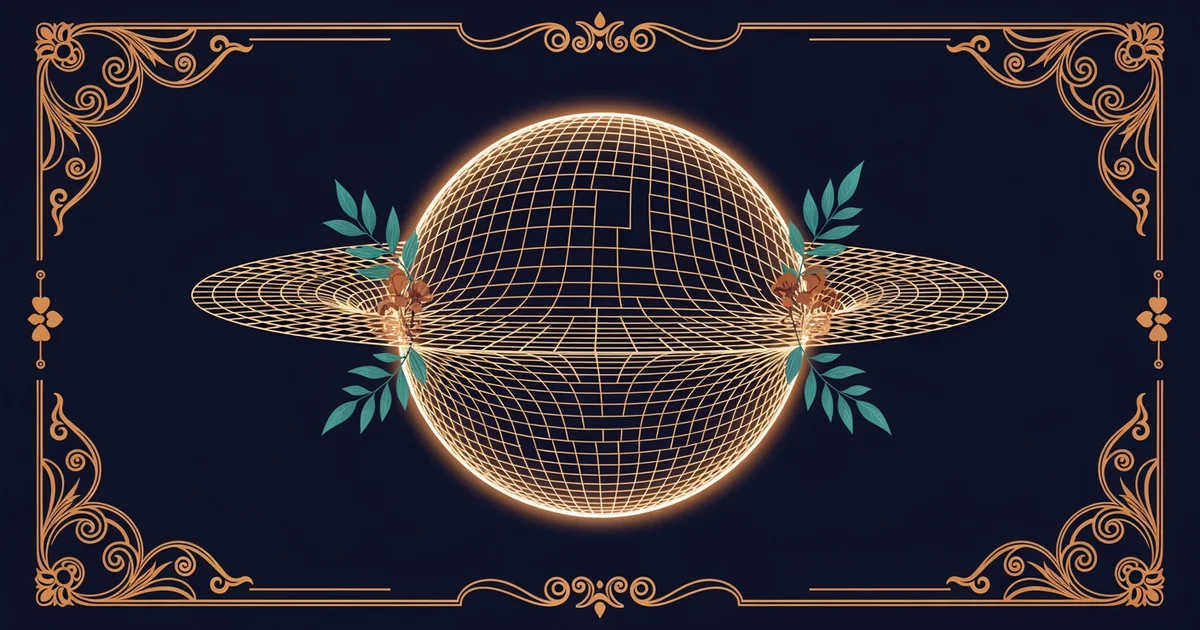
The Geometry of Space Curvature
Gravity acts like a heavy bowling ball placed on a soft rubber sheet. The weight pulls the fabric downward, creating a dip in the surface that forces objects to move along a curved path. Light particles, or photons, always follow the shortest path between two points in space. When space is flat, that path is a straight line, but space is not always flat near massive objects. Because the mass of a star warps the geometry of space, light must follow the curve created by that mass. Think of this like a traveler walking along the curved surface of the Earth. The traveler feels as though they are walking in a straight line, but their path is actually a circle around the globe. In the same way, light follows the contours of space, which causes the light to bend as it passes near a massive star or galaxy.
Key term: Gravitational lensing — the process where the gravity of a massive object bends light passing nearby, acting like a giant cosmic magnifying glass.
Observing the Bending of Light
When we look at distant stars, we often see their light bent by the massive objects located between us and the source. This bending effect can create multiple images of the same object or even distort the light into long, thin arcs. Scientists use these observations to map out invisible matter, such as dark matter, which also exerts gravity and bends light. The degree of bending depends on two main factors that determine the strength of the gravitational influence on the light rays.
Consider the following factors that influence how much a light path shifts during its journey:
- The total mass of the object: A higher mass object creates a deeper curve in space, which forces light to deviate more sharply from its original path.
- The distance of the light path: Light that passes closer to the center of a massive object experiences a stronger pull and bends more than light that stays further away.
- The alignment of the objects: When the source, the lens, and the observer form a perfect line, the light creates a ring shape known as an Einstein ring.
These factors allow astronomers to calculate the mass of objects that are otherwise impossible to see directly. By measuring the distortion of the light, researchers can infer the presence of invisible mass that would otherwise remain hidden from our view. It is much like calculating the weight of an unseen person by observing how much a trampoline surface stretches beneath their feet. Even without seeing the person, the depth of the curve tells you exactly how much weight is pressing down on the fabric.
The Mechanics of Cosmic Magnification
Beyond just bending light, gravity can also act as a natural lens to magnify distant objects. When the light from a very faint, distant galaxy passes near a massive cluster of galaxies, the light is focused toward our telescopes. This creates a brighter image than we could ever see with our standard equipment. This natural magnification allows us to study the earliest stars and galaxies formed in the history of the universe. Without this gravitational boost, many of these ancient structures would be too dim for us to detect with our current technology. The light follows the curvature of space, and by doing so, it reveals secrets about the deep past that would be lost to us forever. We are essentially using the massive structures of the universe as a giant lens to peer into the dark corners of space. This process confirms that gravity does not just pull on matter, but it also shapes the path of light itself.
Massive objects warp the fabric of space, forcing light to follow a curved path that can magnify or distort the images of distant cosmic objects.
Since gravity changes the path of light, how does this affect the way we measure the time it takes for light to travel between two points near a massive object?