
Black Hole Horizons
When a high-speed train enters a narrow tunnel, passengers inside do not notice a change in their own local time. To an observer standing outside the tunnel, however, the train appears to stretch and slow down as it enters the dark passage. This phenomenon mirrors how gravity affects the fabric of space near a massive object. We call this effect time dilation, a core concept established in Station 11 that dictates how clocks behave near intense gravitational fields. Near a black hole, this effect becomes extreme, turning the space around the object into a place where time behaves in ways that defy our daily experience.
The Boundary of No Return
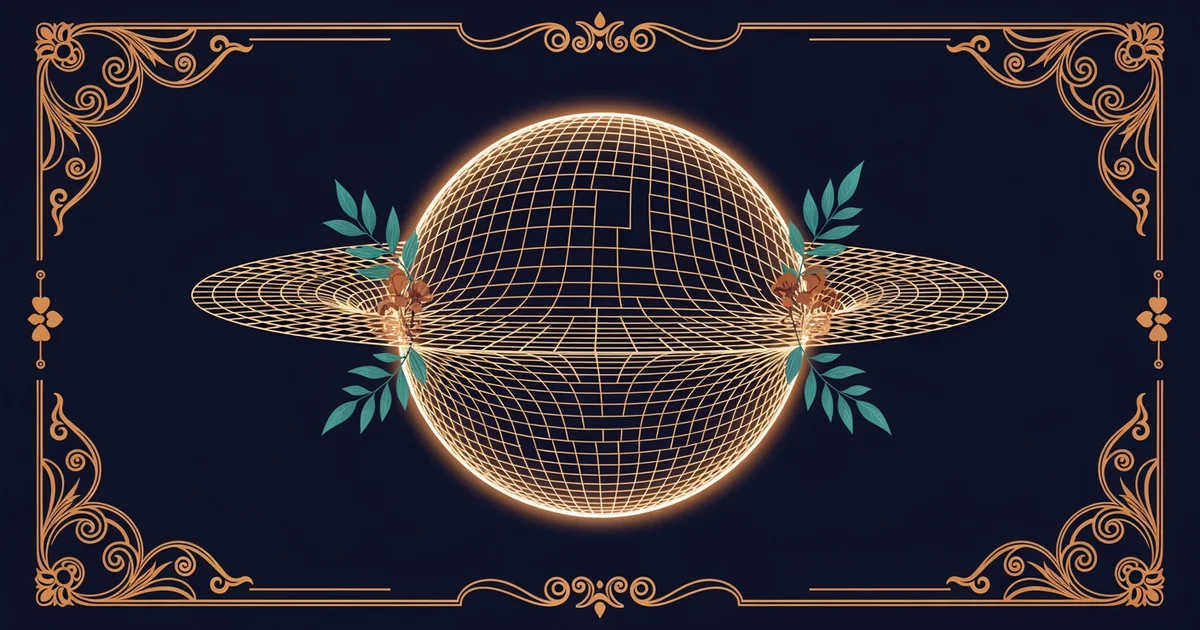
Every black hole possesses a specific point of no return known as the event horizon. This boundary marks the distance where the gravitational pull becomes so strong that nothing, not even light, can escape the inward drag. As an object approaches this invisible sphere, the gravitational field becomes increasingly intense, which forces time to slow down significantly. Imagine a clock falling toward this horizon while you watch from a safe distance far away. The closer the clock gets to the edge, the slower the ticking appears to your eyes, eventually seeming to freeze completely as it reaches the threshold.
Key term: Event horizon — the spherical boundary around a black hole beyond which the gravitational pull is so strong that no matter or light can escape.
This behavior occurs because gravity warps the geometry of space and time together. Near the horizon, the curvature of space is so steep that the path of time itself becomes distorted for any outside observer. While the person falling toward the black hole feels time passing normally, their journey takes an eternity from your perspective. The intense gravity stretches the duration of every second, making the process of falling take much longer than it would in empty space.
Visualizing Time at the Edge
To understand how this works, we must compare the experience of the falling observer to the stationary observer. The table below illustrates how the perceived flow of time changes based on the distance from the center of the black hole.
| Distance from Center | Perceived Time Speed | Gravitational Intensity |
|---|---|---|
| Far Away | Normal Speed | Very Low |
| Near Horizon | Significantly Slower | Extremely High |
| At Event Horizon | Appears Frozen | Infinite Potential |
This table highlights the relationship between space and time near massive objects. As the gravitational intensity climbs, the speed of time drops relative to the outside world. This is not a mechanical failure of the clock but a fundamental change in the structure of the universe caused by the massive concentration of matter at the center. The closer you move toward the singularity, the more extreme the warping of time becomes, effectively isolating the interior from the rest of the universe.
The Practical Reality of Gravity
This effect is not merely a theoretical curiosity, as it represents the same physics we observe with satellite clocks in orbit. The difference lies in the scale of the mass involved in the system. While the Earth causes a tiny shift in time for GPS satellites, a black hole generates a massive field that forces time to crawl. If you were to hover near the event horizon, your watch would tick much slower than the watches of your friends back home. You would return from a short trip to find that centuries had passed on Earth, simply because you spent time in a region where the gravitational pull was strong enough to warp the flow of time itself.
Everything near the horizon experiences this stretching of time because the gravitational potential is so deep. This is the ultimate application of the principles we explored in the previous station regarding synchronization. Gravity acts as a master clock, and the closer you get to a massive object, the slower your clock runs compared to everyone else in the galaxy. This reality forces us to rethink our definition of a universal "now" because time is relative to the gravitational environment of the observer.
Time flows at different speeds depending on how close an object is to a massive gravitational source like a black hole.
But this model of static time dilation becomes much more complex when we account for the rapid rotation of the black hole itself.