
Detecting Invisible Objects
When a city experiences a sudden power blackout at night, observers identify the dark region by noticing the silhouette of buildings against the dim starlight. This scenario demonstrates how we recognize the presence of an object by observing the absence of light in its immediate surroundings. Astronomers apply this same logic when they hunt for black holes, which emit no light of their own. Because these objects remain invisible to standard telescopes, researchers must rely on indirect evidence to confirm their existence. By studying how gravity affects nearby matter, scientists can map the location and mass of these mysterious cosmic voids.
Observing Gravitational Influence
Gravity acts as the primary tool for detecting invisible black holes within our expansive galaxy. When a star orbits an empty patch of space, the movement suggests that a massive, unseen object exerts a powerful gravitational pull. This process mirrors how a hidden anchor holds a ship steady against strong ocean currents, even if the anchor remains below the surface. By tracking the velocity and orbital path of the visible star, astronomers calculate the mass of the hidden companion. If the calculated mass exceeds the limit for a neutron star, the object is likely a black hole.
Key term: Accretion disk — the rotating structure of gas and dust that forms around a massive body, heating up as it spirals inward toward the event horizon.
Detecting High-Energy Radiation
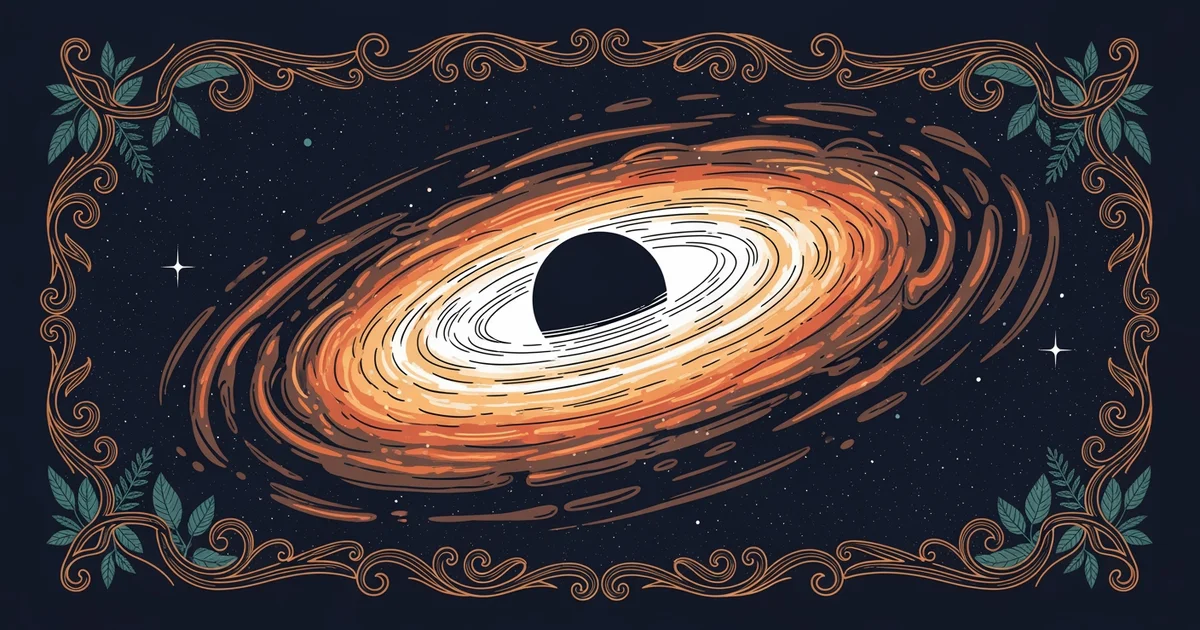
Beyond gravitational effects, the process of matter falling into a black hole creates distinct signatures that telescopes can detect. As gas spirals inward, it forms an accretion disk that generates intense friction and heat. This friction accelerates particles to extreme speeds, causing the gas to emit powerful X-rays before it crosses the point of no return. While the black hole itself remains dark, this glowing disk acts like a neon sign in the dark, marking the location of the invisible trap. Detecting these X-rays allows scientists to study the environment near the event horizon with great precision.
| Observation Method | Primary Indicator | Physical Process |
|---|---|---|
| Stellar Orbits | Velocity shifts | Gravitational pull |
| X-ray Emission | Thermal radiation | Accretion friction |
| Gravitational Lensing | Light distortion | Spacetime bending |
Mapping Spacetime Distortions
Light traveling from distant stars often bends when it passes near a massive, invisible object. This phenomenon, known as gravitational lensing, occurs because the intense gravity of a black hole warps the fabric of space itself. Just as a glass lens bends light to focus an image, the gravitational field of a black hole acts as a cosmic magnifying glass. Astronomers look for sudden, temporary flashes or distortions in the brightness of background stars. These visual anomalies provide evidence that a dense, invisible mass sits directly between the observer and the distant light source.
These methods allow researchers to overcome the challenge of invisibility in deep space. By combining data from orbital speeds, X-ray emissions, and light distortion, scientists build a complete picture of these hidden giants. This approach mirrors how detectives use fingerprints to identify a suspect who has already left the room, relying on traces left behind in the environment. Each piece of evidence confirms the presence of an object that defies direct observation but dominates its local neighborhood through sheer gravitational force. These techniques have transformed our understanding of how invisible entities influence the structure of the entire universe.
Black holes are located by measuring how their intense gravity alters the movement and light of nearby visible celestial objects.
But these indirect detection methods face significant challenges when observing black holes that are not currently consuming nearby matter.