
Supermassive Black Holes
When researchers at the Event Horizon Telescope project captured the first image of a galactic core in 2019, they revealed a dark void surrounded by a glowing ring of superheated gas. This massive dark region exists at the center of the galaxy known as Messier 87, demonstrating that gravity can dominate the structure of an entire stellar system. While small stellar black holes form from dying stars, a supermassive black hole acts as the anchor for an entire galaxy. These giants hold millions or even billions of times the mass of our sun within a relatively compact space. Understanding how they influence their surroundings helps us grasp the evolution of the universe across billions of years.
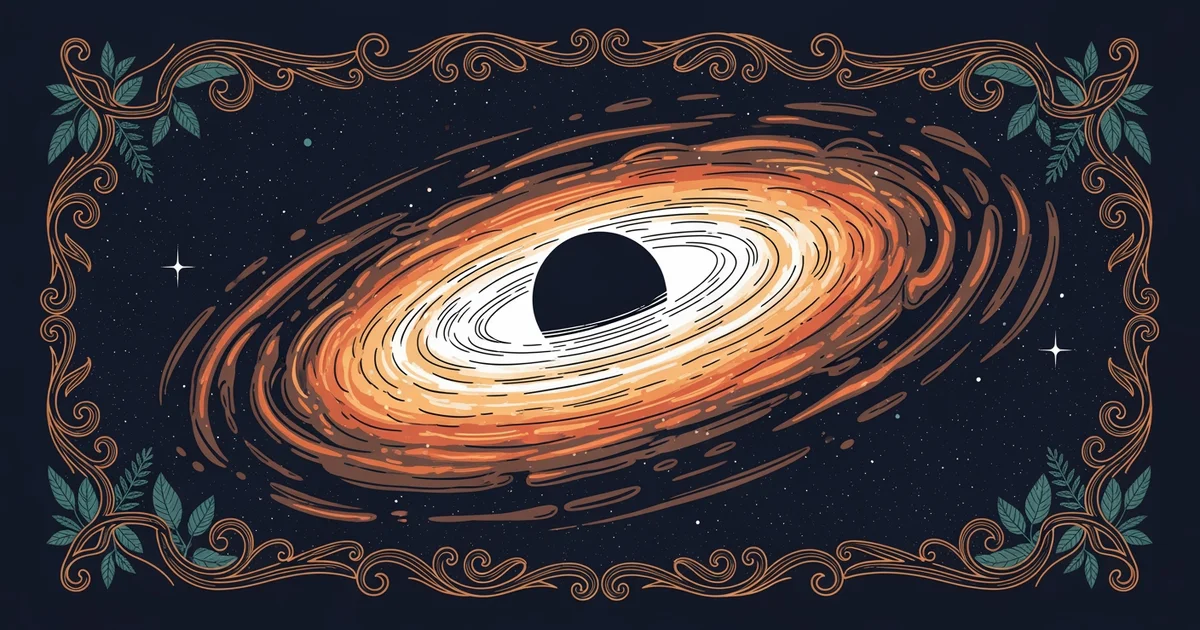
The Scale of Galactic Anchors
Because these objects are so incredibly dense, they shape the orbits of every star and gas cloud within their reach. Think of a crowded dance floor where a heavy, spinning platform sits in the middle and pulls everyone toward the center. If the platform spins slowly, dancers move in smooth circles, but if it speeds up, it flings energy outward. A supermassive black hole behaves like this platform by regulating how quickly a galaxy can create new stars. When the black hole consumes nearby matter, it releases intense radiation that can heat up surrounding gas clouds. This process prevents the gas from cooling down enough to collapse into new stars, effectively slowing down the growth of the galaxy.
Key term: Supermassive black hole — an extremely dense region at the center of a galaxy that contains millions or billions of solar masses.
Unlike the smaller stellar black holes discussed in Station 11, these behemoths do not just emerge from the collapse of a single star. Scientists believe they grow over time by merging with other black holes and consuming vast amounts of interstellar gas. This growth happens in tandem with the galaxy itself, creating a balanced relationship where the black hole and the galaxy evolve together. The gravitational influence of these objects is so strong that it dictates the speed at which stars rotate around the galactic center. Without this central anchor, the stars would likely drift apart, and the galaxy would lose its defined structure and spiral shape.
Comparing Galactic Centers and Stellar Objects
To understand the difference between these two types of gravity wells, we can compare their physical properties and their impact on the local environment. While stellar black holes are the remnants of individual massive stars, supermassive versions are the architects of galactic architecture. The following table highlights the key differences between these two types of objects:
| Property | Stellar Black Hole | Supermassive Black Hole |
|---|---|---|
| Origin | Collapsed star | Multi-stage growth |
| Typical Mass | 5 to 50 | to |
| Location | Throughout the galaxy | Center of the galaxy |
| Influence | Localized gravity | Galactic scale stability |
These differences show that while the physics of the event horizon remains the same, the sheer scale of the supermassive variety changes the outcome. A stellar black hole is like a small stone dropped in a pond, creating ripples that quickly fade away. A supermassive black hole is like a massive concrete pillar driven into the lake bed, permanently altering the flow of the entire water system. This distinction is vital for astronomers who map the history of the cosmos. By studying these differences, researchers can determine how galaxies maintain their shape over immense periods of time.
Finally, the presence of these objects explains why some galaxies appear very active while others remain quiet and dormant. If a supermassive black hole is actively pulling in gas, it creates a bright, energetic core known as an active galactic nucleus. This energy release is so powerful that it can outshine all the stars in the host galaxy combined. This is the application of gravity on a grand scale, proving that invisible objects are the most powerful forces in our universe.
Supermassive black holes serve as the primary gravitational anchors that regulate the structure, growth, and star-forming activity of entire galaxies.
But the immense energy released by these active galactic centers creates ripples in spacetime that we are only just beginning to detect through gravitational wave astronomy.