
Relativistic Time Dilation
Imagine you are holding two identical stopwatches while standing near a massive, heavy object. If you leave one watch on the ground and take the other into deep space, they will eventually show different times. This strange phenomenon happens because gravity acts like a thick syrup that slows down the flow of time itself. While we usually think of time as a constant tick that never changes, physics tells us that gravity warps the fabric of reality. You might feel like your day is moving at a steady pace, but space and time are linked in a dance where gravity dictates the speed of the music.
The Nature of Gravitational Time Distortion
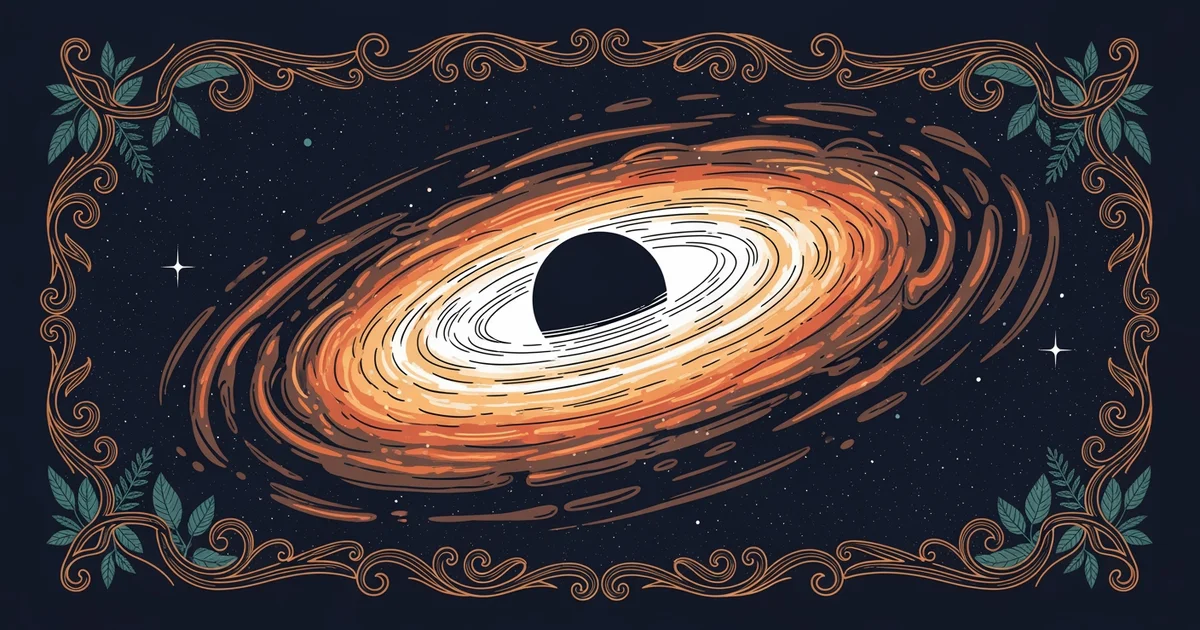
Gravity does not just pull on physical objects; it exerts a measurable influence on the passage of time. This effect, known as gravitational time dilation, means that time moves slower as you get closer to a massive source of gravity. If you were to stand near a black hole, your clock would tick much slower than a clock located far away in empty space. The closer you get to the center of the gravitational pull, the more pronounced this delay becomes for your local perspective. Because the mass of a black hole is so immense, the distortion of time becomes extreme and impossible to ignore.
Key term: Gravitational time dilation — the physical phenomenon where time passes at different rates depending on the strength of the surrounding gravitational field.
Think of this effect like a person walking through deep water compared to someone walking on dry land. The person in the water must work much harder to move forward because the medium is thick and resistant to motion. In this analogy, the gravity of a black hole acts like that thick water, while the open vacuum of space acts like the dry land. Just as the swimmer in the water moves slower than the runner on land, a clock near a black hole records fewer seconds than a clock in deep space. Both clocks are working perfectly, but the environment around them changes the rate at which they experience time.
Comparing Time Rates Across Distances
To understand how this impact works in practice, we must compare the experience of observers at different distances from a heavy object. The following table highlights how gravity changes the perception of time for an observer based on their proximity to a massive body like a black hole.
| Location of Observer | Gravitational Strength | Rate of Time Passage |
|---|---|---|
| Deep space far away | Negligible | Standard rate |
| Near event horizon | Extremely high | Significantly slower |
| Inside the singularity | Infinite | Effectively frozen |
This comparison shows that as you move closer to the source of gravity, the rate of time passage drops significantly. An observer far away would see your movements near a black hole as being in slow motion, even though you would feel like you are moving normally. This happens because the gravitational field bends the space-time fabric, forcing time to stretch out over longer intervals. You are not just seeing light move differently; you are witnessing the actual stretching of the seconds and minutes themselves.
It is important to note that this is not a mechanical failure of your watch or a trick of your eyes. The very nature of time is flexible and depends entirely on the strength of the gravitational field you currently occupy. If you were to return from a trip near a black hole, you would find that much more time had passed for your friends back on Earth. You would have effectively traveled into the future compared to those who stayed in a weaker gravitational field. This reality is a fundamental feature of the universe that defines how gravity shapes our existence in space.
Gravitational time dilation proves that time is not a fixed constant but a flexible dimension that slows down as gravity becomes more intense.
The next Station introduces spaghettification, which determines how extreme gravity affects the physical structure of objects.