
Defining the Event Horizon
Imagine you are standing on a boat near a massive waterfall that is pulling everything toward the edge. If you paddle away from the edge faster than the water flows, you can escape the drop easily. However, once you cross the invisible line where the water flows faster than your top paddling speed, you will surely go over the edge. This invisible line is exactly how scientists describe the boundary around a black hole. It marks the point where the pull of gravity becomes so strong that no speed, not even the speed of light, is enough to break free.
The Gravity Boundary
Gravity acts like a cosmic anchor that pulls objects toward a center point. For most stars, this pull is weak enough that light can travel away from them without any trouble at all. A black hole is different because it packs a huge amount of mass into a tiny space. This creates a region of space where gravity is so intense that the required speed to leave is higher than the speed of light. Since nothing in the universe moves faster than light, this boundary acts as a one-way door into the dark center.
Key term: Event horizon — the theoretical boundary surrounding a black hole beyond which nothing, not even light, can escape the gravitational pull.
When we look at this boundary, we must understand that it is not a physical surface like the ground on a planet. It is a mathematical region in space where the rules of physics change for anything that enters. If you were to cross this line, you would never be able to send a signal back to the outside world. The light from your ship would be trapped by the intense curvature of space itself. This makes the region invisible to our eyes because no light can bounce off it or escape from within it.
Measuring the Point of No Return
Scientists use specific calculations to find where this boundary sits for any given object in the universe. The size of this region depends entirely on the mass of the black hole at the center. A black hole with more mass will have a larger boundary because it exerts a stronger pull over a wider area. We can compare how different amounts of mass affect the reach of this gravitational trap in the table below.
| Object Type | Relative Mass | Boundary Reach |
|---|---|---|
| Small Star | Very narrow | |
| Large Star | Moderate size | |
| Supermassive | Extremely wide |
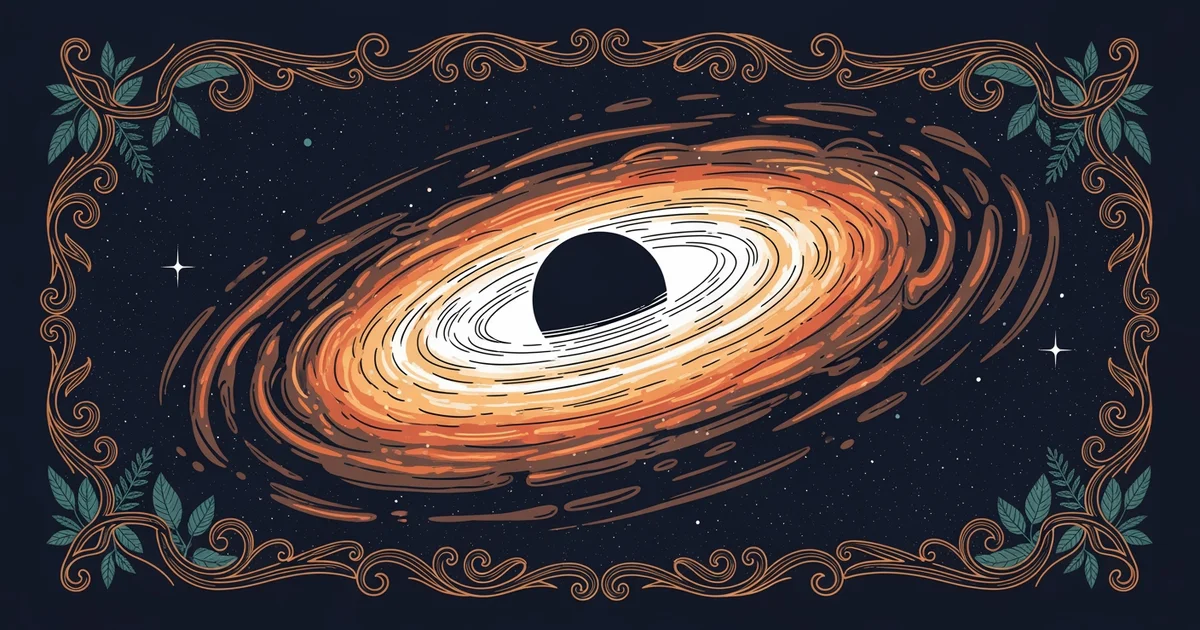
Understanding these differences helps us grasp why some black holes have a much larger influence on their surroundings. A larger boundary means that objects are captured from much further away than they would be for a smaller one. This explains why we see matter swirling around these regions long before it actually crosses the final threshold. The matter gathers speed as it falls, creating a glowing disk that reveals the location of the dark void hidden within.
To visualize this, consider the following traits of the boundary:
- The boundary acts as a permanent barrier that prevents any information from leaving the interior region of the black hole.
- The escape velocity at this specific line is exactly equal to the speed of light, which is the cosmic limit.
- Any object that touches this line is locked into a path that leads directly toward the center of the mass.
Because we cannot see inside this region, we rely on the behavior of light and matter near the edge to study it. The way that light bends around this area gives us clues about the strength of the gravity nearby. We know that the boundary exists because we observe the effects of this extreme gravity on nearby stars and gas clouds. These observations confirm that the boundary is a real feature of the universe even if it remains hidden from our direct view. We are essentially watching the shadows cast by an object that refuses to let any light escape its grasp.
The event horizon represents the critical threshold where the gravitational pull becomes so powerful that the speed of light is no longer sufficient to escape.
Now that we have defined the boundary, we must explore what happens to the matter that falls into the singularity hidden deep inside.