
Schwarzschild Radius
Imagine you are trying to escape the powerful grip of a giant magnet while wearing heavy metal boots. The closer you get to the center of the magnetic field, the harder it becomes for you to walk away. This same logic applies to gravity near a massive object like a black hole where the pull becomes inescapable.
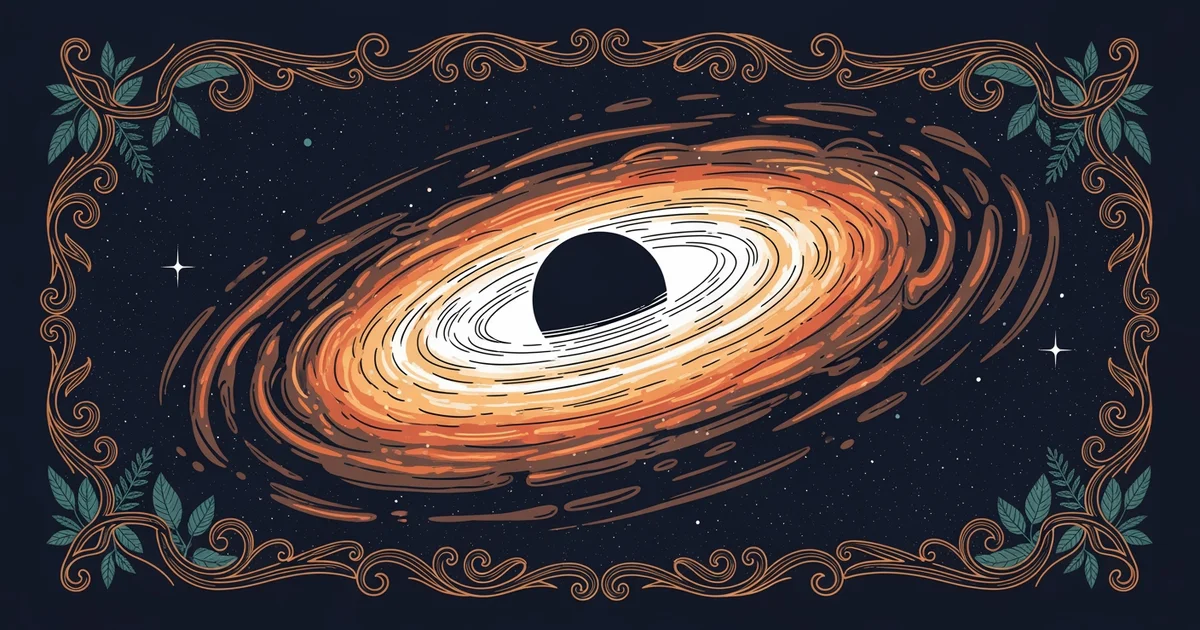
Understanding the Event Horizon
When we talk about the boundary of a black hole, we are looking at the Schwarzschild radius. This specific distance marks the point of no return for any matter or light passing nearby. Once an object crosses this invisible sphere, the gravitational force becomes so intense that escape is impossible. You can think of this like a waterfall where the current moves faster than a boat can travel. If the boat drifts past the edge, no amount of engine power will allow it to swim back upstream. The size of this radius depends entirely on the mass of the object being compressed into the center.
Key term: Schwarzschild radius — the critical distance from the center of a non-rotating massive object where the escape velocity equals the speed of light.
Because light itself cannot move faster than its constant speed, it cannot climb out of this deep gravitational well. This radius acts as a cosmic gatekeeper that separates the internal singularity from the rest of the universe. If you were to squeeze the entire mass of the Earth into a tiny marble, its radius would be very small. However, a massive star would have a much larger radius because it contains more total matter.
Calculating the Critical Distance
To find this distance for any object, scientists use a standard formula based on its total mass. The mass of the object is multiplied by the gravitational constant and then divided by the speed of light squared. This relationship shows that the size of the event horizon grows in direct proportion to the mass involved.
| Object Type | Approximate Mass | Schwarzschild Radius |
|---|---|---|
| Small Asteroid | kg | meters |
| Earth | kg | meters |
| Sun | kg | meters |
As you can see from the table above, the radius remains quite small unless the mass is truly massive. The formula for this calculation is expressed as follows:
In this equation, represents the universal gravitational constant, is the mass of the object, and is the speed of light. Because the speed of light is so incredibly fast, the denominator in this equation is a very large number. This explains why most objects in the universe do not turn into black holes under normal conditions. Only when matter is crushed by extreme pressures does this radius become a physical reality for the object. By studying these values, astronomers can determine if a distant star has the potential to collapse into a black hole.
Understanding these scales helps us map the hidden regions of space where light refuses to travel. We use these calculations to predict how stars end their lives and how gravity shapes the galaxies around us. Every massive body has a potential radius, but only those that collapse completely reach this state.
The Schwarzschild radius defines the exact distance where gravity becomes so strong that light can no longer escape the pull of a massive object.
The next Station introduces Accretion Disk Dynamics, which determines how glowing matter swirls around the outside of this dark boundary.