
Singularity Physics
Imagine a heavy bowling ball resting on a soft mattress, creating a deep depression that pulls nearby marbles toward the center. If you keep adding weight to that single point, the fabric eventually stretches so thin that it tears, creating a bottomless pit where the surface geometry vanishes entirely. This is how physicists visualize a gravitational singularity, the heart of a collapsed star where matter is crushed into a point of infinite density. While common objects occupy space and possess a measurable volume, the singularity defies these physical rules by squeezing massive amounts of stellar material into a region with zero volume. Because the density becomes infinite at this specific location, the curvature of spacetime around it becomes so extreme that traditional laws of physics simply break down.
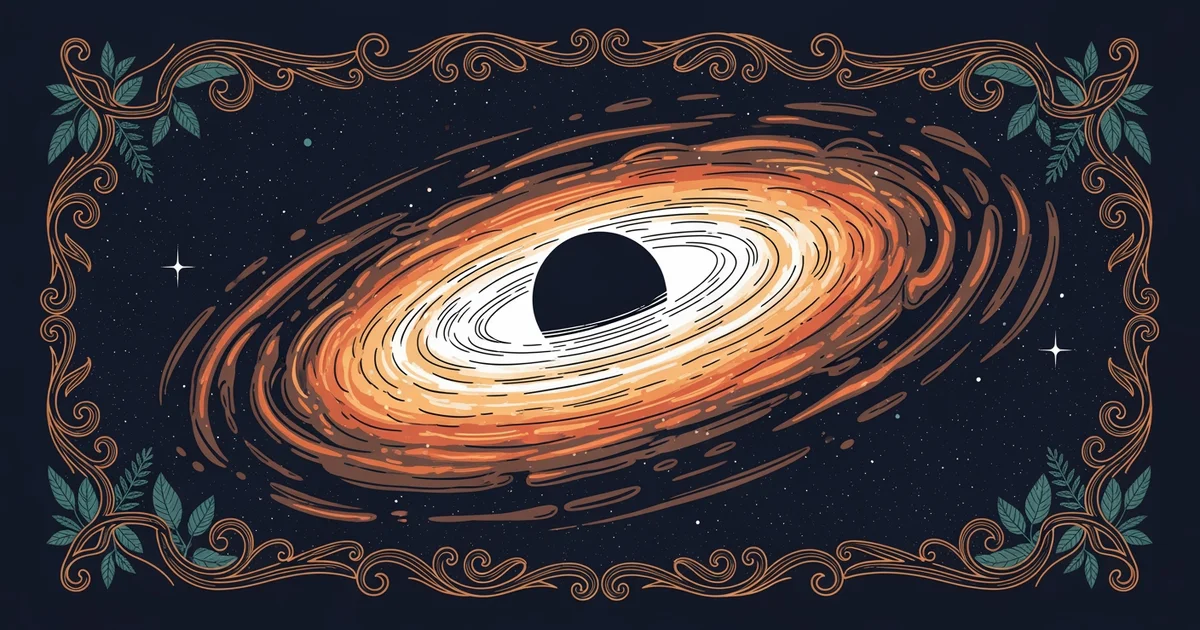
The Anatomy of Infinite Density
When a massive star exhausts its nuclear fuel, the internal pressure that once fought against gravity suddenly vanishes, leading to a total collapse of the core. As the star shrinks inward, the density rises to levels that challenge our current understanding of how matter behaves under extreme conditions. The singularity represents the final stage of this process, where the gravitational pull becomes so strong that even light particles cannot escape the inward drag. Unlike the event horizon, which marks the boundary of no return, the singularity is the actual location where the mass of the star resides. It acts as a gravitational anchor, pulling everything within its reach toward a single, dimensionless point of impossible concentration.
Key term: Gravitational singularity — a point of zero volume and infinite density where the standard laws of physics fail to describe the state of matter.
To understand why this is so strange, consider the difference between a dense crowd at a concert and a single person in an elevator. In a crowd, every person occupies a specific amount of space, and there is a limit to how many people can fit before the room is full. A singularity is like forcing every person in the entire world into a space smaller than a single atom, yet they still maintain their mass. This comparison highlights the absurdity of infinite density, as it forces us to rethink how particles interact when they are pushed beyond the limits of physical reality.
Challenging the Laws of Nature
Because the singularity exists in a state where space and time are warped to their absolute limits, our current mathematical models produce results that do not make sense in the real world. When scientists plug the values for a singularity into their equations, they often receive answers of infinity, which usually indicates that a theory is missing a critical piece of information. This tension suggests that we need a new framework, often called quantum gravity, to explain how the smallest pieces of the universe interact with the strongest gravitational forces. Without this unified theory, the singularity remains a mysterious "point of failure" in our map of the cosmos.
| Feature | Physical Object | Gravitational Singularity |
|---|---|---|
| Volume | Measurable | Zero |
| Density | Finite | Infinite |
| Physics | Predictable | Breaks down |
As shown in the table above, the singularity is not just a very small object, but a fundamental change in the nature of reality. It forces us to confront the fact that our understanding of gravity, while excellent for planets and stars, is incomplete when applied to the extreme environment of a black hole. We must continue to look for ways to bridge the gap between gravity and the quantum world to truly grasp what happens at this central point. By studying these extreme conditions, scientists hope to uncover new rules that govern the universe at its most fundamental level.
A gravitational singularity is a point of zero volume and infinite density where the known laws of physics cease to function as they do in the rest of the universe.
The next Station introduces Schwarzschild Radius, which determines how distance from the center affects the gravitational pull of a black hole.