
Hawking Radiation
Imagine a bank account that slowly loses money every time you look away from your balance. Even without making any withdrawals, your funds disappear because of the way the banking system functions. Black holes work in a similar way, as they constantly lose tiny amounts of energy through a strange process. This process happens at the boundary where space and time become extremely distorted and intense.
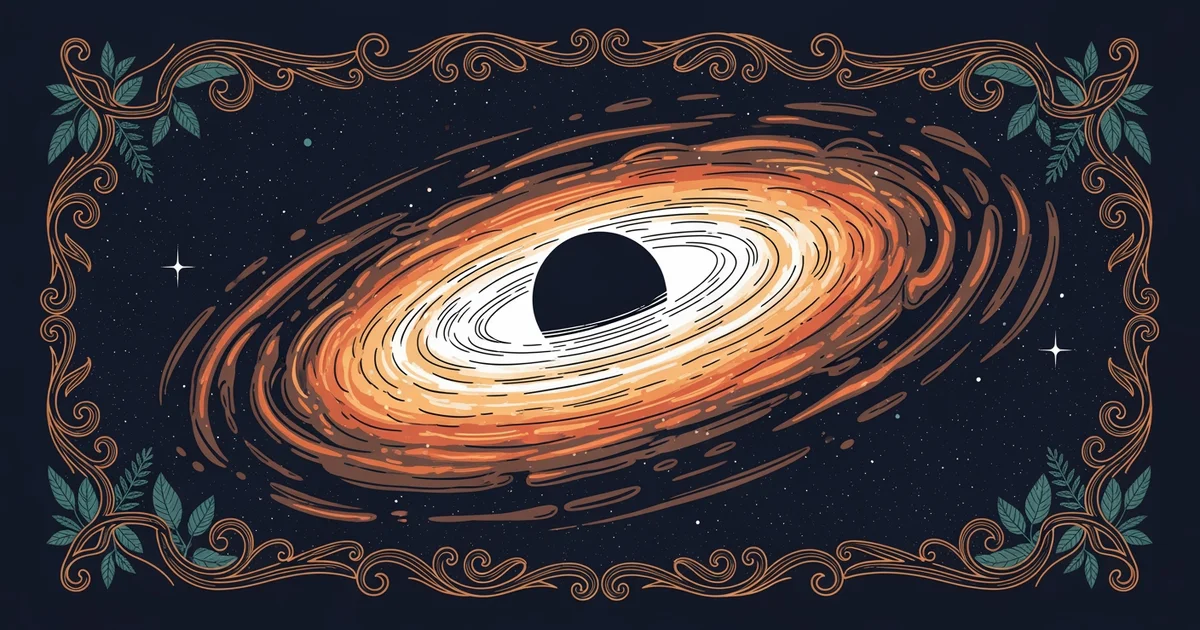
The Quantum Nature of Vacuum Space
Space is not truly empty, even in the deep voids between distant star systems. At a very small scale, the vacuum of space constantly bubbles with energy fluctuations. Pairs of virtual particles appear briefly and then collide to destroy each other almost instantly. This activity is a core feature of the universe that persists everywhere, including near the edge of a massive black hole. When these pairs appear near the event horizon, the intense gravity can pull one particle inside while the other escapes into space. This separation prevents the pair from reuniting, which forces the escaped particle to become real energy. Because the black hole provides the energy for this process, it slowly loses mass over time.
Key term: Hawking Radiation — the thermal energy emitted by black holes due to quantum effects near the event horizon.
This leakage of energy happens because the black hole must balance its total energy budget. When a particle falls inward, it carries negative energy relative to the outside observer. This effectively subtracts from the total mass of the black hole, causing it to shrink. While this process is incredibly slow for large objects, it becomes faster as a black hole loses mass. The smaller a black hole becomes, the more rapidly it radiates energy away into the surrounding universe. This cycle continues until the black hole eventually disappears entirely in a final burst of light.
Understanding Energy Loss Mechanics
To visualize how this works, consider the following breakdown of the evaporation process occurring at the boundary of the hole:
- Quantum fluctuations create particle-antiparticle pairs constantly throughout the vacuum of space, which usually annihilate each other before they can be detected.
- The extreme gravitational gradient near the event horizon separates these pairs before they can collide, effectively preventing their mutual destruction from happening.
- One particle falls beyond the point of no return, while the other particle gains enough energy to escape into the wider universe as radiation.
- The black hole loses a tiny fraction of its total mass to pay for the energy of the escaping particle, leading to a slow but steady evaporation.
| Stage | Action | Result for Black Hole |
|---|---|---|
| Initial | Pair creation | No change in mass |
| Separation | Gravity pulls one | Tiny mass decrease |
| Emission | Particle escapes | Slow energy loss |
| Final | Total evaporation | Complete disappearance |
This table illustrates that the loss of mass is a direct consequence of the energy required to create the escaping particles. As the black hole gives up mass to the universe, it must shrink in size. This behavior is quite different from how we usually think of gravity, which typically pulls matter inward rather than pushing energy outward. The radiation process is essentially a slow leak that eventually drains the entire object of its stored gravitational energy. Over vast periods of time, even the most massive black holes will fade away completely into the void. This discovery changed how experts understand the lifespan of the largest objects in our galaxy.
Black holes lose mass over time because quantum effects near their boundary force them to emit energy into space.
But if these objects are slowly leaking energy into the dark, how can we actually find them if they are invisible to our telescopes?