
Cosmic Structure Formation
Imagine a vast, silent room filled with millions of floating dust motes that slowly begin to clump together. This simple dance of attraction mirrors how the early universe transformed from a smooth soup of particles into the complex web of galaxies we observe today. Gravity acts as the invisible architect of this grand design, pulling matter into dense regions while leaving vast voids in between. Without this constant tugging force, the universe would remain a cold, uniform expanse of gas forever. Understanding this process requires us to look at how tiny variations in density became the seeds for everything that exists in our night sky.
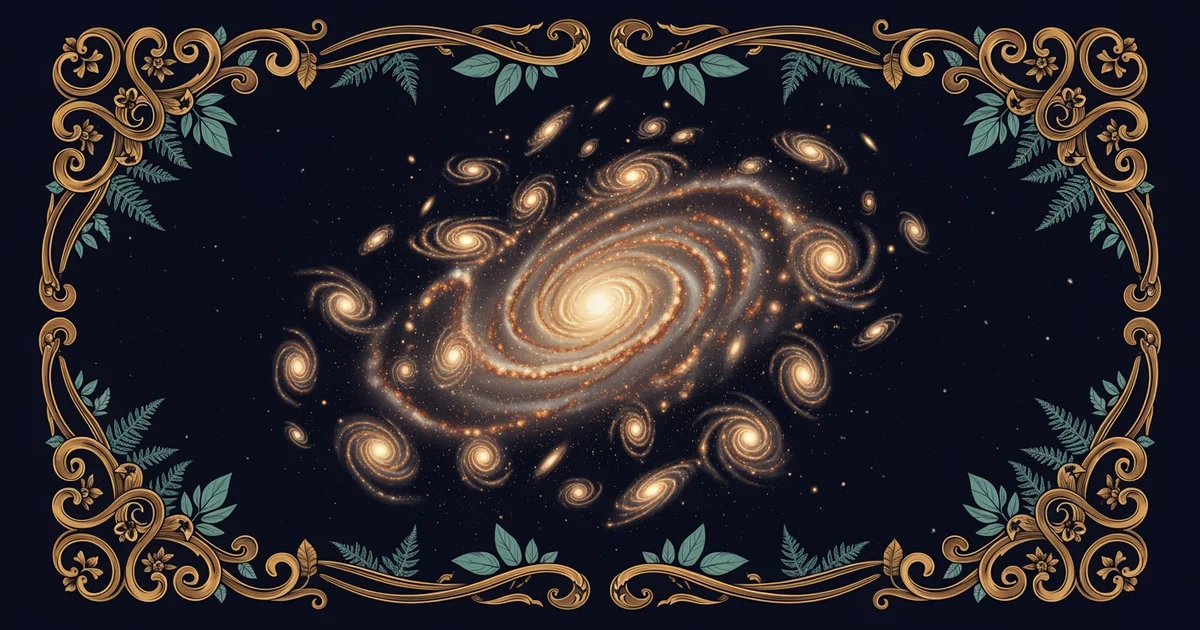
The Origin of Cosmic Seeds
During the earliest moments after the big bang, the universe was incredibly hot and packed with energy. It was not perfectly smooth, because tiny fluctuations in density existed throughout the early cosmic gas. These small ripples acted like the first uneven patches on a smooth surface that eventually cause a fabric to bunch up. Gravity seized these slightly denser regions, pulling in more matter from the surrounding areas to increase their mass. As these regions grew heavier, their gravitational pull became even stronger, creating a cycle of rapid growth. This process is much like a small snowball rolling down a snowy hill, where each turn gathers more snow and increases the size of the ball.
Key term: Density fluctuations — the tiny, uneven variations in the distribution of matter in the early universe that allowed gravity to begin building structures.
This growth happened over billions of years, slowly shaping the landscape of the cosmos into what we see now. The gas clouds began to collapse under their own weight, reaching temperatures high enough to ignite the first stars. These stars gathered into groups, which eventually merged to form the massive systems we call galaxies. The following list outlines the primary stages of this structural development:
- Initial density ripples provided the gravitational foundation for matter to accumulate into larger, more distinct clumps.
- Gas clouds collapsed within these regions, triggering the birth of the first stars that illuminated the dark early universe.
- Galactic mergers occurred as gravity pulled smaller star clusters together to build the massive, complex galaxies we see today.
Gravity and the Large Scale Web
Gravity does not work in isolation, as it shapes the universe into a sprawling web of filaments and voids. The matter we see is actually concentrated along thin, bridge-like structures that connect massive galactic clusters across space. Between these busy filaments lie vast, empty regions where almost no matter exists, acting like the hollow spaces inside a sponge. This structure is often called the cosmic web, representing the final result of billions of years of gravitational evolution. The distribution of this matter follows a specific pattern that scientists map to understand how the universe expands and changes over time. By looking at the spacing of these filaments, we can infer the strength of the forces that drove them apart.
| Feature | Role in Structure | Resulting Effect |
|---|---|---|
| Density Ripples | Starting seeds | Initial mass gathering |
| Gas Clouds | Star formation | Light and heat production |
| Filaments | Matter pathways | Large scale connectivity |
Every galaxy is a testament to the power of gravity, which continues to organize the universe into these complex shapes. The movement of matter is a slow, methodical process that turns simple gas into the intricate systems supporting planets and stars. As we analyze these patterns, we gain insight into the fundamental laws governing the evolution of all physical space. The transition from a smooth, uniform state to a structured, vibrant universe is the result of constant gravitational interaction. We are essentially living inside the remnants of this ancient process, surrounded by the structures that formed when the universe was young and evolving.
The formation of cosmic structures is a self-reinforcing process where gravity amplifies tiny initial density variations into the vast, interconnected web of galaxies seen today.
But how does the mysterious acceleration of space influence the way these structures continue to grow over time?