
Defining Our Universal Origins
Imagine you are holding a small, unlit candle in a room that is completely dark. You strike a single match, and suddenly the light reveals the entire room around you in one brief moment. This is how scientists view the birth of our universe, as a sudden expansion from a tiny point into everything we see today. We often look at the night sky and see stars as static, permanent objects that have always existed in their current places. However, modern science shows us that these stars are actually part of a dynamic, shifting process that started billions of years ago.
The Expansion of Space
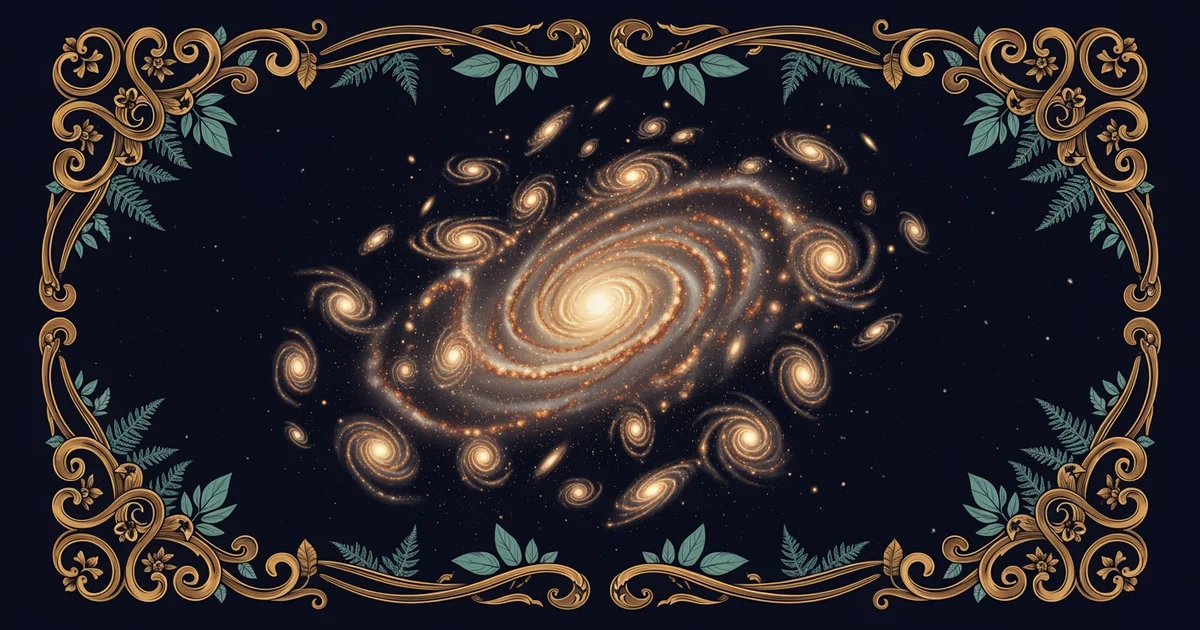
To understand the origins of the universe, we must first accept that space itself is not a fixed container. Think of the universe like a loaf of bread rising in a warm oven with raisins scattered inside it. As the dough expands, the raisins move further away from each other even though they are not moving through the dough. This analogy helps us visualize how the Big Bang works as a rapid expansion of space itself. It was not an explosion that threw matter into empty space, but rather the sudden stretching of space that carried all matter along with it. This expansion continues today, which means that galaxies are moving away from each other at incredible speeds. By measuring this movement, we can calculate how much time has passed since the universe was just a tiny, dense point of energy.
Key term: Big Bang — the theoretical event marking the rapid expansion of the early universe from an extremely dense and hot state.
The Evolution of Matter
Once the early universe began to expand, it also began to cool down significantly over long periods. This cooling process was necessary for the formation of the first simple atoms like hydrogen and helium. These atoms eventually clumped together because of gravity, creating the very first stars that lit up the darkness of space. These stars acted like giant cosmic factories that forged heavier elements inside their burning cores over millions of years. When these stars reached the end of their lives, they exploded and scattered these new elements across the vast reaches of space. This cycle of birth and death is the primary reason why we have planets, moons, and even life on Earth today. The matter that makes up your body was once created inside the intense heat of a dying star.
| Stage of History | Primary Process | Resulting Structure |
|---|---|---|
| Early Expansion | Rapid cooling | Simple gas atoms |
| Middle Era | Gravity pull | First bright stars |
| Late Era | Stellar death | Complex elements |
This table shows how the history of our universe is a series of interconnected events. Each stage relies on the success of the stage that came before it.
- Energy transforms into simple matter as the universe cools down after the initial expansion.
- Gravity pulls these gas clouds together to form the first massive stars and galaxies.
- Stars produce heavy elements that allow for the creation of planets and complex life forms.
Understanding these steps reveals that our universe is a changing system rather than a static picture. We are part of a long chain of events that started with a simple, dense point of energy. This path will guide you through the fundamental laws of physics that govern how these massive structures continue to evolve and interact in the modern age.
The universe evolved from a dense, hot point into a vast, complex system through the constant interaction of expansion, cooling, and gravity.
This path provides a complete overview of the physical laws that shaped our universe from the beginning until now.