
Crankshaft and Energy Transfer
Imagine you are riding a bicycle on a flat road while pedaling with your legs. Your legs move up and down in a straight line, but the wheels spin in a perfect circle. This simple motion creates the speed that moves you forward across the ground. A car engine uses this same logic to turn the violent explosions inside its cylinders into the smooth spinning motion that drives your wheels.
The Mechanics of Motion Conversion
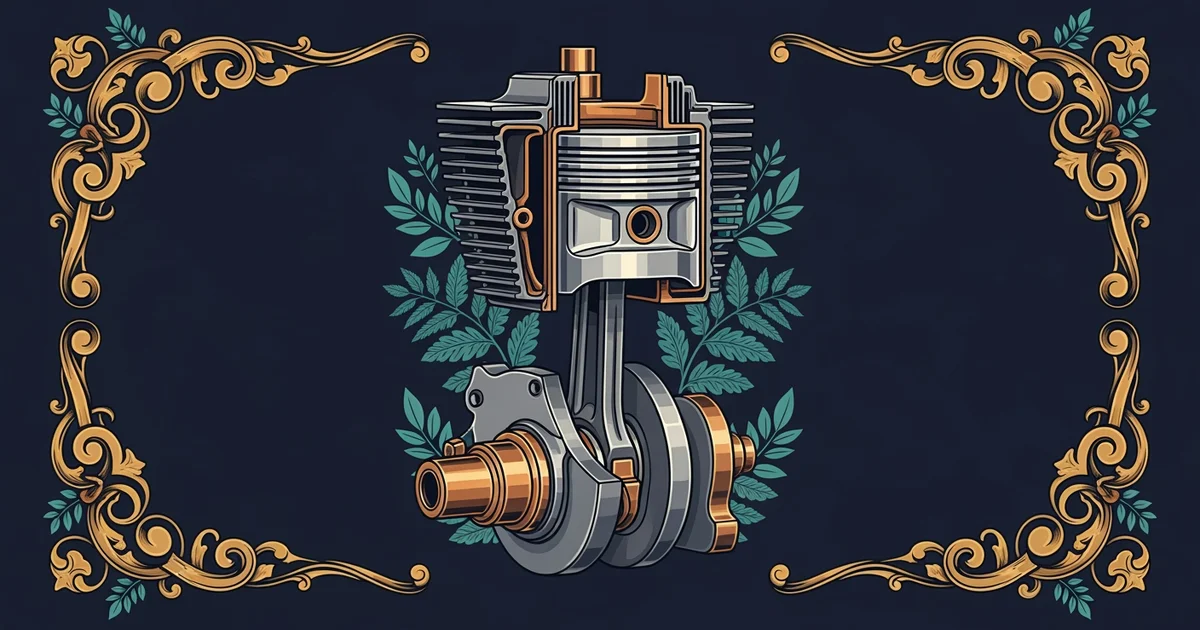
Inside the engine block, the crankshaft acts as the central bridge between raw power and movement. When the fuel burns, it forces the piston to move down with immense pressure and speed. Because the piston is connected to a rod, it pushes against the offset journals of the crankshaft. This offset design forces the shaft to rotate rather than just moving up and down. Think of it like a playground swing where you push the seat to make it arc through the air. The force of your push is linear, but the path of the seat is circular because of the chains holding it in place. Without this specific shape, the engine would simply lock up because the force of the explosion would have nowhere to go. The crankshaft takes that heavy, downward punch and turns it into a steady, circular spin that the transmission can eventually use to turn your tires.
Key term: Crankshaft — the heavy metal component that converts the linear, up-and-down motion of engine pistons into the rotational energy needed to turn vehicle wheels.
Every time a piston fires, it sends a powerful burst of energy into the crankshaft journal. This process happens thousands of times every minute while you are driving down the highway. To keep this motion smooth, the engine uses a counterweight system to balance the heavy spinning parts. If the crankshaft were not perfectly balanced, the entire car would shake violently from the uneven forces of the pistons. Engineers design these weights to offset the mass of the connecting rods and pistons at high speeds. This balance ensures that the energy transfer remains efficient and prevents the metal parts from tearing themselves apart under stress. You can think of this like a spinning coin that stays upright because of its constant, balanced rotation.
Energy Transfer and Load Management
Once the crankshaft begins to spin, it must distribute that energy to other parts of the engine. The rotational force travels through the shaft to the flywheel, which helps keep the engine spinning steadily. This flywheel acts like a heavy storage tank for energy, smoothing out the pulses from the individual combustion events. The following list describes how the crankshaft manages these different energy demands throughout the combustion cycle:
- The main journals provide the central axis for the shaft to spin within the engine block, ensuring that the rotation remains stable during high-speed operation.
- The rod journals provide the attachment point for the connecting rods, which act as the mechanical link that translates piston force into torque.
- The counterweights provide the necessary mass to offset the weight of the pistons, which prevents vibration and protects the engine from mechanical failure.
- The rear flange connects the crankshaft to the transmission system, allowing the rotational energy to reach the wheels and move the vehicle forward.
By managing these forces, the engine maintains a constant flow of power that does not fluctuate with every single explosion. This transition from violent, intermittent pressure to a smooth, continuous circular motion is the secret to modern vehicle performance. Each part of the system must work in perfect harmony to ensure the car moves forward without stalling or shaking. When the crankshaft spins, it creates the mechanical foundation for everything else in the drivetrain to function properly. Without this conversion, the engine would be nothing more than a noisy, stationary box that burns fuel without moving the car at all. The entire design relies on the precise physics of levers and circles to get you from one place to another.
The crankshaft functions as a mechanical translator that converts the vertical force of burning fuel into the rotational motion required for driving a vehicle.
But what does the timing of these movements look like when the valves are involved in the process?
Want this with sources you can check?
Premium Learning Paths for Engineering & Robotics are researched against open-access libraries — PubMed, arXiv, government databases, and more — with their distinctive claims cited to real sources and independently checked.
See what Premium includes