
The Power Stroke Event
Imagine holding a tightly coiled spring inside a box and suddenly releasing it with massive force. This burst of energy is precisely what happens inside your car engine during the critical power stroke. You have already learned how the engine compresses air and fuel into a tiny space. Now, you will see how that mixture transforms into the movement that drives your vehicle down the road. This transition represents the singular moment where potential energy finally becomes kinetic motion.
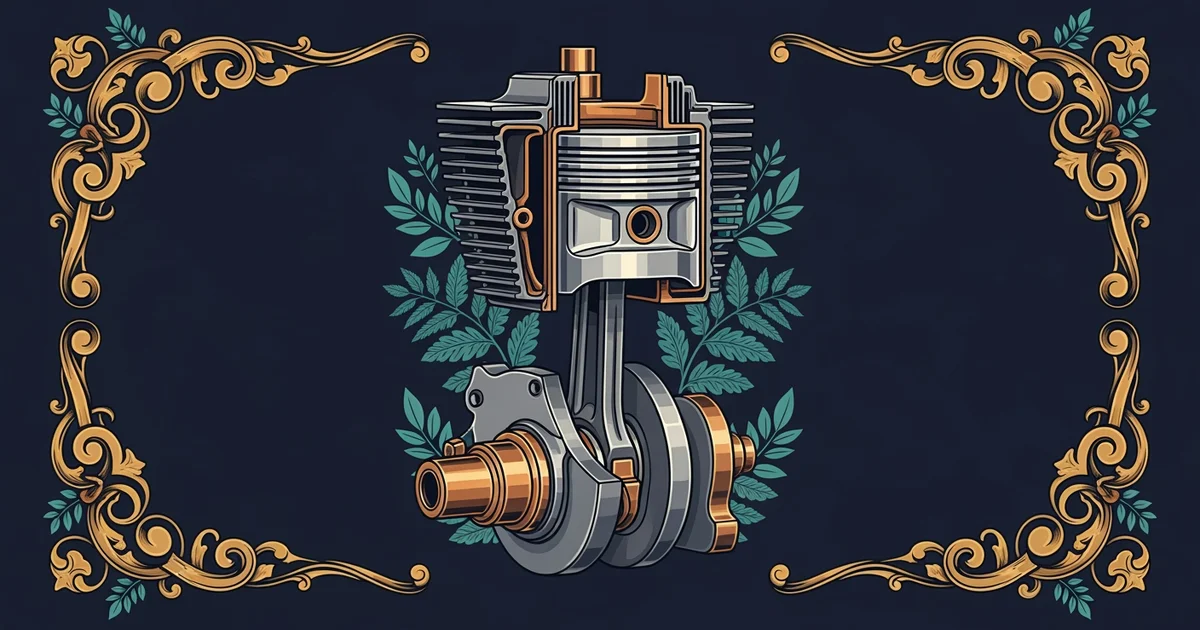
The Moment of Ignition
When the piston reaches the very top of the cylinder, the compressed fuel and air mixture waits under extreme pressure. A small electrical device called a spark plug fires a tiny bolt of lightning into this dense, volatile chamber. This spark provides the activation energy needed to ignite the fuel, causing a rapid expansion of hot gases. Think of this like lighting a firework inside a tube; the gases have nowhere to go but down. The force of this explosion pushes the piston away from the top of the cylinder with incredible speed and strength.
Key term: Combustion — the chemical process where fuel reacts rapidly with oxygen to release heat and pressure.
This downward movement is the only part of the entire engine cycle that actually produces useful work. All other strokes, such as intake and compression, simply prepare the engine for this specific, explosive event. Without this powerful shove, the engine would have no way to turn the crankshaft. The energy released here must be strong enough to overcome the friction of the engine parts and the weight of the entire vehicle. It is a violent, controlled release that repeats thousands of times every single minute while you drive.
Translating Force into Motion
To understand how this explosion moves the car, we must look at how the piston connects to the rest of the machine. The piston attaches to a rod that pushes on a rotating component called the crankshaft. This system works exactly like a cyclist pedaling a bicycle. When your leg pushes down on the pedal, that downward force turns the circular gear. In the engine, the piston acts as your leg, and the crankshaft acts as the pedal system. The following list describes the vital components that manage this transfer of power:
- The piston acts as a movable wall that traps the hot, expanding gases while transferring their pressure into mechanical force.
- The connecting rod serves as the bridge between the piston and the crankshaft, turning straight-line motion into a circular rotation.
- The crankshaft acts as the main rotating shaft that collects the energy from all cylinders to spin the transmission and wheels.
Every single power stroke adds a fresh pulse of energy to the rotation of the crankshaft. If the engine has four cylinders, it receives four of these pulses for every two full rotations of the shaft. This constant rhythm keeps the engine spinning smoothly even when the car is idling at a stoplight. The timing of these sparks must be perfect, or the engine will lose efficiency and struggle to maintain speed. Modern computers manage this timing to ensure that every drop of fuel provides the maximum possible push for your journey.
| Component | Primary Function | Energy Role |
|---|---|---|
| Spark Plug | Initiates ignition | Triggering event |
| Piston | Compresses and moves | Force receiver |
| Crankshaft | Rotates the output | Motion converter |
This table highlights how each part plays a specific role in turning chemical fire into mechanical rotation. By coordinating these parts, the engine ensures that the massive pressure from the power stroke does not go to waste. Instead, the system captures that energy and channels it directly to your wheels. This process remains the heart of automotive engineering, allowing heavy vehicles to move with ease.
The power stroke converts the chemical energy of burning fuel into physical motion by using expanding gases to force the piston downward against the crankshaft.
The next Station introduces Exhaust and Scavenging Systems, which determine how the engine cleans out the spent gases after the power stroke is finished.